Removed text is struck through; added text is highlighted.
Country of origin: Japan. Part of Car makes and the history of the motor car.
History and development
Subaru emerged from Japan's post-war aircraft industry and established a car-making identity with compact cars. The Subaru name is associated with the Pleiades star cluster. Wikipedia: Subaru history.
Horizontally opposed boxer engines and all-wheel drive became familiar features across many Subaru models. Not every Subaru has the same drivetrain, and individual WRX generations and markets differ.
Examples are selected rather than a complete production list. Engine and equipment specifications can vary with year and market.
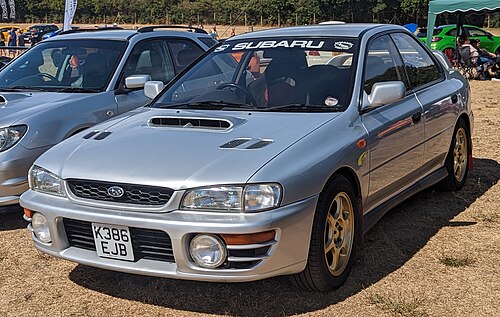
CarWhy it mattersEvidenceImpreza WRX (1992 Japan)The original WRX used a turbocharged 2.0-litre EJ20 boxer four and all-wheel drive.Illustrated turbo historyImprezaA compact model family offered in naturally aspirated and performance versions depending on generation and market.Model referenceLegacyA larger Subaru family car offered with several boxer-engine and drivetrain combinations.Model referenceBRZA rear-wheel-drive sports coupé developed with Toyota, distinct from Subaru's all-wheel-drive rally-derived cars.Model reference
More models and representative engines
These are specific examples rather than every engine offered. Equipment, output and capacity can change with model year and market; identify the exact vehicle before ordering parts.
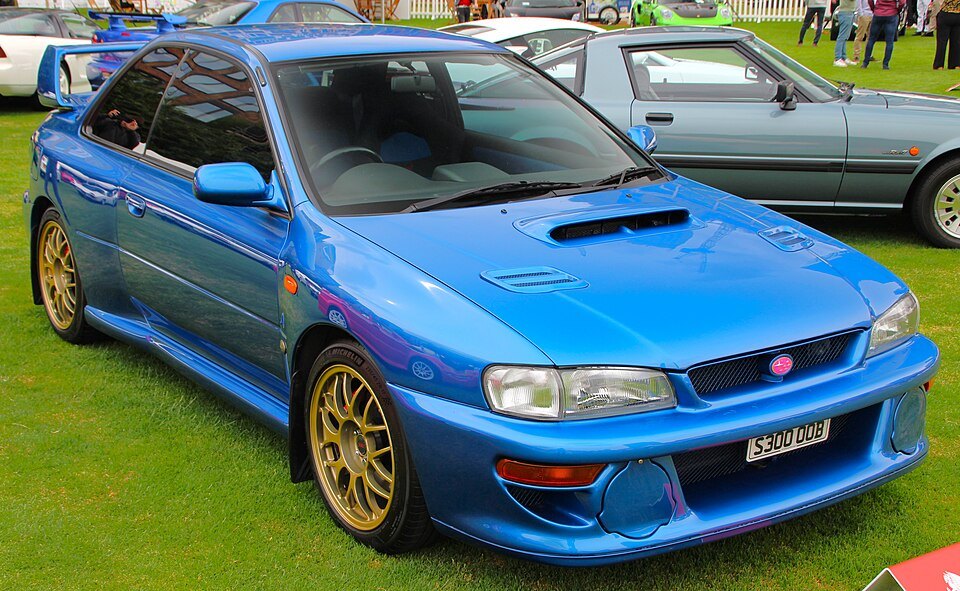
A Subaru Impreza 22B STI. Photo: MrWalkr, Wikimedia Commons, CC BY-SA 4.0; resized and re-encoded.
Model and versionEngine or powertrainEvidenceImpreza 22B STI2.2-litre EJ22 turbocharged boxer four in the limited 22B.Manufacturer or technical sourceWRX STI (2004 US model)2.5-litre turbocharged and intercooled boxer four; Japanese and other market models differed.Manufacturer or technical sourceBRZ (2022 model year)2.4-litre naturally aspirated FA24 horizontally opposed four, driving the rear wheels.Manufacturer or technical sourceLegacy RS (first generation)A 2.0-litre turbocharged boxer four and all-wheel drive in the performance Legacy RS.Manufacturer or technical sourceSVX (1992)A 3.3-litre naturally aspirated horizontally opposed six-cylinder engine.Manufacturer or technical source
Identifying a car and engine
Use the VIN, market, model year and engine code when researching servicing, tuning or parts. A model badge may cover naturally aspirated, turbocharged, supercharged, hybrid or electric versions depending on the particular vehicle. Factory fitment and aftermarket conversions are distinguished in the linked guides.
Sources and related reading
Wikipedia: Subaru — marque history and further references.Tuning Wiki: illustrated turbocharged-car timeline.Tuning Wiki: supercharger types and Eaton guides.
Text is unchanged; formatting, links or images changed. Compare the rendered revisions below.
Rendered revisions
Open each version to inspect formatting, tables and photographs.
Subaru emerged from Japan's post-war aircraft industry and established a car-making identity with compact cars. The Subaru name is associated with the Pleiades star cluster. Wikipedia: Subaru history.
Horizontally opposed boxer engines and all-wheel drive became familiar features across many Subaru models. Not every Subaru has the same drivetrain, and individual WRX generations and markets differ.
These are specific examples rather than every engine offered. Equipment, output and capacity can change with model year and market; identify the exact vehicle before ordering parts.
Use the VIN, market, model year and engine code when researching servicing, tuning or parts. A model badge may cover naturally aspirated, turbocharged, supercharged, hybrid or electric versions depending on the particular vehicle. Factory fitment and aftermarket conversions are distinguished in the linked guides.