Removed text is struck through; added text is highlighted.
Country of origin: South Korea. Part of Car makes and the history of the motor car.
History and development
Genesis began as a Hyundai model name before being established as a separate luxury marque in 2015. Wikipedia: Genesis history.
The Korean brand offers luxury saloons, SUVs and electric vehicles. Earlier Hyundai Genesis cars and later Genesis-branded cars should be identified by their specific generation.
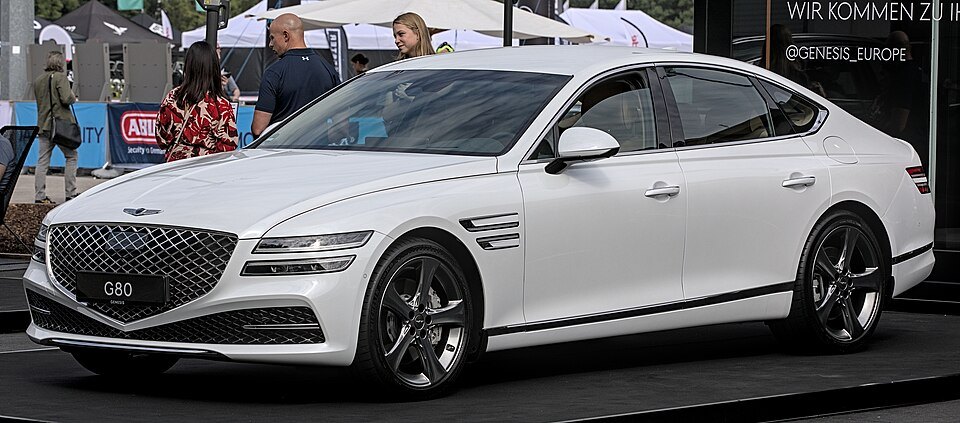
A Genesis G80. Photo: Alexander Migl, Wikimedia Commons, CC BY-SA 4.0; resized and re-encoded.
Selected cars and engines
Examples are selected rather than a complete production list. Engine and equipment specifications can vary with year and market.
CarWhy it mattersEvidenceG80An executive saloon family sold with combustion-engine and electric versions in different generations.Model referenceG90A large luxury saloon.Model referenceGV70A luxury SUV offered with different powertrains.Model referenceGV60A battery-electric crossover.Model reference
More models and representative engines
These are specific examples rather than every engine offered. Equipment, output and capacity can change with model year and market; identify the exact vehicle before ordering parts. Battery-electric models are described by their motors.
A Genesis G70 3.3T. Photo: Kevauto, Wikimedia Commons, CC BY-SA 4.0; resized and re-encoded.
Model and versionEngine or powertrainEvidenceG70 3.3TA 3.3-litre twin-turbocharged V6 in the specified G70.Manufacturer or technical sourceGV80 3.5TA 3.5-litre twin-turbocharged V6 in specified GV80 versions.Manufacturer or technical sourceGV60A battery-electric crossover with motor arrangements depending on variant.Manufacturer or technical source
Identifying a car and engine
Use the VIN, market, model year and engine code when researching servicing, tuning or parts. A model badge may cover naturally aspirated, turbocharged, supercharged, hybrid or electric versions depending on the particular vehicle. Factory fitment and aftermarket conversions are distinguished in the linked guides.
Related marque: Hyundai: history and cars.
Sources and related reading
Wikipedia: Genesis — marque history and further references.Tuning Wiki: illustrated turbocharged-car timeline.Tuning Wiki: supercharger types and Eaton guides.
Text is unchanged; formatting, links or images changed. Compare the rendered revisions below.
Rendered revisions
Open each version to inspect formatting, tables and photographs.
Genesis began as a Hyundai model name before being established as a separate luxury marque in 2015. Wikipedia: Genesis history.
The Korean brand offers luxury saloons, SUVs and electric vehicles. Earlier Hyundai Genesis cars and later Genesis-branded cars should be identified by their specific generation.
These are specific examples rather than every engine offered. Equipment, output and capacity can change with model year and market; identify the exact vehicle before ordering parts. Battery-electric models are described by their motors.
Use the VIN, market, model year and engine code when researching servicing, tuning or parts. A model badge may cover naturally aspirated, turbocharged, supercharged, hybrid or electric versions depending on the particular vehicle. Factory fitment and aftermarket conversions are distinguished in the linked guides.