Country of origin: Japan. Part of Car makes and the history of the motor car.
History and development
Mazda's roots go back to Toyo Cork Kogyo in Hiroshima in 1920. The company moved into vehicle manufacture and became known for small cars, sports cars and rotary-engine development. Wikipedia: Mazda history.
Mazda used the Wankel rotary engine in a number of production cars. Its MX-5 takes a different approach as a lightweight front-engined, rear-wheel-drive roadster.


Selected cars and engines
Examples are selected rather than a complete production list. Engine and equipment specifications can vary with year and market.
| Car | Why it matters | Evidence |
|---|---|---|
| MX-5 / Miata | The roadster has appeared in several generations with different four-cylinder engines. | Model reference |
| MX-5 2.0, specified 2016–2018 cars | An Edelbrock E-Force kit uses Eaton TVS R900; the referenced fitment is aftermarket, not original factory equipment. | Eaton fitment guide |
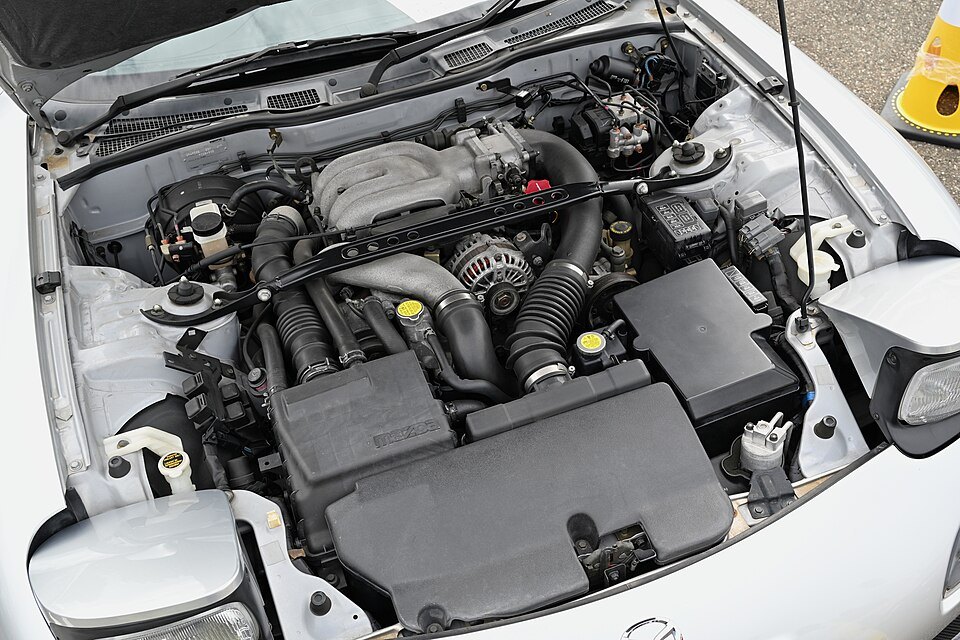
| RX-7 | A rotary-engined sports-car family; the third-generation car used sequential turbocharging. | Model reference |
| RX-8 | A later four-seat sports car powered by a naturally aspirated rotary engine. | Model reference |
More models and representative engines
These are specific examples rather than every engine offered. Equipment, output and capacity can change with model year and market; identify the exact vehicle before ordering parts.

| Model and version | Engine or powertrain | Evidence |
|---|---|---|
| RX-7 FD | A 1.3-litre 13B two-rotor Wankel engine with sequential twin turbochargers. | Manufacturer or technical source |
| RX-8 | The 1,308 cc RENESIS two-rotor engine was naturally aspirated in the production RX-8. | Manufacturer or technical source |
| MX-5 NB 1.8 | A 1.8-litre naturally aspirated inline-four in the specified second-generation roadster; 1.6-litre versions also existed. | Manufacturer or technical source |
| Mazda3 MPS | 2.3-litre DISI turbocharged petrol inline-four in the MPS performance hatchback. | Manufacturer or technical source |
Identifying a car and engine
Use the VIN, market, model year and engine code when researching servicing, tuning or parts. A model badge may cover naturally aspirated, turbocharged, supercharged, hybrid or electric versions depending on the particular vehicle. Factory fitment and aftermarket conversions are distinguished in the linked guides.
Sources and related reading
- Wikipedia: Mazda — marque history and further references.
- Tuning Wiki: illustrated turbocharged-car timeline.
- Tuning Wiki: supercharger types and Eaton guides.