Country of origin: Germany. Part of Car makes and the history of the motor car.
History and development
Ferdinand Porsche established an engineering business in 1931; Porsche-branded sports-car production began with the 356 in 1948. The 911 followed in 1963 and remains central to the marque's identity. Wikipedia: Porsche history.
Porsche's history includes air-cooled and water-cooled flat engines, racing-led turbo development, front-engined models and later SUVs and electric cars.
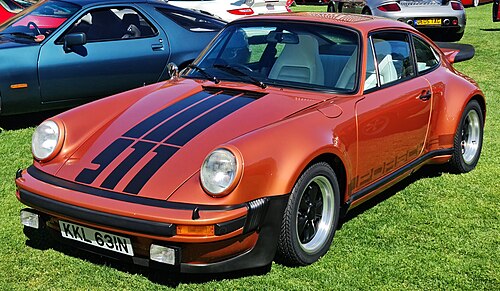

Selected cars and engines
Examples are selected rather than a complete production list. Engine and equipment specifications can vary with year and market.
| Car | Why it matters | Evidence |
|---|---|---|
| 911 Turbo 930, 3.0 (1974 reveal) | A 2,994 cc air-cooled flat-six with one turbo; 1975 deliveries followed the 1974 presentation. | Illustrated turbo history |
| 911 Turbo 930, 3.3 (1978 model year) | The later 3,299 cc version added an intercooler and revised output; it is not identical to the original 3.0. | Illustrated turbo history |
| 959 | A 2.85-litre flat-six used sequential twin turbocharging alongside all-wheel drive. | Illustrated turbo history |
| 911 Turbo 997 (2006) | Its 3.6-litre flat-six used twin variable-turbine-geometry turbochargers. | Illustrated turbo history |
| 356 / 911 | The early 356 and the long-running 911 illustrate the development of Porsche's rear-engined road cars. | Model reference |
Identifying a car and engine
Use the VIN, market, model year and engine code when researching servicing, tuning or parts. A model badge may cover naturally aspirated, turbocharged, supercharged, hybrid or electric versions depending on the particular vehicle. Factory fitment and aftermarket conversions are distinguished in the linked guides.
Sources and related reading
- Wikipedia: Porsche — marque history and further references.
- Tuning Wiki: illustrated turbocharged-car timeline.
- Tuning Wiki: supercharger types and Eaton guides.