Tuning Wiki

This is a historical revision. Read the current page or return to its history.

Page organisation in this revision
Page type
Technical article
Subject
Car makes
Parent
Section level
Applies to
No ECU-specific applicability
Tool groups
None
Manufacturers
Caterham

Changes from revision 1 to revision 1

Removed text is struck through; added text is highlighted.

Caterham Cars (Caterham Cars Ltd) is the British manufacturer of the Caterham Seven, the front-engined, rear-drive, spaceframe two-seater that continues the Lotus Seven. Graham Nearn bought the Seven's rights, tooling and designs from Lotus in 1973. The firm has built the car ever since, first in Caterham, Surrey, and from 1987 in Dartford, Kent. Cars are sold as self-assembly kits or factory-built. Since 2021 the company has been owned by the Japanese automotive group VT Holdings. Over five decades the Seven has used Lotus, Ford, Cosworth, Vauxhall, Rover, Honda and Suzuki engines, and from 2026 a Horse Powertrain engine. The current road range uses the Suzuki 660 cc turbo three-cylinder and the 2.0-litre Ford Duratec. The last cars with the 1.6 Ford Sigma were built in 2025–26. For tuning, the important distinction is between the Rover MEMS units on K-series cars and the Caterham-supplied MBE ECUs on later Ford-engined cars, which are locked at manufacture.

History

Graham Nearn's Caterham Car Sales was a major Lotus Seven dealer in the 1960s. When Lotus decided to drop the Seven, Nearn and Colin Chapman agreed in May 1973 that Caterham would take over its tooling, designs and rights. Production began in June 1973 at Town End, Caterham. Only 38 of the Lotus-designed Series 4 were built before customers' preference for the older Series 3 shape led Caterham to relaunch the Series 3 in 1974, with Lotus Twin Cam and Ford crossflow engines. The trading company was called Seven Cars Limited from 1974 to 1989.

Production and administration moved to Kennett Road, Dartford, in 1987. In 1991 Caterham switched its mainstream engine supply from Ford to the Rover K-series. UK Low Volume Type Approval in 1993 allowed it to sell fully built cars as well as kits. The 21 roadster followed in 1994, the Caterham Scholarship (now the Caterham Academy) in 1995 and the larger SV chassis in 2000. Ford Sigma engines replaced the Rover units in 2006.

The Nearn family sold the business in 2005 to a group backed by the private-equity firm Corven Ventures. In 2011 Corven sold it to Team Lotus Enterprises, led by Tony Fernandes and Kamarudin Meranun. Some sources date that sale to 2012, but contemporary reports from April 2011 support 2011. That ownership produced the Caterham F1 Team (2012–2014), a GP2 team and a 2012–2014 joint venture with Renault on a sports car that became the Alpine A110. Some operations moved to Leafield, Oxfordshire, in 2012. The Caterham South showroom closed in February 2013 and moved to the Crawley area near Gatwick.

VT Holdings, Caterham's Japanese importer since 2009, bought Caterham Cars from Fernandes and Meranun with effect from 31 March 2021. Caterham sold a record 670 cars in 2021. It showed the electric Project V concept and an EV Seven development car in 2023, and in 2024 moved production to a new facility in Dartford. In 2025 it announced that the Seven 310 Encore, limited to 25 cars, would be the last Sigma-engined Seven. It also adopted a 1.3-litre turbocharged Horse Powertrain engine for the 2026 Academy race car. Caterham's 2026 road range kept the Suzuki and Duratec engines unchanged.

Motorsport

Caterham launched the one-make Super 7 Racing championship in 1986. The Caterham Scholarship, a series for novice racers, began in 1995 and became the Caterham Academy. It was split into two parallel championships in 2000, and about 1,000 drivers have come through it. The Academy car used the Ford Sigma from 2008 to 2025 and the Horse HR13 from 2026. Caterham won the 24-hour "Longest Day of Nelson" race in Ohio in June 1992. A production-based Superlight R400 was entered in the 2002 Nürburgring 24 Hours. Caterham's own history says it won its class. The Caterham F1 Team (2012–2014) and Caterham Racing in GP2 shared ownership and branding with the car company, but were separate operations.

Models
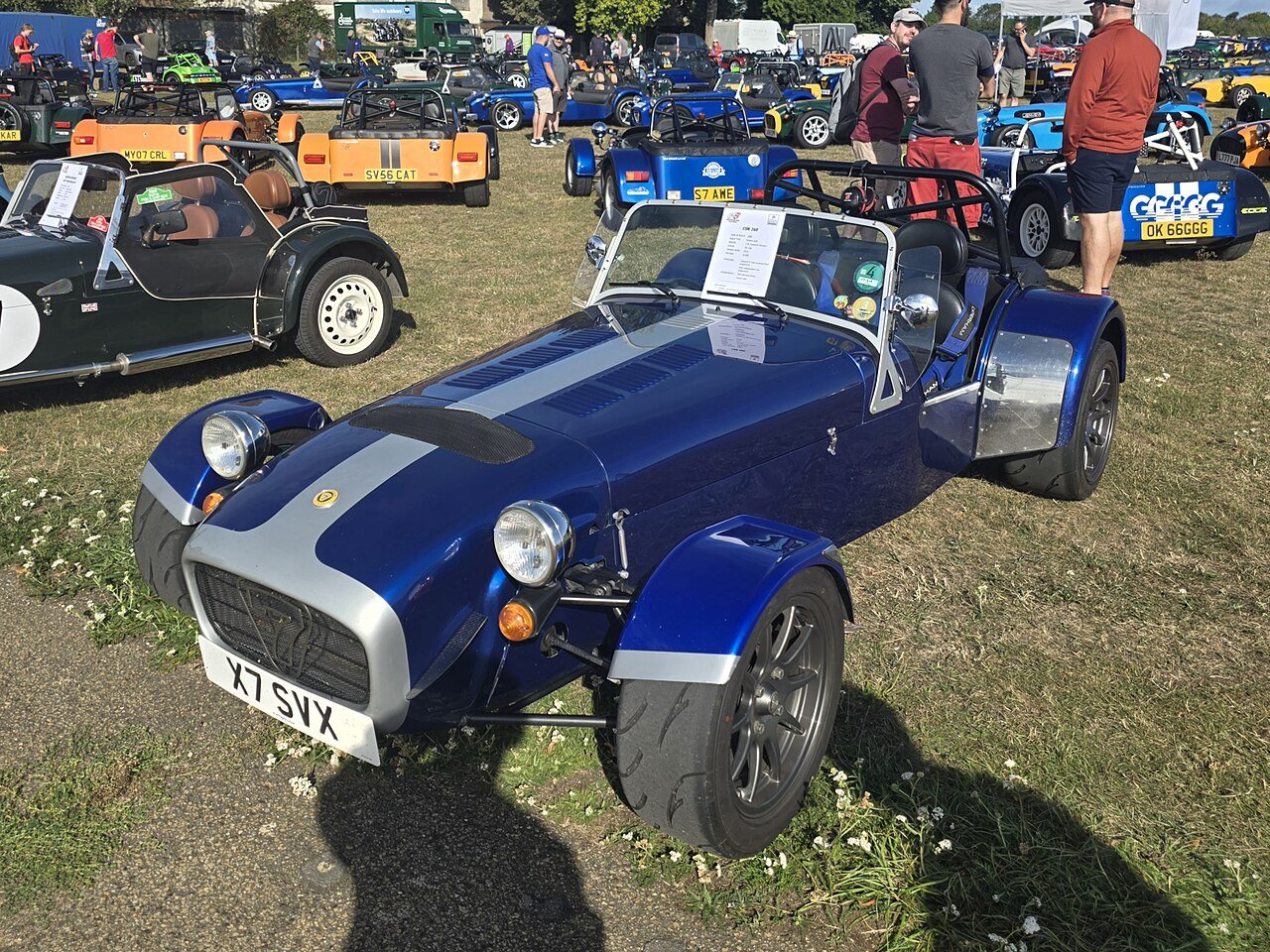
1997 Caterham Seven Supersport (Rover K-series era), photographed in 2025. Photo: Calreyn88, Wikimedia Commons, CC BY-SA 4.0; resized.

Almost every Caterham is a Seven: a steel tubular spaceframe with aluminium and glassfibre panels, front engine and rear-wheel drive. Since the mid-1980s it has used a De Dion rear axle. The live axle was dropped in 2002 and revived for the Suzuki-engined 160, 170 and Super Seven 600. The standard chassis is the Series 3 (S3). The SV, introduced in 2000, is 110 mm wider in the cockpit and about 25 kg heavier. The CSR (2005) has its own stiffer chassis on SV dimensions, with pushrod front suspension and independent rear suspension. No Caterham uses a donor car, and all are sold as kits or factory-built cars. Years below come mainly from the Caterham 7 production list and Caterham's own timeline. Power figures are manufacturer claims.

Model or familyYearsEngineClaimed powerNotes Seven Series 41973–74Lotus-era specification—38 built before the S3 relaunch Seven S3 Twin Cam1974–83Lotus Twin Cam (built by Vegantune after Caterham took over the engine rights in 1977)—313 built 1300 GT, 1600 GT, 1600 Sprint, 1700 Supersprint1975–92Ford Kent crossflow 1.3–1.71600 GT 84 hpCarburetted Vegantune VTA1981–85Vegantune twin-cam 1.6 / 1.7140–160 hpAbout 40 supplied 1600 BDR, 1700 BDR, HPC 17001983–99Cosworth BDR 1.6 / 1.7About 140–150 bhp1986 HPC: 62 built CVH1986–91Ford CVH—Swiss export only HPC (VX, VXi)1990–93Vauxhall 2.0 16v (86 × 86 mm)175 bhp; 218–235 bhp with Swindon upgradesWeber 45 DCOE carburettors replaced Vauxhall injection JPE1992–2001Vauxhall 2.0 16vAbout 250 bhp0–60 mph in 3.4 s claimed Classic VX, Classic VX Supersprint1997–2002Vauxhall 1.6—Entry model S7 Competition R1995–2001Vauxhall 2.0 turbo—Swiss market, 25 built K-series 1.4, Supersport 1.41991–97Rover K-series 1.4 (from the Metro GTi)—First K-series Sevens K-series 1.6, Superlight 1.6, Road-Sport1996–2012Rover K-series 1.6—Road-Sport (1996) introduced the Caterham six-speed gearbox K-series 1.8 and VVC1997–2006Rover K-series 1.8, 1.8 VVC—— Superlight R1997–2002Rover K-series 1.8 VHPD—127 built Superlight R500 (K-series)1999–2005Rover K-series 1.8, Minister-built; R500 Evo 1,998 ccAbout 230 bhp; Evo 250 bhp— Superlight R300, R400 (first series)From 2002R400: tuned Rover K-series 1.8; R300: not establishedR400 about 214 bhp (one sale listing)Duratec engines replaced the K-series from 2006 (R400) and 2008 (R300) Blackbird, Fireblade2000–04Honda CBR1100XX Blackbird; Honda Fireblade170 bhp; 128 bhpMotorcycle engines and sequential gearboxes Hayabusa (Canada)From 2000Suzuki GSX1300R Hayabusa—Canadian market Zetec (US market)1998–2008Ford Zetec 2.0—US-market cars Caterham 211994–2000Not established from the sources used—Roadster body on a modified Seven chassis; 48 or 49 built CSR200, CSR260, CSR260 SuperlightFrom 2005 (CSR200 to 2011)Ford Duratec 2.3, Cosworth-developed200 bhp at 7,000 rpm; 260 bhp at 7,500 rpmCSR200 five-speed; CSR260 Caterham six-speed Levante2008Motopower RST-V8400 or 550 hpBuilt by RS Performance; 8 built Roadsport, Superlight, Supersport, 270 (Sigma)2006–2021Ford Sigma 1.6—Version names include 120, 125, 140 and 150; Supersport 2011–14 Superlight R400 (Duratec)From 2006Ford Duratec 2.0—— Superlight R300, Roadsport 175, CSR1752008–about 2014Ford Duratec 2.0, Caterham Powertrain—CSR175 from 2009 Superlight R500 (Duratec)2008–14Ford Duratec 2.0, Caterham Powertrain263 bhp at 8,500 rpm; 177 lb ft175 built; optional Caterham sequential gearbox 620R, 620SFrom 2013Supercharged Ford Duratec 2.0310 bhpReplaced the R500; "620" reflects a claimed 620 bhp per tonne 160 (165 in the EU)2013/14–about 2021Suzuki K6A 660 cc three-cylinder turbo80 hpSuzuki five-speed gearbox and live axle; meets Japanese kei-car rules 360, 420From 2015Ford Duratec 2.0180 bhp; 210 bhpS (road) and R (track) packs 3102016–21Ford Sigma 1.6—Seven Sprint (90 cars) also 2016 170From 2021Suzuki R06A 660 cc three-cylinder turbo84 bhpReplaced the 160 Super Seven 600, Super Seven 2000From 2022Suzuki 660 turbo; Ford Duratec 2.084 bhp; 180 bhpHeritage models 420 CupFrom 2022Ford Duratec 2.0210 bhpSadev six-speed sequential gearbox CSR TwentyFrom 2024Ford Duratec 2.0210 bhpFactory price from £79,995 (2026) 3402020sFord Duratec 2.0170 hp at 7,250 rpmReported as the 275's replacement; not in the 2026 UK list 310 Encore2025–26Ford Sigma 1.6152–154 bhpLast Sigma Seven; 25 built 420 Nürburgring Edition2026Ford Duratec 2.0210 bhpLimited edition Academy Race PackageFrom 2026Horse HR13DDT 1.3 turbo130 bhpMazda MX-5 six-speed gearbox; Caterham-developed ECU SP/300.RAbout 2010–13Not established from the sources used—Track-only car developed with Lola; limited to 25 a year

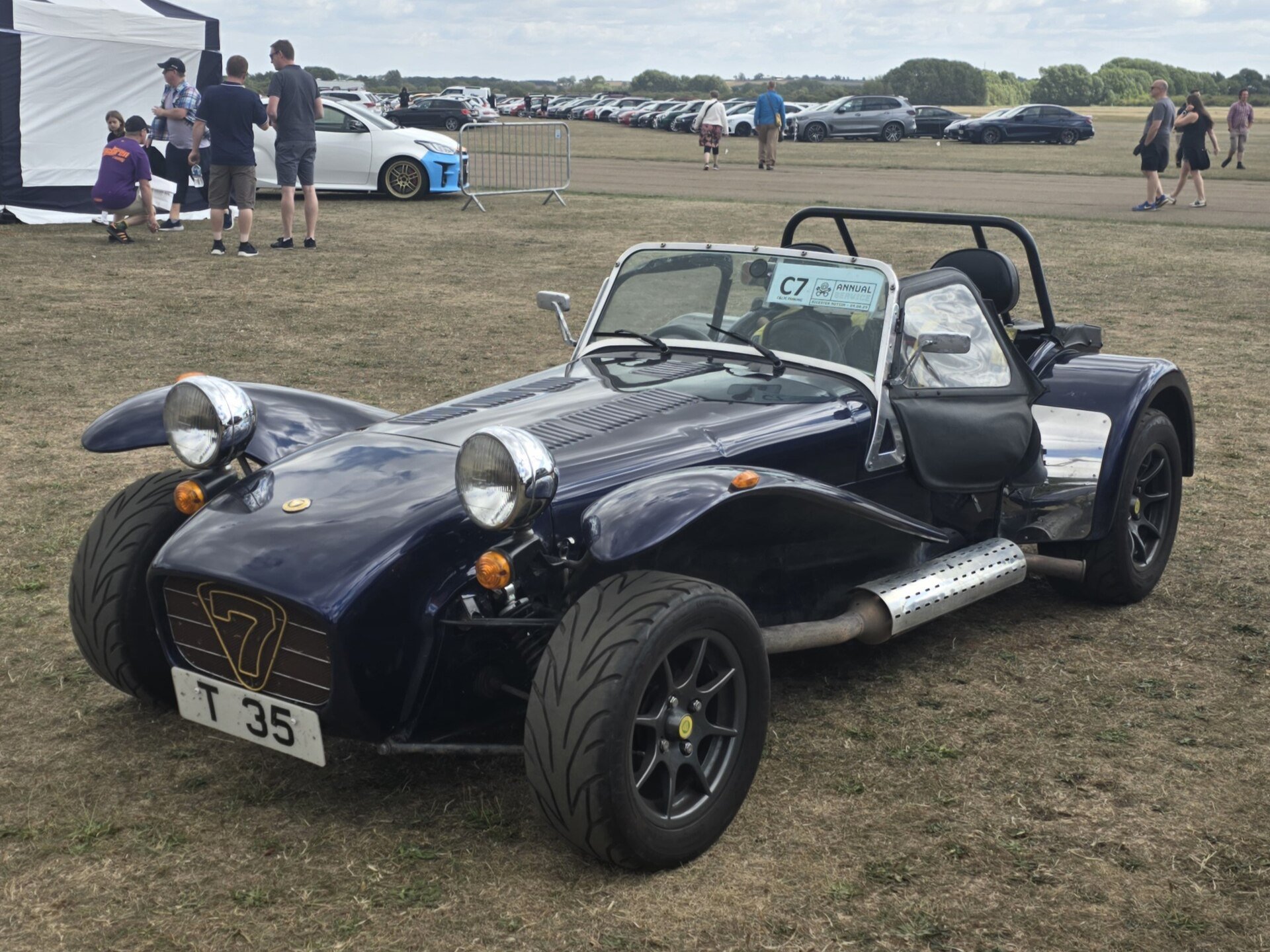
2006 Caterham CSR 260 with the Cosworth-developed 2.3 Duratec, photographed in 2025. Photo: Calreyn88, Wikimedia Commons, CC BY-SA 4.0; resized.

Caterham's 2026 UK list contains the Seven 170, Super Seven 600, Super Seven 2000, Seven 360, 420, 420 Cup, 420 Nürburgring Edition, CSR Twenty, 620, 310 Encore, the Academy Race Package and the 420R Race Package. Project V is listed as a separate model under development. Production dates in the table conflict between sources for the 160 (2016, 2018 or 2021) and for some Sigma models. Wikipedia's model list gives the 21 as 48 built and Caterham's timeline gives 49.

Engines

Caterham has always bought engines from larger manufacturers. It has also built and tuned many of them, in house or through contracted specialists.

Lotus Twin Cam and Ford Kent. Caterham took over the Twin Cam engine rights in 1977, and Vegantune built the engines. By 1991 Caterham was assembling its own Ford engines. Cosworth BDR and Vauxhall 16v. The HPC engines were Vauxhall 2.0 16v units supplied without their electronic injection or exhaust manifolds. In standard form they produced 175 bhp instead of the production engine's 150 bhp. Swindon Racing Engines offered upgrades of up to 235 bhp. Rover K-series. Caterham used the K-series from 1991, and it was the mainstream engine until 2006. Caterham's tuned versions included the VHPD (Very High Performance Derivative) of the Superlight R and the Minister-built engines of the R500. The R500's 1.8 produced about 230 bhp. The 2004 R500 Evo was bored to 1,998 cc and produced 250 bhp. See Rover, MG F and MG TF and Lotus Elise for the same engine family in other cars. Ford Sigma 1.6 (2006–2026). Caterham used the Sigma for its lower-powered road models and for the Academy. After Ford ended Sigma production, Caterham built engines from stockpiled engines and new spare parts. The final 310 Encore engine has twin overhead camshafts, a lightened flywheel and a recalibrated ECU, and produces about 152–154 bhp and 124 lb ft. Ford Duratec 2.0 and 2.3. Cosworth developed the CSR's 2.3. From 2008 Caterham Powertrain (CPT) built and tuned 2.0 Duratecs, including the 263 bhp R500. The supercharged 620 produces 310 bhp. Current race packages are listed as Caterham Motorsport 2.0 Duratec and 1.3 Horse engines. Suzuki 660 cc turbo. Caterham raised the K6A in the 160 from its standard 64 bhp to 80 bhp. The 170 uses the newer R06A at 84 bhp. Both are three-cylinder turbo engines with a Suzuki gearbox. See Suzuki. Horse HR13 (from 2026). The HR13DDT is a 1.3-litre turbocharged four with an aluminium block. In the Academy car it produces 130 bhp. Caterham pairs it with the six-speed gearbox from the current MX-5 and its own differential, replacing the BMW 1 Series unit. Horse has a multi-year supply agreement. Press reports suggest the engine could eventually replace the Duratec, but Caterham has not confirmed this.

Engine management

Caterham's engine management falls into four eras. Little of the detail appears in Caterham's own published documents. Most of the evidence below comes from specialist suppliers, owner clubs and period road tests, and it is graded in each item.

Carburettors (1973 to early 1990s). The Lotus Twin Cam, Ford Kent, Cosworth BDR and Vauxhall HPC engines were carburetted. On the HPC, Caterham removed Vauxhall's electronic injection and fitted 45 mm Weber sidedraught carburettors. Period test: Motor Sport, 1991. The fuel systems of the JPE and Classic VX are not established. Rover MEMS on the K-series. K-series Sevens used Rover's MEMS engine management. Owner and specialist reports describe the EU2-era cars, including the Supersport, as running MEMS 1.9. That unit is programmed at manufacture and cannot be erased and reprogrammed. The common Rover 200 MEMS 1.9 unit MKC104022 is reported to be nearly identical to the Caterham Supersport ECU (owner report). Later EU3 engines use MEMS 3, which owners report cannot be remapped in the conventional way. The VHPD Superlight R was supplied with MEMS. Owner reports say the standard Superlight R ECU later changed from MEMS to MBE, but the changeover date is not established. On VVC engines, the standard Rover ECU drives the two VVC solenoids. MBE on Sigma and Duratec cars. Caterham's Ford-engined cars from the mid-2000s use ECUs made by MBE Systems and supplied by Caterham. Owners and dealers most often identify them as the MBE 9A4. Some Duratec R500 owners report an MBE 992 instead, and a 2011 Sigma 140 owner reports an MBE unit labelled 30L 148A (single source). SBD Motorsport, MBE's distributor, states that all Cosworth and Caterham MBE ECUs are locked at manufacture and cannot be modified. Easimap 6 with a CAN mapping kit can read live data from them but cannot change the maps. Downloading anything into a locked unit permanently disables it. Caterham has re-flashed customer ECUs to higher specifications, with the calibration done by SBD (owner report). A Caterham dealer reports that an unlocked aftermarket 9A4 is pin-compatible with the locked factory unit. SBD says the 9M4, which replaces the 9A4, keeps the same pinout. An open-source tool reads MBE ECUs in modern Sevens over CAN at 500 kbit/s. See MBE Systems standalone ECUs. CSR. Cosworth calibrated the CSR's 2.3 Duratec, and its MBE units are covered by the same lock. A specification-sheet claim that the CSR200 used a Ford ECU while the CSR260 used an open MBE unit could not be verified and is not relied on here. US Zetec cars. One owner describes the "official" US Zetec Supersport package as a black-top Zetec with TWM throttle bodies and a Pectel T2 ECU. This is a single-source report. The ECU on other US Zetec cars is not established. Suzuki 160 and 170. Caterham's parts listing, as quoted by an owner, describes the factory unit as "ECU Seven EFI 160-275 models", but the maker is not established. Owner teardown of a 170 shows that the factory ECU also runs chassis functions. It drives the shift light, fuel-pump control, fog-light relay and seatbelt, handbrake and brake-fluid warnings, and sends engine data to the tachometer over CAN. A replacement ECU therefore has to take over or rewire these functions. Re-flashing the original unit would mean soldering to the circuit board (owner report). One documented conversion uses an SCS Delta 700 with a calibration derived from SCS's Caterham 160 base map. With a hybrid turbo it gave 116 PS on the "sport" map, against 84 bhp standard (owner report). Horse HR13 (2026 Academy). According to a 2025 evo review, "Caterham has also created its own ECU" for the Horse engine. Its hardware supplier is not named.

Common aftermarket replacements reported by owners include unlocked MBE units from SBD, the Emerald M3DK on K-series cars, the Emerald K6 with Emerald's Caterham Duratec loom, and the Omex 600. The M3DK is sold as a plug-compatible replacement for MEMS on distributor and wasted-spark K-series engines. Owners report it is not plug-and-play on EU3 looms without an adaptor. See also Emerald and Omex.

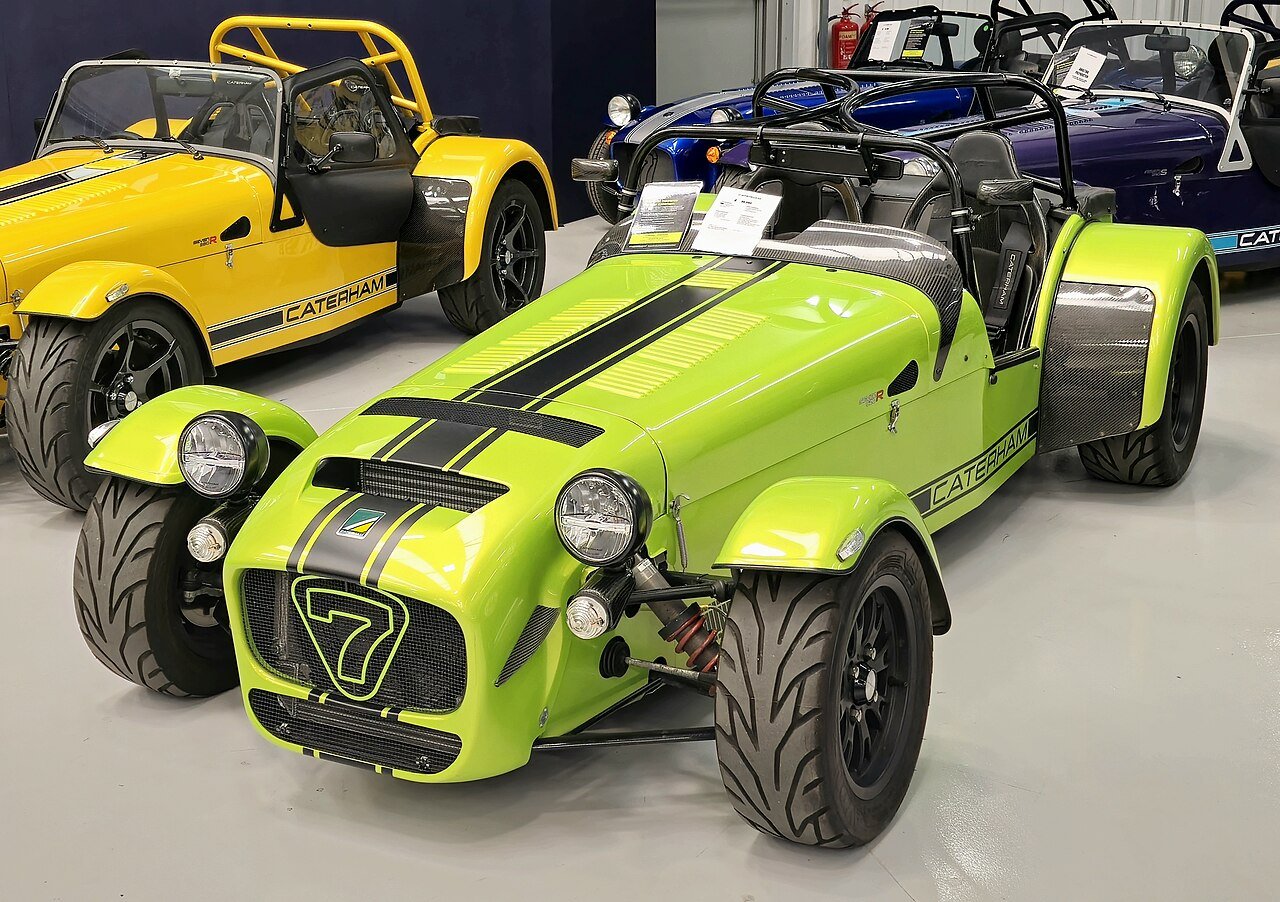
2024 Caterham Seven 620R with the supercharged 2.0 Duratec, photographed in June 2024. Photo: Calreyn88, Wikimedia Commons, CC BY-SA 4.0; resized.

Identification and buying notes

Model names describe performance, not engine size. The 620R's number reflects a claimed 620 bhp per tonne. The S and R suffixes on current models mark road and track specification packs. The engine fitted is not always the one the name suggests. Many older cars have been re-engined, and the same name has covered different engines over time. Examples are the R300 and R400 (K-series, then Duratec) and the R500 (Minister K-series, then CPT Duratec). Check the engine itself, not just the badge. On Sigma and Duratec cars, find out whether the ECU is a locked Caterham MBE unit or an unlocked replacement before planning a remap. Owners report difficulty getting replacement factory ECUs with the correct calibration. Mapping a locked unit is not possible. Suzuki-engined cars have a live axle. Most other Sevens since the mid-1980s have a De Dion rear. The SV chassis is wider than the S3, so panels and interior parts are not interchangeable.

Not established

Who makes the factory ECU on the Suzuki-engined 160 and 170. When K-series cars changed from MEMS to MBE, and which MEMS version each K-series model used from the factory. The engine management of the JPE, the Classic VX and the early (2006–08) Sigma cars. Caterham's part numbers for its MBE ECUs. Which engine the 2002 Nürburgring R400 used, and the official result.

Sources

50 at 50, Caterham Cars (company timeline, 2023). Accessed 19 November 2026. The range, Caterham Cars (UK model list and prices, 2026). Accessed 19 November 2026. Caterham Cars, English Wikipedia. Accessed 19 November 2026. Caterham 7, English Wikipedia (model and engine list). Accessed 19 November 2026. Caterham CSR, English Wikipedia. Accessed 19 November 2026. Caterham bought by Japanese importer VT Holdings, paultan.org, 6 April 2021; Team Lotus buys Caterham, Autoblog, 27 April 2011. Accessed 19 November 2026. Road test: Caterham Super 7 HPC, Motor Sport, October 1991. Accessed 19 November 2026. Caterham Horse prototype 2025 review, evo, 16 October 2025. Accessed 19 November 2026. Caterham Seven 2026 updates, evo, 11 February 2026. Accessed 19 November 2026. Caterham Seven 310 Encore 2026 review, Motoring Research, 2026. Accessed 19 November 2026. New Caterham 620R replaces R500, evo, 9 July 2013. Accessed 19 November 2026. Caterham Superlight R500 (2008) review, CAR magazine, 2008 (specification as indexed). Accessed 19 November 2026. Caterham Seven 340 debuts, Motor1 (search-indexed text). Accessed 19 November 2026. Caterham Super Seven 600 and 2000 heritage models debut, evo, 2022 (search-indexed text). Accessed 19 November 2026. Caterham Seven 160 review, Autocar; Caterham Seven 160 unpeeled, PistonHeads, 2013 (search-indexed text). Accessed 19 November 2026. When Caterham enjoyed its finest hour in improbable surroundings, Autosport (2002 Nürburgring 24 Hours; search-indexed text). Accessed 19 November 2026. Cosworth & Caterham MBE ECUs, SBD Motorsport FAQ (vendor statement). Accessed 19 November 2026. Caterham customer cars, SBD Motorsport (MBE 9A4 and 992 installations). Accessed 19 November 2026. ECU recommendations, USA7s owners' forum, August 2019 to January 2020 (owner and dealer reports). Accessed 19 November 2026. Zetec Supersport issues, USA7s owners' forum, March 2012 (owner report of the Pectel T2). Accessed 19 November 2026. K-series Caterham VVC intake cam phasing control, USA7s owners' forum, April 2026. Accessed 19 November 2026. Lotus Seven Club forum threads (owner reports; the site blocks automated reading, so these are cited from search-indexed text): Recreating the Caterham Supersport EU2 ECU; MEMS failure, M3DK replacement; 2011 1600 Sigma 140 ECU problems; Emerald for EU3 engines. Accessed 19 November 2026. can7: tools for MBE ECUs in Caterham 7 cars, GitHub (open-source project). Accessed 19 November 2026. ECU upgrade: chassis harness, the rabbit hole and MH7 SCS-Delta engine management and hybrid turbo, Caterham 170 owner's blog, January 2025. Accessed 19 November 2026. Caterham Seven 160 assembly guide, Caterham Cars, 2015 (does not name the ECU maker). Accessed 19 November 2026. Photographs from Wikimedia Commons, credited in each caption: 1997 Caterham Seven Supersport, 2006 Caterham CSR 260 and 2024 Caterham Seven 620R. Accessed 19 November 2026.

Rendered revisions

Open each version to inspect formatting, tables and photographs.

Revision 1: Caterham Cars: history and cars

Caterham Cars (Caterham Cars Ltd) is the British manufacturer of the Caterham Seven, the front-engined, rear-drive, spaceframe two-seater that continues the Lotus Seven. Graham Nearn bought the Seven's rights, tooling and designs from Lotus in 1973. The firm has built the car ever since, first in Caterham, Surrey, and from 1987 in Dartford, Kent. Cars are sold as self-assembly kits or factory-built. Since 2021 the company has been owned by the Japanese automotive group VT Holdings. Over five decades the Seven has used Lotus, Ford, Cosworth, Vauxhall, Rover, Honda and Suzuki engines, and from 2026 a Horse Powertrain engine. The current road range uses the Suzuki 660 cc turbo three-cylinder and the 2.0-litre Ford Duratec. The last cars with the 1.6 Ford Sigma were built in 2025–26. For tuning, the important distinction is between the Rover MEMS units on K-series cars and the Caterham-supplied MBE ECUs on later Ford-engined cars, which are locked at manufacture.

History

Graham Nearn's Caterham Car Sales was a major Lotus Seven dealer in the 1960s. When Lotus decided to drop the Seven, Nearn and Colin Chapman agreed in May 1973 that Caterham would take over its tooling, designs and rights. Production began in June 1973 at Town End, Caterham. Only 38 of the Lotus-designed Series 4 were built before customers' preference for the older Series 3 shape led Caterham to relaunch the Series 3 in 1974, with Lotus Twin Cam and Ford crossflow engines. The trading company was called Seven Cars Limited from 1974 to 1989.

Production and administration moved to Kennett Road, Dartford, in 1987. In 1991 Caterham switched its mainstream engine supply from Ford to the Rover K-series. UK Low Volume Type Approval in 1993 allowed it to sell fully built cars as well as kits. The 21 roadster followed in 1994, the Caterham Scholarship (now the Caterham Academy) in 1995 and the larger SV chassis in 2000. Ford Sigma engines replaced the Rover units in 2006.

The Nearn family sold the business in 2005 to a group backed by the private-equity firm Corven Ventures. In 2011 Corven sold it to Team Lotus Enterprises, led by Tony Fernandes and Kamarudin Meranun. Some sources date that sale to 2012, but contemporary reports from April 2011 support 2011. That ownership produced the Caterham F1 Team (2012–2014), a GP2 team and a 2012–2014 joint venture with Renault on a sports car that became the Alpine A110. Some operations moved to Leafield, Oxfordshire, in 2012. The Caterham South showroom closed in February 2013 and moved to the Crawley area near Gatwick.

VT Holdings, Caterham's Japanese importer since 2009, bought Caterham Cars from Fernandes and Meranun with effect from 31 March 2021. Caterham sold a record 670 cars in 2021. It showed the electric Project V concept and an EV Seven development car in 2023, and in 2024 moved production to a new facility in Dartford. In 2025 it announced that the Seven 310 Encore, limited to 25 cars, would be the last Sigma-engined Seven. It also adopted a 1.3-litre turbocharged Horse Powertrain engine for the 2026 Academy race car. Caterham's 2026 road range kept the Suzuki and Duratec engines unchanged.

Motorsport

  • Caterham launched the one-make Super 7 Racing championship in 1986.
  • The Caterham Scholarship, a series for novice racers, began in 1995 and became the Caterham Academy. It was split into two parallel championships in 2000, and about 1,000 drivers have come through it. The Academy car used the Ford Sigma from 2008 to 2025 and the Horse HR13 from 2026.
  • Caterham won the 24-hour "Longest Day of Nelson" race in Ohio in June 1992.
  • A production-based Superlight R400 was entered in the 2002 Nürburgring 24 Hours. Caterham's own history says it won its class.
  • The Caterham F1 Team (2012–2014) and Caterham Racing in GP2 shared ownership and branding with the car company, but were separate operations.

Models

A 1997 Caterham Seven Supersport with the Rover K-series engine.
1997 Caterham Seven Supersport (Rover K-series era), photographed in 2025. Photo: Calreyn88, Wikimedia Commons, CC BY-SA 4.0; resized.

Almost every Caterham is a Seven: a steel tubular spaceframe with aluminium and glassfibre panels, front engine and rear-wheel drive. Since the mid-1980s it has used a De Dion rear axle. The live axle was dropped in 2002 and revived for the Suzuki-engined 160, 170 and Super Seven 600. The standard chassis is the Series 3 (S3). The SV, introduced in 2000, is 110 mm wider in the cockpit and about 25 kg heavier. The CSR (2005) has its own stiffer chassis on SV dimensions, with pushrod front suspension and independent rear suspension. No Caterham uses a donor car, and all are sold as kits or factory-built cars. Years below come mainly from the Caterham 7 production list and Caterham's own timeline. Power figures are manufacturer claims.

Model or familyYearsEngineClaimed powerNotes
Seven Series 41973–74Lotus-era specification—38 built before the S3 relaunch
Seven S3 Twin Cam1974–83Lotus Twin Cam (built by Vegantune after Caterham took over the engine rights in 1977)—313 built
1300 GT, 1600 GT, 1600 Sprint, 1700 Supersprint1975–92Ford Kent crossflow 1.3–1.71600 GT 84 hpCarburetted
Vegantune VTA1981–85Vegantune twin-cam 1.6 / 1.7140–160 hpAbout 40 supplied
1600 BDR, 1700 BDR, HPC 17001983–99Cosworth BDR 1.6 / 1.7About 140–150 bhp1986 HPC: 62 built
CVH1986–91Ford CVH—Swiss export only
HPC (VX, VXi)1990–93Vauxhall 2.0 16v (86 × 86 mm)175 bhp; 218–235 bhp with Swindon upgradesWeber 45 DCOE carburettors replaced Vauxhall injection
JPE1992–2001Vauxhall 2.0 16vAbout 250 bhp0–60 mph in 3.4 s claimed
Classic VX, Classic VX Supersprint1997–2002Vauxhall 1.6—Entry model
S7 Competition R1995–2001Vauxhall 2.0 turbo—Swiss market, 25 built
K-series 1.4, Supersport 1.41991–97Rover K-series 1.4 (from the Metro GTi)—First K-series Sevens
K-series 1.6, Superlight 1.6, Road-Sport1996–2012Rover K-series 1.6—Road-Sport (1996) introduced the Caterham six-speed gearbox
K-series 1.8 and VVC1997–2006Rover K-series 1.8, 1.8 VVC——
Superlight R1997–2002Rover K-series 1.8 VHPD—127 built
Superlight R500 (K-series)1999–2005Rover K-series 1.8, Minister-built; R500 Evo 1,998 ccAbout 230 bhp; Evo 250 bhp—
Superlight R300, R400 (first series)From 2002R400: tuned Rover K-series 1.8; R300: not establishedR400 about 214 bhp (one sale listing)Duratec engines replaced the K-series from 2006 (R400) and 2008 (R300)
Blackbird, Fireblade2000–04Honda CBR1100XX Blackbird; Honda Fireblade170 bhp; 128 bhpMotorcycle engines and sequential gearboxes
Hayabusa (Canada)From 2000Suzuki GSX1300R Hayabusa—Canadian market
Zetec (US market)1998–2008Ford Zetec 2.0—US-market cars
Caterham 211994–2000Not established from the sources used—Roadster body on a modified Seven chassis; 48 or 49 built
CSR200, CSR260, CSR260 SuperlightFrom 2005 (CSR200 to 2011)Ford Duratec 2.3, Cosworth-developed200 bhp at 7,000 rpm; 260 bhp at 7,500 rpmCSR200 five-speed; CSR260 Caterham six-speed
Levante2008Motopower RST-V8400 or 550 hpBuilt by RS Performance; 8 built
Roadsport, Superlight, Supersport, 270 (Sigma)2006–2021Ford Sigma 1.6—Version names include 120, 125, 140 and 150; Supersport 2011–14
Superlight R400 (Duratec)From 2006Ford Duratec 2.0——
Superlight R300, Roadsport 175, CSR1752008–about 2014Ford Duratec 2.0, Caterham Powertrain—CSR175 from 2009
Superlight R500 (Duratec)2008–14Ford Duratec 2.0, Caterham Powertrain263 bhp at 8,500 rpm; 177 lb ft175 built; optional Caterham sequential gearbox
620R, 620SFrom 2013Supercharged Ford Duratec 2.0310 bhpReplaced the R500; "620" reflects a claimed 620 bhp per tonne
160 (165 in the EU)2013/14–about 2021Suzuki K6A 660 cc three-cylinder turbo80 hpSuzuki five-speed gearbox and live axle; meets Japanese kei-car rules
360, 420From 2015Ford Duratec 2.0180 bhp; 210 bhpS (road) and R (track) packs
3102016–21Ford Sigma 1.6—Seven Sprint (90 cars) also 2016
170From 2021Suzuki R06A 660 cc three-cylinder turbo84 bhpReplaced the 160
Super Seven 600, Super Seven 2000From 2022Suzuki 660 turbo; Ford Duratec 2.084 bhp; 180 bhpHeritage models
420 CupFrom 2022Ford Duratec 2.0210 bhpSadev six-speed sequential gearbox
CSR TwentyFrom 2024Ford Duratec 2.0210 bhpFactory price from £79,995 (2026)
3402020sFord Duratec 2.0170 hp at 7,250 rpmReported as the 275's replacement; not in the 2026 UK list
310 Encore2025–26Ford Sigma 1.6152–154 bhpLast Sigma Seven; 25 built
420 Nürburgring Edition2026Ford Duratec 2.0210 bhpLimited edition
Academy Race PackageFrom 2026Horse HR13DDT 1.3 turbo130 bhpMazda MX-5 six-speed gearbox; Caterham-developed ECU
SP/300.RAbout 2010–13Not established from the sources used—Track-only car developed with Lola; limited to 25 a year
A 2006 Caterham CSR 260.
2006 Caterham CSR 260 with the Cosworth-developed 2.3 Duratec, photographed in 2025. Photo: Calreyn88, Wikimedia Commons, CC BY-SA 4.0; resized.

Caterham's 2026 UK list contains the Seven 170, Super Seven 600, Super Seven 2000, Seven 360, 420, 420 Cup, 420 Nürburgring Edition, CSR Twenty, 620, 310 Encore, the Academy Race Package and the 420R Race Package. Project V is listed as a separate model under development. Production dates in the table conflict between sources for the 160 (2016, 2018 or 2021) and for some Sigma models. Wikipedia's model list gives the 21 as 48 built and Caterham's timeline gives 49.

Engines

Caterham has always bought engines from larger manufacturers. It has also built and tuned many of them, in house or through contracted specialists.

  • Lotus Twin Cam and Ford Kent. Caterham took over the Twin Cam engine rights in 1977, and Vegantune built the engines. By 1991 Caterham was assembling its own Ford engines.
  • Cosworth BDR and Vauxhall 16v. The HPC engines were Vauxhall 2.0 16v units supplied without their electronic injection or exhaust manifolds. In standard form they produced 175 bhp instead of the production engine's 150 bhp. Swindon Racing Engines offered upgrades of up to 235 bhp.
  • Rover K-series. Caterham used the K-series from 1991, and it was the mainstream engine until 2006. Caterham's tuned versions included the VHPD (Very High Performance Derivative) of the Superlight R and the Minister-built engines of the R500. The R500's 1.8 produced about 230 bhp. The 2004 R500 Evo was bored to 1,998 cc and produced 250 bhp. See Rover, MG F and MG TF and Lotus Elise for the same engine family in other cars.
  • Ford Sigma 1.6 (2006–2026). Caterham used the Sigma for its lower-powered road models and for the Academy. After Ford ended Sigma production, Caterham built engines from stockpiled engines and new spare parts. The final 310 Encore engine has twin overhead camshafts, a lightened flywheel and a recalibrated ECU, and produces about 152–154 bhp and 124 lb ft.
  • Ford Duratec 2.0 and 2.3. Cosworth developed the CSR's 2.3. From 2008 Caterham Powertrain (CPT) built and tuned 2.0 Duratecs, including the 263 bhp R500. The supercharged 620 produces 310 bhp. Current race packages are listed as Caterham Motorsport 2.0 Duratec and 1.3 Horse engines.
  • Suzuki 660 cc turbo. Caterham raised the K6A in the 160 from its standard 64 bhp to 80 bhp. The 170 uses the newer R06A at 84 bhp. Both are three-cylinder turbo engines with a Suzuki gearbox. See Suzuki.
  • Horse HR13 (from 2026). The HR13DDT is a 1.3-litre turbocharged four with an aluminium block. In the Academy car it produces 130 bhp. Caterham pairs it with the six-speed gearbox from the current MX-5 and its own differential, replacing the BMW 1 Series unit. Horse has a multi-year supply agreement. Press reports suggest the engine could eventually replace the Duratec, but Caterham has not confirmed this.

Engine management

Caterham's engine management falls into four eras. Little of the detail appears in Caterham's own published documents. Most of the evidence below comes from specialist suppliers, owner clubs and period road tests, and it is graded in each item.

  • Carburettors (1973 to early 1990s). The Lotus Twin Cam, Ford Kent, Cosworth BDR and Vauxhall HPC engines were carburetted. On the HPC, Caterham removed Vauxhall's electronic injection and fitted 45 mm Weber sidedraught carburettors. Period test: Motor Sport, 1991. The fuel systems of the JPE and Classic VX are not established.
  • Rover MEMS on the K-series. K-series Sevens used Rover's MEMS engine management. Owner and specialist reports describe the EU2-era cars, including the Supersport, as running MEMS 1.9. That unit is programmed at manufacture and cannot be erased and reprogrammed. The common Rover 200 MEMS 1.9 unit MKC104022 is reported to be nearly identical to the Caterham Supersport ECU (owner report). Later EU3 engines use MEMS 3, which owners report cannot be remapped in the conventional way. The VHPD Superlight R was supplied with MEMS. Owner reports say the standard Superlight R ECU later changed from MEMS to MBE, but the changeover date is not established. On VVC engines, the standard Rover ECU drives the two VVC solenoids.
  • MBE on Sigma and Duratec cars. Caterham's Ford-engined cars from the mid-2000s use ECUs made by MBE Systems and supplied by Caterham. Owners and dealers most often identify them as the MBE 9A4. Some Duratec R500 owners report an MBE 992 instead, and a 2011 Sigma 140 owner reports an MBE unit labelled 30L 148A (single source). SBD Motorsport, MBE's distributor, states that all Cosworth and Caterham MBE ECUs are locked at manufacture and cannot be modified. Easimap 6 with a CAN mapping kit can read live data from them but cannot change the maps. Downloading anything into a locked unit permanently disables it. Caterham has re-flashed customer ECUs to higher specifications, with the calibration done by SBD (owner report). A Caterham dealer reports that an unlocked aftermarket 9A4 is pin-compatible with the locked factory unit. SBD says the 9M4, which replaces the 9A4, keeps the same pinout. An open-source tool reads MBE ECUs in modern Sevens over CAN at 500 kbit/s. See MBE Systems standalone ECUs.
  • CSR. Cosworth calibrated the CSR's 2.3 Duratec, and its MBE units are covered by the same lock. A specification-sheet claim that the CSR200 used a Ford ECU while the CSR260 used an open MBE unit could not be verified and is not relied on here.
  • US Zetec cars. One owner describes the "official" US Zetec Supersport package as a black-top Zetec with TWM throttle bodies and a Pectel T2 ECU. This is a single-source report. The ECU on other US Zetec cars is not established.
  • Suzuki 160 and 170. Caterham's parts listing, as quoted by an owner, describes the factory unit as "ECU Seven EFI 160-275 models", but the maker is not established. Owner teardown of a 170 shows that the factory ECU also runs chassis functions. It drives the shift light, fuel-pump control, fog-light relay and seatbelt, handbrake and brake-fluid warnings, and sends engine data to the tachometer over CAN. A replacement ECU therefore has to take over or rewire these functions. Re-flashing the original unit would mean soldering to the circuit board (owner report). One documented conversion uses an SCS Delta 700 with a calibration derived from SCS's Caterham 160 base map. With a hybrid turbo it gave 116 PS on the "sport" map, against 84 bhp standard (owner report).
  • Horse HR13 (2026 Academy). According to a 2025 evo review, "Caterham has also created its own ECU" for the Horse engine. Its hardware supplier is not named.

Common aftermarket replacements reported by owners include unlocked MBE units from SBD, the Emerald M3DK on K-series cars, the Emerald K6 with Emerald's Caterham Duratec loom, and the Omex 600. The M3DK is sold as a plug-compatible replacement for MEMS on distributor and wasted-spark K-series engines. Owners report it is not plug-and-play on EU3 looms without an adaptor. See also Emerald and Omex.
A 2024 Caterham Seven 620R.
2024 Caterham Seven 620R with the supercharged 2.0 Duratec, photographed in June 2024. Photo: Calreyn88, Wikimedia Commons, CC BY-SA 4.0; resized.

Identification and buying notes

  • Model names describe performance, not engine size. The 620R's number reflects a claimed 620 bhp per tonne. The S and R suffixes on current models mark road and track specification packs.
  • The engine fitted is not always the one the name suggests. Many older cars have been re-engined, and the same name has covered different engines over time. Examples are the R300 and R400 (K-series, then Duratec) and the R500 (Minister K-series, then CPT Duratec). Check the engine itself, not just the badge.
  • On Sigma and Duratec cars, find out whether the ECU is a locked Caterham MBE unit or an unlocked replacement before planning a remap. Owners report difficulty getting replacement factory ECUs with the correct calibration. Mapping a locked unit is not possible.
  • Suzuki-engined cars have a live axle. Most other Sevens since the mid-1980s have a De Dion rear. The SV chassis is wider than the S3, so panels and interior parts are not interchangeable.

Not established

  • Who makes the factory ECU on the Suzuki-engined 160 and 170.
  • When K-series cars changed from MEMS to MBE, and which MEMS version each K-series model used from the factory.
  • The engine management of the JPE, the Classic VX and the early (2006–08) Sigma cars.
  • Caterham's part numbers for its MBE ECUs.
  • Which engine the 2002 Nürburgring R400 used, and the official result.

Sources

Revision 1: Caterham Cars: history and cars

Caterham Cars (Caterham Cars Ltd) is the British manufacturer of the Caterham Seven, the front-engined, rear-drive, spaceframe two-seater that continues the Lotus Seven. Graham Nearn bought the Seven's rights, tooling and designs from Lotus in 1973. The firm has built the car ever since, first in Caterham, Surrey, and from 1987 in Dartford, Kent. Cars are sold as self-assembly kits or factory-built. Since 2021 the company has been owned by the Japanese automotive group VT Holdings. Over five decades the Seven has used Lotus, Ford, Cosworth, Vauxhall, Rover, Honda and Suzuki engines, and from 2026 a Horse Powertrain engine. The current road range uses the Suzuki 660 cc turbo three-cylinder and the 2.0-litre Ford Duratec. The last cars with the 1.6 Ford Sigma were built in 2025–26. For tuning, the important distinction is between the Rover MEMS units on K-series cars and the Caterham-supplied MBE ECUs on later Ford-engined cars, which are locked at manufacture.

History

Graham Nearn's Caterham Car Sales was a major Lotus Seven dealer in the 1960s. When Lotus decided to drop the Seven, Nearn and Colin Chapman agreed in May 1973 that Caterham would take over its tooling, designs and rights. Production began in June 1973 at Town End, Caterham. Only 38 of the Lotus-designed Series 4 were built before customers' preference for the older Series 3 shape led Caterham to relaunch the Series 3 in 1974, with Lotus Twin Cam and Ford crossflow engines. The trading company was called Seven Cars Limited from 1974 to 1989.

Production and administration moved to Kennett Road, Dartford, in 1987. In 1991 Caterham switched its mainstream engine supply from Ford to the Rover K-series. UK Low Volume Type Approval in 1993 allowed it to sell fully built cars as well as kits. The 21 roadster followed in 1994, the Caterham Scholarship (now the Caterham Academy) in 1995 and the larger SV chassis in 2000. Ford Sigma engines replaced the Rover units in 2006.

The Nearn family sold the business in 2005 to a group backed by the private-equity firm Corven Ventures. In 2011 Corven sold it to Team Lotus Enterprises, led by Tony Fernandes and Kamarudin Meranun. Some sources date that sale to 2012, but contemporary reports from April 2011 support 2011. That ownership produced the Caterham F1 Team (2012–2014), a GP2 team and a 2012–2014 joint venture with Renault on a sports car that became the Alpine A110. Some operations moved to Leafield, Oxfordshire, in 2012. The Caterham South showroom closed in February 2013 and moved to the Crawley area near Gatwick.

VT Holdings, Caterham's Japanese importer since 2009, bought Caterham Cars from Fernandes and Meranun with effect from 31 March 2021. Caterham sold a record 670 cars in 2021. It showed the electric Project V concept and an EV Seven development car in 2023, and in 2024 moved production to a new facility in Dartford. In 2025 it announced that the Seven 310 Encore, limited to 25 cars, would be the last Sigma-engined Seven. It also adopted a 1.3-litre turbocharged Horse Powertrain engine for the 2026 Academy race car. Caterham's 2026 road range kept the Suzuki and Duratec engines unchanged.

Motorsport

  • Caterham launched the one-make Super 7 Racing championship in 1986.
  • The Caterham Scholarship, a series for novice racers, began in 1995 and became the Caterham Academy. It was split into two parallel championships in 2000, and about 1,000 drivers have come through it. The Academy car used the Ford Sigma from 2008 to 2025 and the Horse HR13 from 2026.
  • Caterham won the 24-hour "Longest Day of Nelson" race in Ohio in June 1992.
  • A production-based Superlight R400 was entered in the 2002 Nürburgring 24 Hours. Caterham's own history says it won its class.
  • The Caterham F1 Team (2012–2014) and Caterham Racing in GP2 shared ownership and branding with the car company, but were separate operations.

Models

A 1997 Caterham Seven Supersport with the Rover K-series engine.
1997 Caterham Seven Supersport (Rover K-series era), photographed in 2025. Photo: Calreyn88, Wikimedia Commons, CC BY-SA 4.0; resized.

Almost every Caterham is a Seven: a steel tubular spaceframe with aluminium and glassfibre panels, front engine and rear-wheel drive. Since the mid-1980s it has used a De Dion rear axle. The live axle was dropped in 2002 and revived for the Suzuki-engined 160, 170 and Super Seven 600. The standard chassis is the Series 3 (S3). The SV, introduced in 2000, is 110 mm wider in the cockpit and about 25 kg heavier. The CSR (2005) has its own stiffer chassis on SV dimensions, with pushrod front suspension and independent rear suspension. No Caterham uses a donor car, and all are sold as kits or factory-built cars. Years below come mainly from the Caterham 7 production list and Caterham's own timeline. Power figures are manufacturer claims.

Model or familyYearsEngineClaimed powerNotes
Seven Series 41973–74Lotus-era specification—38 built before the S3 relaunch
Seven S3 Twin Cam1974–83Lotus Twin Cam (built by Vegantune after Caterham took over the engine rights in 1977)—313 built
1300 GT, 1600 GT, 1600 Sprint, 1700 Supersprint1975–92Ford Kent crossflow 1.3–1.71600 GT 84 hpCarburetted
Vegantune VTA1981–85Vegantune twin-cam 1.6 / 1.7140–160 hpAbout 40 supplied
1600 BDR, 1700 BDR, HPC 17001983–99Cosworth BDR 1.6 / 1.7About 140–150 bhp1986 HPC: 62 built
CVH1986–91Ford CVH—Swiss export only
HPC (VX, VXi)1990–93Vauxhall 2.0 16v (86 × 86 mm)175 bhp; 218–235 bhp with Swindon upgradesWeber 45 DCOE carburettors replaced Vauxhall injection
JPE1992–2001Vauxhall 2.0 16vAbout 250 bhp0–60 mph in 3.4 s claimed
Classic VX, Classic VX Supersprint1997–2002Vauxhall 1.6—Entry model
S7 Competition R1995–2001Vauxhall 2.0 turbo—Swiss market, 25 built
K-series 1.4, Supersport 1.41991–97Rover K-series 1.4 (from the Metro GTi)—First K-series Sevens
K-series 1.6, Superlight 1.6, Road-Sport1996–2012Rover K-series 1.6—Road-Sport (1996) introduced the Caterham six-speed gearbox
K-series 1.8 and VVC1997–2006Rover K-series 1.8, 1.8 VVC——
Superlight R1997–2002Rover K-series 1.8 VHPD—127 built
Superlight R500 (K-series)1999–2005Rover K-series 1.8, Minister-built; R500 Evo 1,998 ccAbout 230 bhp; Evo 250 bhp—
Superlight R300, R400 (first series)From 2002R400: tuned Rover K-series 1.8; R300: not establishedR400 about 214 bhp (one sale listing)Duratec engines replaced the K-series from 2006 (R400) and 2008 (R300)
Blackbird, Fireblade2000–04Honda CBR1100XX Blackbird; Honda Fireblade170 bhp; 128 bhpMotorcycle engines and sequential gearboxes
Hayabusa (Canada)From 2000Suzuki GSX1300R Hayabusa—Canadian market
Zetec (US market)1998–2008Ford Zetec 2.0—US-market cars
Caterham 211994–2000Not established from the sources used—Roadster body on a modified Seven chassis; 48 or 49 built
CSR200, CSR260, CSR260 SuperlightFrom 2005 (CSR200 to 2011)Ford Duratec 2.3, Cosworth-developed200 bhp at 7,000 rpm; 260 bhp at 7,500 rpmCSR200 five-speed; CSR260 Caterham six-speed
Levante2008Motopower RST-V8400 or 550 hpBuilt by RS Performance; 8 built
Roadsport, Superlight, Supersport, 270 (Sigma)2006–2021Ford Sigma 1.6—Version names include 120, 125, 140 and 150; Supersport 2011–14
Superlight R400 (Duratec)From 2006Ford Duratec 2.0——
Superlight R300, Roadsport 175, CSR1752008–about 2014Ford Duratec 2.0, Caterham Powertrain—CSR175 from 2009
Superlight R500 (Duratec)2008–14Ford Duratec 2.0, Caterham Powertrain263 bhp at 8,500 rpm; 177 lb ft175 built; optional Caterham sequential gearbox
620R, 620SFrom 2013Supercharged Ford Duratec 2.0310 bhpReplaced the R500; "620" reflects a claimed 620 bhp per tonne
160 (165 in the EU)2013/14–about 2021Suzuki K6A 660 cc three-cylinder turbo80 hpSuzuki five-speed gearbox and live axle; meets Japanese kei-car rules
360, 420From 2015Ford Duratec 2.0180 bhp; 210 bhpS (road) and R (track) packs
3102016–21Ford Sigma 1.6—Seven Sprint (90 cars) also 2016
170From 2021Suzuki R06A 660 cc three-cylinder turbo84 bhpReplaced the 160
Super Seven 600, Super Seven 2000From 2022Suzuki 660 turbo; Ford Duratec 2.084 bhp; 180 bhpHeritage models
420 CupFrom 2022Ford Duratec 2.0210 bhpSadev six-speed sequential gearbox
CSR TwentyFrom 2024Ford Duratec 2.0210 bhpFactory price from £79,995 (2026)
3402020sFord Duratec 2.0170 hp at 7,250 rpmReported as the 275's replacement; not in the 2026 UK list
310 Encore2025–26Ford Sigma 1.6152–154 bhpLast Sigma Seven; 25 built
420 Nürburgring Edition2026Ford Duratec 2.0210 bhpLimited edition
Academy Race PackageFrom 2026Horse HR13DDT 1.3 turbo130 bhpMazda MX-5 six-speed gearbox; Caterham-developed ECU
SP/300.RAbout 2010–13Not established from the sources used—Track-only car developed with Lola; limited to 25 a year
A 2006 Caterham CSR 260.
2006 Caterham CSR 260 with the Cosworth-developed 2.3 Duratec, photographed in 2025. Photo: Calreyn88, Wikimedia Commons, CC BY-SA 4.0; resized.

Caterham's 2026 UK list contains the Seven 170, Super Seven 600, Super Seven 2000, Seven 360, 420, 420 Cup, 420 Nürburgring Edition, CSR Twenty, 620, 310 Encore, the Academy Race Package and the 420R Race Package. Project V is listed as a separate model under development. Production dates in the table conflict between sources for the 160 (2016, 2018 or 2021) and for some Sigma models. Wikipedia's model list gives the 21 as 48 built and Caterham's timeline gives 49.

Engines

Caterham has always bought engines from larger manufacturers. It has also built and tuned many of them, in house or through contracted specialists.

  • Lotus Twin Cam and Ford Kent. Caterham took over the Twin Cam engine rights in 1977, and Vegantune built the engines. By 1991 Caterham was assembling its own Ford engines.
  • Cosworth BDR and Vauxhall 16v. The HPC engines were Vauxhall 2.0 16v units supplied without their electronic injection or exhaust manifolds. In standard form they produced 175 bhp instead of the production engine's 150 bhp. Swindon Racing Engines offered upgrades of up to 235 bhp.
  • Rover K-series. Caterham used the K-series from 1991, and it was the mainstream engine until 2006. Caterham's tuned versions included the VHPD (Very High Performance Derivative) of the Superlight R and the Minister-built engines of the R500. The R500's 1.8 produced about 230 bhp. The 2004 R500 Evo was bored to 1,998 cc and produced 250 bhp. See Rover, MG F and MG TF and Lotus Elise for the same engine family in other cars.
  • Ford Sigma 1.6 (2006–2026). Caterham used the Sigma for its lower-powered road models and for the Academy. After Ford ended Sigma production, Caterham built engines from stockpiled engines and new spare parts. The final 310 Encore engine has twin overhead camshafts, a lightened flywheel and a recalibrated ECU, and produces about 152–154 bhp and 124 lb ft.
  • Ford Duratec 2.0 and 2.3. Cosworth developed the CSR's 2.3. From 2008 Caterham Powertrain (CPT) built and tuned 2.0 Duratecs, including the 263 bhp R500. The supercharged 620 produces 310 bhp. Current race packages are listed as Caterham Motorsport 2.0 Duratec and 1.3 Horse engines.
  • Suzuki 660 cc turbo. Caterham raised the K6A in the 160 from its standard 64 bhp to 80 bhp. The 170 uses the newer R06A at 84 bhp. Both are three-cylinder turbo engines with a Suzuki gearbox. See Suzuki.
  • Horse HR13 (from 2026). The HR13DDT is a 1.3-litre turbocharged four with an aluminium block. In the Academy car it produces 130 bhp. Caterham pairs it with the six-speed gearbox from the current MX-5 and its own differential, replacing the BMW 1 Series unit. Horse has a multi-year supply agreement. Press reports suggest the engine could eventually replace the Duratec, but Caterham has not confirmed this.

Engine management

Caterham's engine management falls into four eras. Little of the detail appears in Caterham's own published documents. Most of the evidence below comes from specialist suppliers, owner clubs and period road tests, and it is graded in each item.

  • Carburettors (1973 to early 1990s). The Lotus Twin Cam, Ford Kent, Cosworth BDR and Vauxhall HPC engines were carburetted. On the HPC, Caterham removed Vauxhall's electronic injection and fitted 45 mm Weber sidedraught carburettors. Period test: Motor Sport, 1991. The fuel systems of the JPE and Classic VX are not established.
  • Rover MEMS on the K-series. K-series Sevens used Rover's MEMS engine management. Owner and specialist reports describe the EU2-era cars, including the Supersport, as running MEMS 1.9. That unit is programmed at manufacture and cannot be erased and reprogrammed. The common Rover 200 MEMS 1.9 unit MKC104022 is reported to be nearly identical to the Caterham Supersport ECU (owner report). Later EU3 engines use MEMS 3, which owners report cannot be remapped in the conventional way. The VHPD Superlight R was supplied with MEMS. Owner reports say the standard Superlight R ECU later changed from MEMS to MBE, but the changeover date is not established. On VVC engines, the standard Rover ECU drives the two VVC solenoids.
  • MBE on Sigma and Duratec cars. Caterham's Ford-engined cars from the mid-2000s use ECUs made by MBE Systems and supplied by Caterham. Owners and dealers most often identify them as the MBE 9A4. Some Duratec R500 owners report an MBE 992 instead, and a 2011 Sigma 140 owner reports an MBE unit labelled 30L 148A (single source). SBD Motorsport, MBE's distributor, states that all Cosworth and Caterham MBE ECUs are locked at manufacture and cannot be modified. Easimap 6 with a CAN mapping kit can read live data from them but cannot change the maps. Downloading anything into a locked unit permanently disables it. Caterham has re-flashed customer ECUs to higher specifications, with the calibration done by SBD (owner report). A Caterham dealer reports that an unlocked aftermarket 9A4 is pin-compatible with the locked factory unit. SBD says the 9M4, which replaces the 9A4, keeps the same pinout. An open-source tool reads MBE ECUs in modern Sevens over CAN at 500 kbit/s. See MBE Systems standalone ECUs.
  • CSR. Cosworth calibrated the CSR's 2.3 Duratec, and its MBE units are covered by the same lock. A specification-sheet claim that the CSR200 used a Ford ECU while the CSR260 used an open MBE unit could not be verified and is not relied on here.
  • US Zetec cars. One owner describes the "official" US Zetec Supersport package as a black-top Zetec with TWM throttle bodies and a Pectel T2 ECU. This is a single-source report. The ECU on other US Zetec cars is not established.
  • Suzuki 160 and 170. Caterham's parts listing, as quoted by an owner, describes the factory unit as "ECU Seven EFI 160-275 models", but the maker is not established. Owner teardown of a 170 shows that the factory ECU also runs chassis functions. It drives the shift light, fuel-pump control, fog-light relay and seatbelt, handbrake and brake-fluid warnings, and sends engine data to the tachometer over CAN. A replacement ECU therefore has to take over or rewire these functions. Re-flashing the original unit would mean soldering to the circuit board (owner report). One documented conversion uses an SCS Delta 700 with a calibration derived from SCS's Caterham 160 base map. With a hybrid turbo it gave 116 PS on the "sport" map, against 84 bhp standard (owner report).
  • Horse HR13 (2026 Academy). According to a 2025 evo review, "Caterham has also created its own ECU" for the Horse engine. Its hardware supplier is not named.

Common aftermarket replacements reported by owners include unlocked MBE units from SBD, the Emerald M3DK on K-series cars, the Emerald K6 with Emerald's Caterham Duratec loom, and the Omex 600. The M3DK is sold as a plug-compatible replacement for MEMS on distributor and wasted-spark K-series engines. Owners report it is not plug-and-play on EU3 looms without an adaptor. See also Emerald and Omex.

A 2024 Caterham Seven 620R.
2024 Caterham Seven 620R with the supercharged 2.0 Duratec, photographed in June 2024. Photo: Calreyn88, Wikimedia Commons, CC BY-SA 4.0; resized.

Identification and buying notes

  • Model names describe performance, not engine size. The 620R's number reflects a claimed 620 bhp per tonne. The S and R suffixes on current models mark road and track specification packs.
  • The engine fitted is not always the one the name suggests. Many older cars have been re-engined, and the same name has covered different engines over time. Examples are the R300 and R400 (K-series, then Duratec) and the R500 (Minister K-series, then CPT Duratec). Check the engine itself, not just the badge.
  • On Sigma and Duratec cars, find out whether the ECU is a locked Caterham MBE unit or an unlocked replacement before planning a remap. Owners report difficulty getting replacement factory ECUs with the correct calibration. Mapping a locked unit is not possible.
  • Suzuki-engined cars have a live axle. Most other Sevens since the mid-1980s have a De Dion rear. The SV chassis is wider than the S3, so panels and interior parts are not interchangeable.

Not established

  • Who makes the factory ECU on the Suzuki-engined 160 and 170.
  • When K-series cars changed from MEMS to MBE, and which MEMS version each K-series model used from the factory.
  • The engine management of the JPE, the Classic VX and the early (2006–08) Sigma cars.
  • Caterham's part numbers for its MBE ECUs.
  • Which engine the 2002 Nürburgring R400 used, and the official result.

Sources