Removed text is struck through; added text is highlighted.
Burton is a Dutch kit car built on the chassis and running gear of the Citroën 2CV. The Burton Car Company of Zutphen has made it since 2000. It is a two-seat open roadster with a glass-fibre body styled after 1930s and 1940s European sports cars, and it uses the donor car's 602 cc air-cooled flat-twin engine and four-speed gearbox. With about 1,400 built by 2025, it is the most numerous Dutch kit car. The company was founded by the brothers Dimitri and Iwan Göbel. In November 2022 the French 2CV Méhari Club Cassis took a majority stake, and the founders stayed on as minority shareholders and managers. Burton has never made its own engine; its engine work consists of rebuilds, a big-bore kit and ignition upgrades for the Citroën twin. Part of Dutch kit car and specialist car makers.
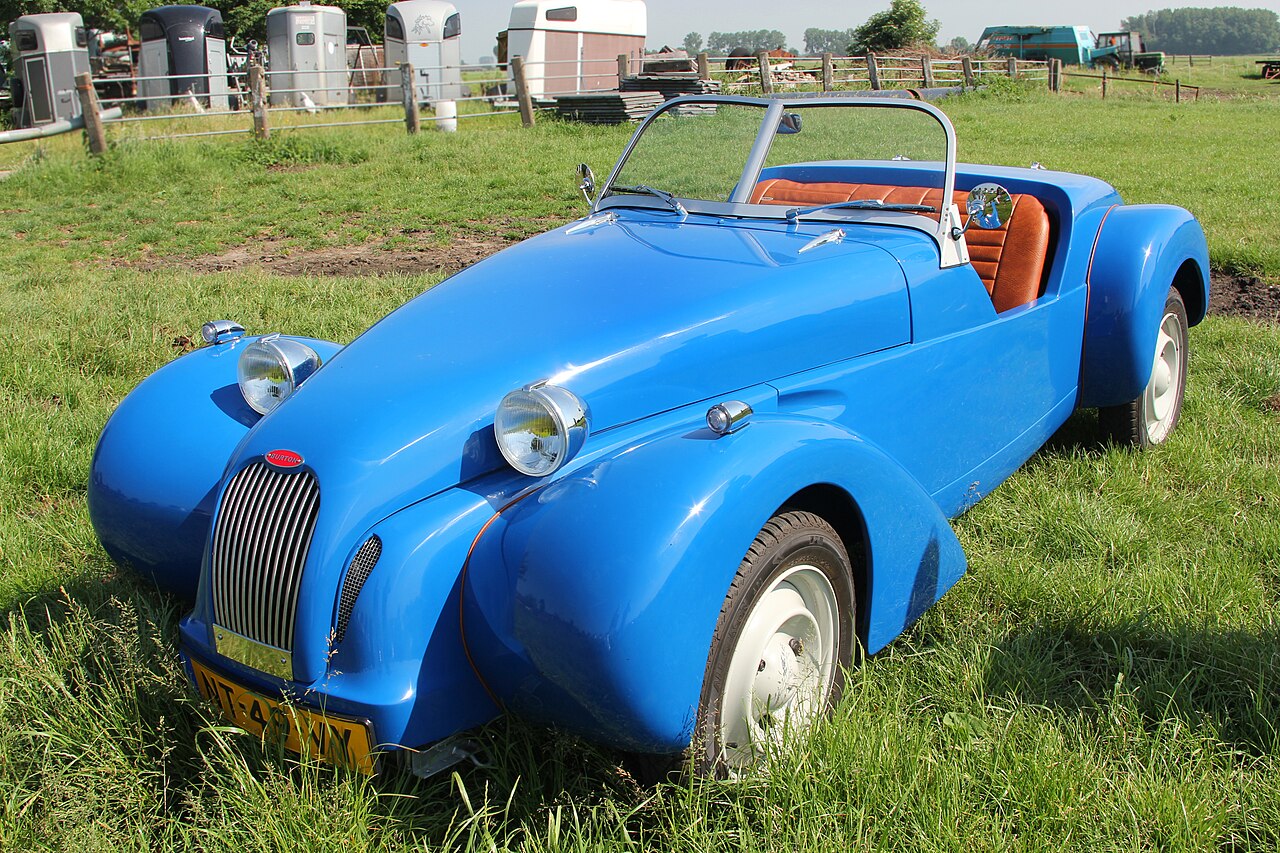
Burton roadster on Citroën 2CV running gear, Netherlands, 2018. Photo: Pabo5, Wikimedia Commons, public domain; resized.
History
The Göbel brothers built their first small car in 1978, with a DAF steering rack and a Zündapp engine. In 1993 they founded DuckHunt, which converted 2CVs into pick-ups and imported the British 2CV-based Lomax. Work on a four-wheeled 2CV-based sports car, code-named "Hunter", began in 1997–1998. Its styling drew on Bugatti, Jaguar, Talbot-Lago, Delahaye and Alfa Romeo. The first body came out of the mould in February 2000. The car was shown at Citromobile 2000 under the name Burton, and 98 orders had been taken by the end of that year. The first customer car was completed in 2001, and DuckHunt was renamed Burton Car Company in 2004.
A parts business, Burton 2CV Parts, followed in 2008. It now lists over 4,000 items for 2CV-family cars. Burton added an engine, gearbox and carburettor reconditioning department in 2013 and a dynamometer in 2018. A battery-electric Burton was developed with HAN University of Applied Sciences and shown in 2010. Reports from 2011 give it a 16 kWh LiFePO4 battery and a 25 kW motor; those figures come from a single source. The electric car remained a prototype, and a new electric prototype was tested in 2025.
The company was offered for sale in 2019. In November 2022 the brothers sold the majority of their shares to 2CV Méhari Club Cassis, a French restorer and parts maker for the Méhari and 2CV. Burton kept its headquarters in Zutphen. Some reports describe this simply as an acquisition, but the more detailed account confirms a majority-stake sale with the Göbels remaining. The 1,400th Burton was completed in January 2025. In April 2025 the Burton roadster kit was homologated in France for 2CV6 donors (types AZKA and AZKA-A), with fitting restricted to the Méhari Club Cassis workshop network.
Models and variants
Model / variantYearsDescription
Burton roadster2000–Two-seat glass-fibre open body on a 2CV chassis; Classic and Sport versions are offered, but the difference between them has not been documented
Burton hardtop ("coupé")2000s–Optional hardtop with gull-wing doors fitted to the roadster
Burton Electric2010 and 2025 prototypesBattery-electric version; not in series production
Burton Elementz2008 conceptWinner of a 2007 design contest by Rob Wolkers: a 2CV engine in a carbon-fibre frame with minimal bodywork; not produced
2CV pick-up1990sDuckHunt pick-up conversions of the 2CV
A "Burton double turbo" one-off was photographed at a Belgian show in 2012. No technical description of it has been published.
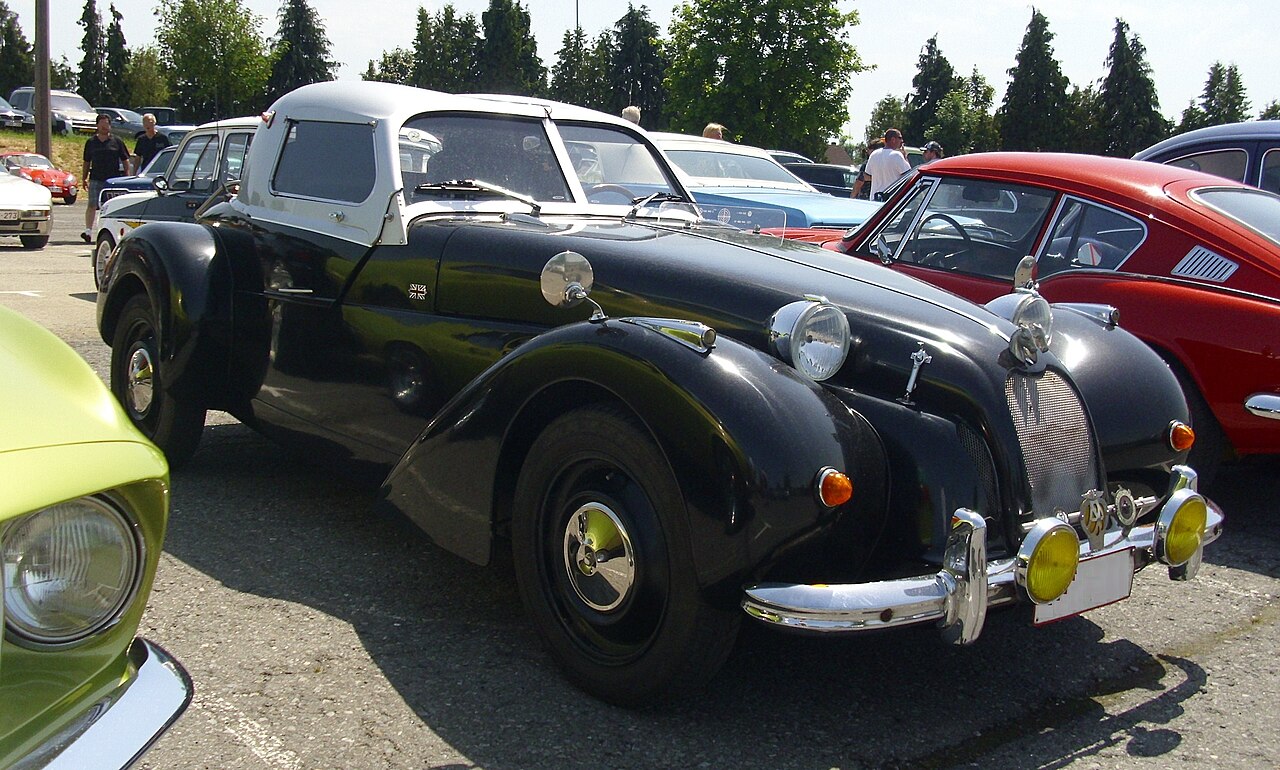
Burton with the gull-wing hardtop, Expo Ciney, 2014. Photo: Buch-t, Wikimedia Commons, CC BY-SA 3.0 DE; resized.
Kit, donor and registration
The donor must be a Citroën 2CV6 or Dyane 6 with the 602 cc engine and its original identification number. The kit supplies the glass-fibre body, which is available in over 200 gelcoat colours. A new galvanised chassis or a complete rolling chassis can also be supplied. The donor provides the suspension, steering, brakes, engine and gearbox. Options include wire, aluminium or Burton sport wheels, low or high windscreens, LED headlights, a big-bore engine, uprated suspension and a limited-slip differential. Burton publishes a build manual.
In the Netherlands, the RDW first approves the conversion of the donor car, and the finished car is then inspected and re-registered. Press reports note that the car keeps the donor's date of first registration. In France the kit must be fitted by an approved workshop, with about 50 hours of labour quoted in 2026. Prices have risen from about €8,000 for a self-built car in 2009 to a basic kit from about €4,700 in Dutch pricing in 2026; a finished car was quoted at about €12,500 in 2022. French pricing in 2026 is €10,000 for the kit and €28,000 for a complete car without the donor.
Engine and performance
The Burton uses the donor's Citroën air-cooled flat-twin: a four-stroke pushrod OHV engine with hemispherical combustion chambers. It drives the front wheels through a four-speed gearbox. See Citroën 2CV models and engines.
ItemValue
EngineCitroën 2CV6 / Dyane 6, 602 cc (74 x 70 mm), 8.5:1 compression
Standard outputAbout 28–29 hp (the final 2CV6 rating is 29 hp at 5,750 rpm)
Fuel systemTwin-choke Solex 26/35 CSIC carburettor, as on the donor
IgnitionContact breaker with wasted spark and no distributor; centrifugal advance only
WeightAbout 480 kg (manufacturer); press figures are under 500 kg
Top speed130 km/h (manufacturer)
Fuel consumptionAbout 5 l/100 km (1 litre per 20 km)
There is no electronic engine management. Burton does not offer an injection conversion. The engine upgrades sold through Burton 2CV Parts and the French parent are:
652 cc big-bore kit. 77 mm barrels and pistons at 9:1 compression, with valves unchanged. Rejetting the Solex is recommended (110 primary and 115 secondary main jets). The seller says it is almost equivalent to the 730 cc kits sold elsewhere, but no power figure has been published. Complete reconditioned 652 cc engines are also sold.
Electronic ignition. A 123 EVO 12 V unit with 16 selectable advance curves.
Burton "PowerTube" intake. Fitted to at least one auctioned 652 cc car. Its effect has not been documented.
The only published performance test of a modified car is a 2009 press drive of Iwan Göbel's own car, tuned to about 35 hp. It reached 0–100 km/h in about 12 seconds and a top speed of 140 km/h. That was a single modified example.
Not established
The difference between the Classic and Sport versions.
A measured power figure for the 652 cc big-bore engine.
The specification of the "double turbo" one-off.
Current annual production and the production status of the Burton Electric.
Luggage capacity: figures of 430 litres and over 700 litres are both published.
Sources
Burton Car Company, About us, home and Build (manufacturer, undated). Accessed 19 November 2026.
Burton komt in Franse handen, Autozine, 2 November 2022. Accessed 19 November 2026.
Uli Baumann, Burton: Kit-Car-Hersteller nach Frankreich verkauft, auto motor und sport, 3 November 2022. Accessed 19 November 2026.
Harold Rolloos, Burton: Vreemde eend, Rijtesten.nl, 30 May 2009. Accessed 19 November 2026.
Ben Branch, Citroën 2CV Roadster by Burton, Silodrome, 25 May 2021. Accessed 19 November 2026.
Burton celebrates 25 years, Citroënvie, 19 January 2025. Accessed 19 November 2026.
2CV Méhari Club Cassis, Burton Roadster homologation in France, 23 April 2025, and 652 cc big-bore engine kit (product page). Accessed 19 November 2026.
Brian McCulloch, How France's classic Citroën 2CV became a British-style retro sports car, The Connexion, 9 May 2026. Accessed 19 November 2026.
Alisdair Suttie, New 2CV-based sportster (Burton Elementz), CarEnthusiast, 12 March 2008. Accessed 19 November 2026.
Burton 2CV Parts product listings for the 652 cc barrel and piston set and 123 EVO electronic ignition (titles only; pages refuse automated access). Accessed 19 November 2026.
Burton (car), English Wikipedia; Burton Car Company, German Wikipedia; Burton Car Company, Dutch Wikipedia; Citroën 2CV, English Wikipedia (engine data). Accessed 19 November 2026.
Photographs from Wikimedia Commons, credited in each caption. Accessed 19 November 2026.
Rendered revisions
Open each version to inspect formatting, tables and photographs.
Revision 1: Burton Car Company: history and cars
Burton is a Dutch kit car built on the chassis and running gear of the Citroën 2CV. The Burton Car Company of Zutphen has made it since 2000. It is a two-seat open roadster with a glass-fibre body styled after 1930s and 1940s European sports cars, and it uses the donor car's 602 cc air-cooled flat-twin engine and four-speed gearbox. With about 1,400 built by 2025, it is the most numerous Dutch kit car. The company was founded by the brothers Dimitri and Iwan Göbel. In November 2022 the French 2CV Méhari Club Cassis took a majority stake, and the founders stayed on as minority shareholders and managers. Burton has never made its own engine; its engine work consists of rebuilds, a big-bore kit and ignition upgrades for the Citroën twin. Part of Dutch kit car and specialist car makers.
Burton roadster on Citroën 2CV running gear, Netherlands, 2018. Photo: Pabo5, Wikimedia Commons, public domain; resized.
History
The Göbel brothers built their first small car in 1978, with a DAF steering rack and a Zündapp engine. In 1993 they founded DuckHunt, which converted 2CVs into pick-ups and imported the British 2CV-based Lomax. Work on a four-wheeled 2CV-based sports car, code-named "Hunter", began in 1997–1998. Its styling drew on Bugatti, Jaguar, Talbot-Lago, Delahaye and Alfa Romeo. The first body came out of the mould in February 2000. The car was shown at Citromobile 2000 under the name Burton, and 98 orders had been taken by the end of that year. The first customer car was completed in 2001, and DuckHunt was renamed Burton Car Company in 2004.
A parts business, Burton 2CV Parts, followed in 2008. It now lists over 4,000 items for 2CV-family cars. Burton added an engine, gearbox and carburettor reconditioning department in 2013 and a dynamometer in 2018. A battery-electric Burton was developed with HAN University of Applied Sciences and shown in 2010. Reports from 2011 give it a 16 kWh LiFePO4 battery and a 25 kW motor; those figures come from a single source. The electric car remained a prototype, and a new electric prototype was tested in 2025.
The company was offered for sale in 2019. In November 2022 the brothers sold the majority of their shares to 2CV Méhari Club Cassis, a French restorer and parts maker for the Méhari and 2CV. Burton kept its headquarters in Zutphen. Some reports describe this simply as an acquisition, but the more detailed account confirms a majority-stake sale with the Göbels remaining. The 1,400th Burton was completed in January 2025. In April 2025 the Burton roadster kit was homologated in France for 2CV6 donors (types AZKA and AZKA-A), with fitting restricted to the Méhari Club Cassis workshop network.
Models and variants
Model / variant
Years
Description
Burton roadster
2000–
Two-seat glass-fibre open body on a 2CV chassis; Classic and Sport versions are offered, but the difference between them has not been documented
Burton hardtop ("coupé")
2000s–
Optional hardtop with gull-wing doors fitted to the roadster
Burton Electric
2010 and 2025 prototypes
Battery-electric version; not in series production
Burton Elementz
2008 concept
Winner of a 2007 design contest by Rob Wolkers: a 2CV engine in a carbon-fibre frame with minimal bodywork; not produced
2CV pick-up
1990s
DuckHunt pick-up conversions of the 2CV
A "Burton double turbo" one-off was photographed at a Belgian show in 2012. No technical description of it has been published.
The donor must be a Citroën 2CV6 or Dyane 6 with the 602 cc engine and its original identification number. The kit supplies the glass-fibre body, which is available in over 200 gelcoat colours. A new galvanised chassis or a complete rolling chassis can also be supplied. The donor provides the suspension, steering, brakes, engine and gearbox. Options include wire, aluminium or Burton sport wheels, low or high windscreens, LED headlights, a big-bore engine, uprated suspension and a limited-slip differential. Burton publishes a build manual.
In the Netherlands, the RDW first approves the conversion of the donor car, and the finished car is then inspected and re-registered. Press reports note that the car keeps the donor's date of first registration. In France the kit must be fitted by an approved workshop, with about 50 hours of labour quoted in 2026. Prices have risen from about €8,000 for a self-built car in 2009 to a basic kit from about €4,700 in Dutch pricing in 2026; a finished car was quoted at about €12,500 in 2022. French pricing in 2026 is €10,000 for the kit and €28,000 for a complete car without the donor.
Engine and performance
The Burton uses the donor's Citroën air-cooled flat-twin: a four-stroke pushrod OHV engine with hemispherical combustion chambers. It drives the front wheels through a four-speed gearbox. See Citroën 2CV models and engines.
Item
Value
Engine
Citroën 2CV6 / Dyane 6, 602 cc (74 x 70 mm), 8.5:1 compression
Standard output
About 28–29 hp (the final 2CV6 rating is 29 hp at 5,750 rpm)
Fuel system
Twin-choke Solex 26/35 CSIC carburettor, as on the donor
Ignition
Contact breaker with wasted spark and no distributor; centrifugal advance only
Weight
About 480 kg (manufacturer); press figures are under 500 kg
Top speed
130 km/h (manufacturer)
Fuel consumption
About 5 l/100 km (1 litre per 20 km)
There is no electronic engine management. Burton does not offer an injection conversion. The engine upgrades sold through Burton 2CV Parts and the French parent are:
652 cc big-bore kit. 77 mm barrels and pistons at 9:1 compression, with valves unchanged. Rejetting the Solex is recommended (110 primary and 115 secondary main jets). The seller says it is almost equivalent to the 730 cc kits sold elsewhere, but no power figure has been published. Complete reconditioned 652 cc engines are also sold.
Electronic ignition. A 123 EVO 12 V unit with 16 selectable advance curves.
Burton "PowerTube" intake. Fitted to at least one auctioned 652 cc car. Its effect has not been documented.
The only published performance test of a modified car is a 2009 press drive of Iwan Göbel's own car, tuned to about 35 hp. It reached 0–100 km/h in about 12 seconds and a top speed of 140 km/h. That was a single modified example.
Not established
The difference between the Classic and Sport versions.
A measured power figure for the 652 cc big-bore engine.
The specification of the "double turbo" one-off.
Current annual production and the production status of the Burton Electric.
Luggage capacity: figures of 430 litres and over 700 litres are both published.
Sources
Burton Car Company, About us, home and Build (manufacturer, undated). Accessed 19 November 2026.
Photographs from Wikimedia Commons, credited in each caption. Accessed 19 November 2026.
Revision 1: Burton Car Company: history and cars
Burton is a Dutch kit car built on the chassis and running gear of the Citroën 2CV. The Burton Car Company of Zutphen has made it since 2000. It is a two-seat open roadster with a glass-fibre body styled after 1930s and 1940s European sports cars, and it uses the donor car's 602 cc air-cooled flat-twin engine and four-speed gearbox. With about 1,400 built by 2025, it is the most numerous Dutch kit car. The company was founded by the brothers Dimitri and Iwan Göbel. In November 2022 the French 2CV Méhari Club Cassis took a majority stake, and the founders stayed on as minority shareholders and managers. Burton has never made its own engine; its engine work consists of rebuilds, a big-bore kit and ignition upgrades for the Citroën twin. Part of Dutch kit car and specialist car makers.
Burton roadster on Citroën 2CV running gear, Netherlands, 2018. Photo: Pabo5, Wikimedia Commons, public domain; resized.
History
The Göbel brothers built their first small car in 1978, with a DAF steering rack and a Zündapp engine. In 1993 they founded DuckHunt, which converted 2CVs into pick-ups and imported the British 2CV-based Lomax. Work on a four-wheeled 2CV-based sports car, code-named "Hunter", began in 1997–1998. Its styling drew on Bugatti, Jaguar, Talbot-Lago, Delahaye and Alfa Romeo. The first body came out of the mould in February 2000. The car was shown at Citromobile 2000 under the name Burton, and 98 orders had been taken by the end of that year. The first customer car was completed in 2001, and DuckHunt was renamed Burton Car Company in 2004.
A parts business, Burton 2CV Parts, followed in 2008. It now lists over 4,000 items for 2CV-family cars. Burton added an engine, gearbox and carburettor reconditioning department in 2013 and a dynamometer in 2018. A battery-electric Burton was developed with HAN University of Applied Sciences and shown in 2010. Reports from 2011 give it a 16 kWh LiFePO4 battery and a 25 kW motor; those figures come from a single source. The electric car remained a prototype, and a new electric prototype was tested in 2025.
The company was offered for sale in 2019. In November 2022 the brothers sold the majority of their shares to 2CV Méhari Club Cassis, a French restorer and parts maker for the Méhari and 2CV. Burton kept its headquarters in Zutphen. Some reports describe this simply as an acquisition, but the more detailed account confirms a majority-stake sale with the Göbels remaining. The 1,400th Burton was completed in January 2025. In April 2025 the Burton roadster kit was homologated in France for 2CV6 donors (types AZKA and AZKA-A), with fitting restricted to the Méhari Club Cassis workshop network.
Models and variants
Model / variant
Years
Description
Burton roadster
2000–
Two-seat glass-fibre open body on a 2CV chassis; Classic and Sport versions are offered, but the difference between them has not been documented
Burton hardtop ("coupé")
2000s–
Optional hardtop with gull-wing doors fitted to the roadster
Burton Electric
2010 and 2025 prototypes
Battery-electric version; not in series production
Burton Elementz
2008 concept
Winner of a 2007 design contest by Rob Wolkers: a 2CV engine in a carbon-fibre frame with minimal bodywork; not produced
2CV pick-up
1990s
DuckHunt pick-up conversions of the 2CV
A "Burton double turbo" one-off was photographed at a Belgian show in 2012. No technical description of it has been published.
The donor must be a Citroën 2CV6 or Dyane 6 with the 602 cc engine and its original identification number. The kit supplies the glass-fibre body, which is available in over 200 gelcoat colours. A new galvanised chassis or a complete rolling chassis can also be supplied. The donor provides the suspension, steering, brakes, engine and gearbox. Options include wire, aluminium or Burton sport wheels, low or high windscreens, LED headlights, a big-bore engine, uprated suspension and a limited-slip differential. Burton publishes a build manual.
In the Netherlands, the RDW first approves the conversion of the donor car, and the finished car is then inspected and re-registered. Press reports note that the car keeps the donor's date of first registration. In France the kit must be fitted by an approved workshop, with about 50 hours of labour quoted in 2026. Prices have risen from about €8,000 for a self-built car in 2009 to a basic kit from about €4,700 in Dutch pricing in 2026; a finished car was quoted at about €12,500 in 2022. French pricing in 2026 is €10,000 for the kit and €28,000 for a complete car without the donor.
Engine and performance
The Burton uses the donor's Citroën air-cooled flat-twin: a four-stroke pushrod OHV engine with hemispherical combustion chambers. It drives the front wheels through a four-speed gearbox. See Citroën 2CV models and engines.
Item
Value
Engine
Citroën 2CV6 / Dyane 6, 602 cc (74 x 70 mm), 8.5:1 compression
Standard output
About 28–29 hp (the final 2CV6 rating is 29 hp at 5,750 rpm)
Fuel system
Twin-choke Solex 26/35 CSIC carburettor, as on the donor
Ignition
Contact breaker with wasted spark and no distributor; centrifugal advance only
Weight
About 480 kg (manufacturer); press figures are under 500 kg
Top speed
130 km/h (manufacturer)
Fuel consumption
About 5 l/100 km (1 litre per 20 km)
There is no electronic engine management. Burton does not offer an injection conversion. The engine upgrades sold through Burton 2CV Parts and the French parent are:
652 cc big-bore kit. 77 mm barrels and pistons at 9:1 compression, with valves unchanged. Rejetting the Solex is recommended (110 primary and 115 secondary main jets). The seller says it is almost equivalent to the 730 cc kits sold elsewhere, but no power figure has been published. Complete reconditioned 652 cc engines are also sold.
Electronic ignition. A 123 EVO 12 V unit with 16 selectable advance curves.
Burton "PowerTube" intake. Fitted to at least one auctioned 652 cc car. Its effect has not been documented.
The only published performance test of a modified car is a 2009 press drive of Iwan Göbel's own car, tuned to about 35 hp. It reached 0–100 km/h in about 12 seconds and a top speed of 140 km/h. That was a single modified example.
Not established
The difference between the Classic and Sport versions.
A measured power figure for the 652 cc big-bore engine.
The specification of the "double turbo" one-off.
Current annual production and the production status of the Burton Electric.
Luggage capacity: figures of 430 litres and over 700 litres are both published.
Sources
Burton Car Company, About us, home and Build (manufacturer, undated). Accessed 19 November 2026.