Bench connection pins
The Bosch EDC15C13 uses three connector blocks. Two application diagrams exist with different pin naming and different pin roles, so they are presented separately and are not merged.
Opel application (connectors T1, T2, T3)
Five pins are used for off-car (bench) programming: T2 pins F1 and M3 carry the permanent battery +12 V supply, T2 pin A1 carries the switched (ignition) +12 V supply, T2 pin M4 is ground and T3 pin F2 is the K-line. Each block has four rows (1 to 4); T1 is lettered H to A, T2 A to M and T3 A to H.

Renault application (connectors A, B, C)
The Renault diagram labels the blocks A, B and C, each with four rows, and draws wider cavities at the high-current positions. Marked pins are: B/A1 as +12 V (ACC I, switched on first and off first), B/M2 as +12 V (ACC II, switched on second and off second), B/J3, B/J4 and B/M4 as ground, and C/F2 as the K-line (diagnosis). B/J1 and B/K1 are a CAN pair; the diagram's text and its colour coding disagree on which is high and which is low, so the assignment is not resolved here.
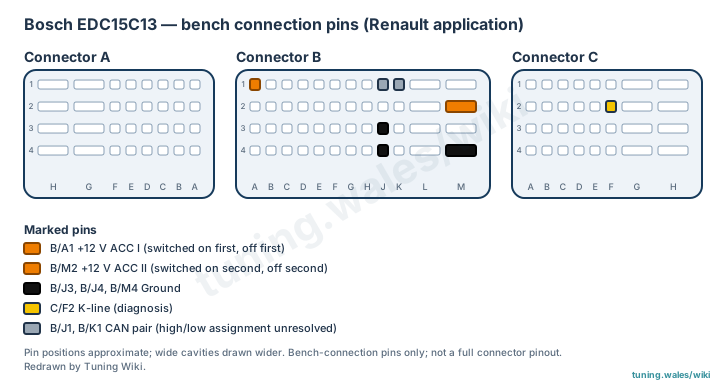
The diagrams show only bench-connection pins; they are not full connector pinouts. Pin assignments should be verified against the ECU label and hardware before the unit is powered.
Connector pinout
Bosch EDC15C13: Opel application (T1/T2/T3 connector naming) and Renault application (A/B/C connector naming) are drawn separately because the two diagrams use different pin roles and are not merged. Bench-connection pins only; not a full connector pinout. Pin positions approximate.
View orientation is stated beside each photograph. Unknown functions remain in the pin index.
Bench connection (Opel application)
- Instructions
- Connect the listed pins to the flashing tool's bench cable as labelled; confirm against the ECU label and hardware before powering.
| Connector / pin | Connection role | Recorded function |
|---|---|---|
| Connector T2 (Opel application) / F1 | +12 V battery supply | +12 V battery supply (Suspected) |
| Connector T2 (Opel application) / M3 | +12 V battery supply | +12 V battery supply (Suspected) |
| Connector T2 (Opel application) / A1 | Switched +12 V (ignition) | Switched +12 V (ignition) (Suspected) |
| Connector T2 (Opel application) / M4 | Ground | Ground (Suspected) |
| Connector T3 (Opel application) / F2 | K-line | K-line (Suspected) |
Bench connection (Renault application)
- Instructions
- Connect the listed pins to the flashing tool's bench cable as labelled; confirm against the ECU label and hardware before powering. Power sequencing as shown for the diagram: +12 V ACC I (B/A1) first on and first off, +12 V ACC II (B/M2) second on and second off.
| Connector / pin | Connection role | Recorded function |
|---|---|---|
| Connector B (Renault application) / A1 | +12 V ACC I (switched) | +12 V ACC I (switched) (Suspected) |
| Connector B (Renault application) / M2 | +12 V ACC II (switched) | +12 V ACC II (switched) (Suspected) |
| Connector B (Renault application) / J3 | Ground | Ground (Suspected) |
| Connector B (Renault application) / J4 | Ground | Ground (Suspected) |
| Connector B (Renault application) / M4 | Ground | Ground (Suspected) |
| Connector B (Renault application) / J1 | CAN line (high/low unresolved) | CAN line (high/low unresolved) (Suspected) |
| Connector B (Renault application) / K1 | CAN line (high/low unresolved) | CAN line (high/low unresolved) (Suspected) |
| Connector C (Renault application) / F2 | K-line | K-line (Suspected) |
Connector T2 (Opel application)
View: As drawn; pin positions approximate
Select a pin in a photograph or the index to highlight it.
| Pin | Function / cavity | Confidence / source | Notes |
|---|---|---|---|
| +12 V battery supply Cavity: Populated |
Suspected | ||
| +12 V battery supply Cavity: Populated |
Suspected | ||
| Switched +12 V (ignition) Cavity: Populated |
Suspected | ||
| Ground Cavity: Populated |
Suspected |
Connector T3 (Opel application)
View: As drawn; pin positions approximate
Select a pin in a photograph or the index to highlight it.
| Pin | Function / cavity | Confidence / source | Notes |
|---|---|---|---|
| K-line Cavity: Populated |
Suspected |
Connector B (Renault application)
View: As drawn; pin positions approximate
Select a pin in a photograph or the index to highlight it.
| Pin | Function / cavity | Confidence / source | Notes |
|---|---|---|---|
| +12 V ACC I (switched) Cavity: Populated |
Suspected | Power-sequencing note: ACC I is switched on first and off first. | |
| +12 V ACC II (switched) Cavity: Populated |
Suspected | Power-sequencing note: ACC II is switched on second and off second. | |
| Ground Cavity: Populated |
Suspected | ||
| Ground Cavity: Populated |
Suspected | ||
| Ground Cavity: Populated |
Suspected | ||
| CAN line (high/low unresolved) Cavity: Populated |
Suspected | High/low assignment is not resolved: the diagram text and its colour coding disagree. | |
| CAN line (high/low unresolved) Cavity: Populated |
Suspected | High/low assignment is not resolved: the diagram text and its colour coding disagree. |
Connector C (Renault application)
View: As drawn; pin positions approximate
Select a pin in a photograph or the index to highlight it.
| Pin | Function / cavity | Confidence / source | Notes |
|---|---|---|---|
| K-line Cavity: Populated |
Suspected | Labelled diagnosis in the diagram. |