A remap changes the calibration data an engine control unit uses. The job has three operations: obtain a copy of the calibration, change tables in a working copy, and write the result back. Depending on the ECU and tool, the starting file is read from the unit or supplied as a matching virtual read, and the result is written electronically or, on older controllers, supplied in a replacement memory device. What the tables control is covered in ECU remapping; trade terms that are often mistaken for a description of the calibration are corrected in common misconceptions about remapping.
Pinouts, programming voltages, authorisation methods and checksum algorithms are specific to the control unit and the tool manual, and are not given here. A road vehicle must still comply with the law where it is used, including its emissions equipment.
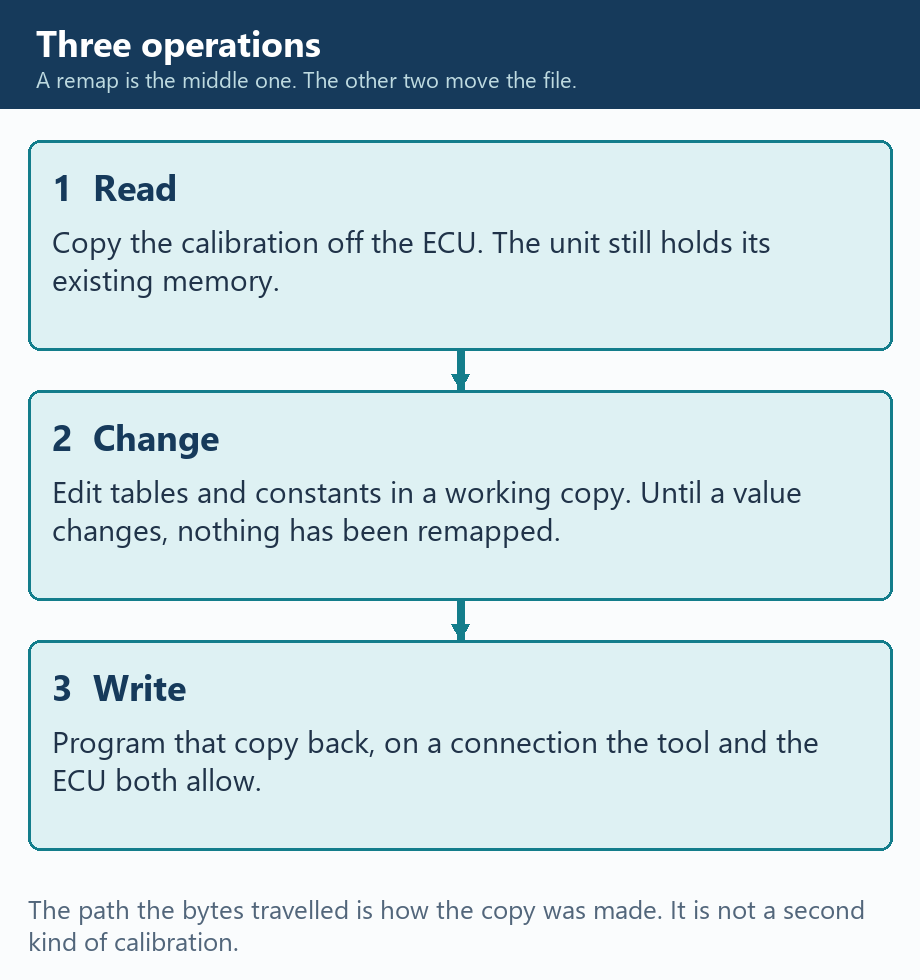
| Step | What must be true before the next one |
|---|---|
| Record the identity | Hardware number, software number, any calibration identifier, and the vehicle they came from. |
| Obtain and preserve the starting file | Whether it is an actual read or a virtual file, and its scope, are recorded. An untouched copy is stored and a second copy is edited. |
| Change the working copy | The objects meant to change are the only objects that differ. |
| Correct supported checksums | The file is consistent enough to be accepted. This is not a verdict on the calibration. |
| Write it back | The connection is one both tool and ECU allow, and the supply stays up throughout. |
| Verify the write, then log it | A read-back or tool verification confirms the transfer; a log compares request with delivered behaviour. Neither alone proves the calibration is safe. |
Program and calibration
The memory of an engine ECU holds the operating strategy (the program) and the lookup tables and constants it reads (the calibration). MOTOR described the PROM of earlier controllers as the carrier of all three. A remap in the ordinary sense changes the calibration: a request, a limit, an injection or ignition table, a temperature correction or a sensor scaling. Replacing the program is a different alteration, even when both travel in the same file. How a given ECU divides program, calibration and any separate serial EEPROM is a fact about that ECU and its software, not about a family name; some reads return only a calibration area and others a larger image.
From replaced chips to flash
Early controllers stored the calibration in a one-time-programmable PROM or an ultraviolet-erasable EPROM. Changing the calibration meant fitting a different device, or removing an EPROM, erasing it under ultraviolet light and reprogramming it. That is the origin of the terms "chipping" and "chip tuning". ST's M27C512 is an example of the device class, sold both as a windowed, UV-erasable ceramic part and as a plastic one-time-programmable part.
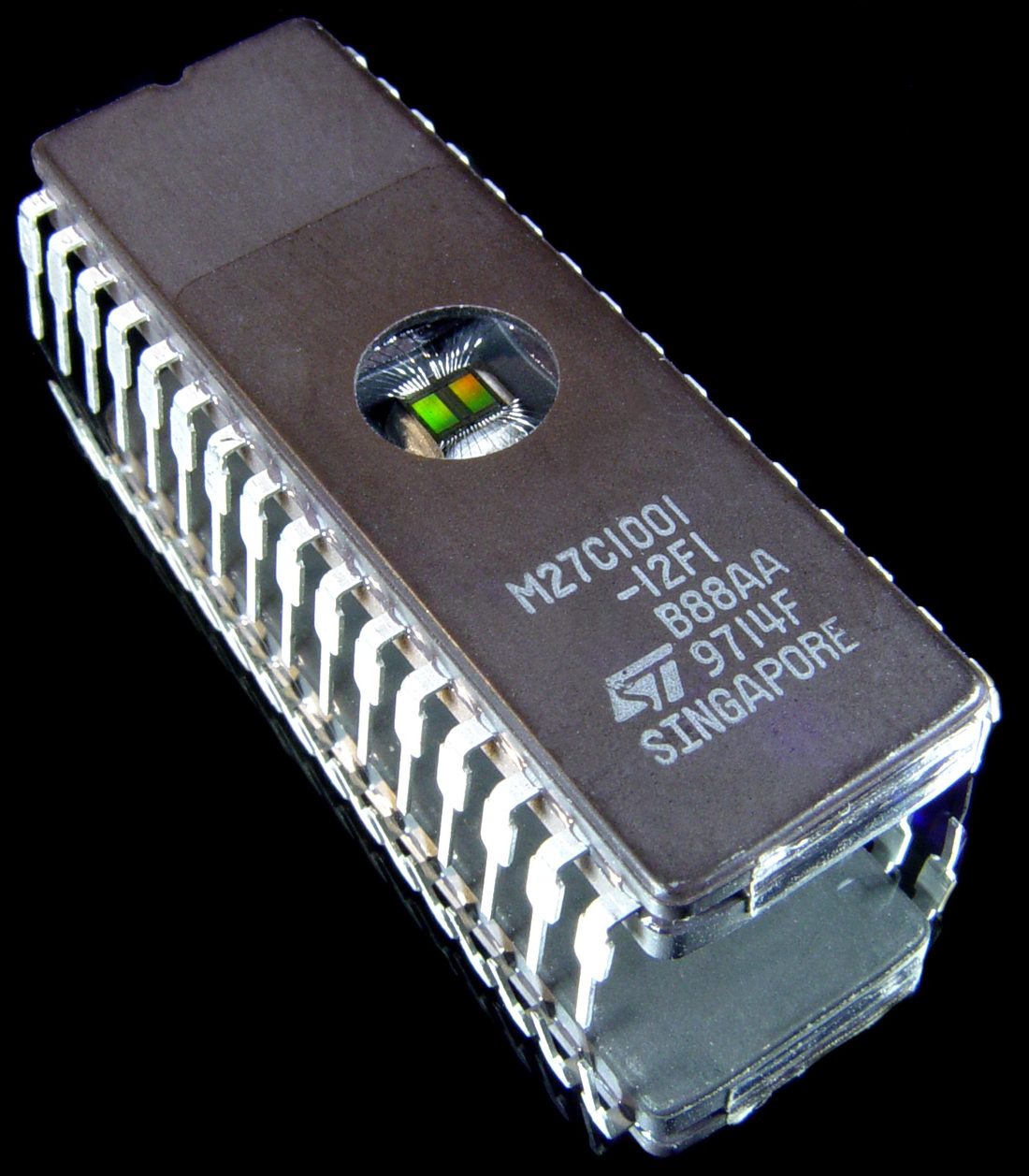

MOTOR recorded in 1999 that from the early 1990s a growing number of powertrain controllers could be reprogrammed electrically through the diagnostic connector, with a computer and scan tool connected for the whole transfer and no device removed. MOTOR also reported that US carmakers were required to provide OBD-II powertrain reprogramming to independent technicians from December 1997; that is a US service rule, not a date for the European aftermarket.
Identifying the unit
A file belongs to a software identifier, not a model name. Dealer reprogramming applies the same rule from the other side: MOTOR's 1999 account has the scan tool read the current revision before offering the update for that revision.
| Record before the read | Purpose |
|---|---|
| Hardware number | Identifies the board the file came from. |
| Software number | The program a definition has to match; a familiar map name is not a match. |
| Calibration identifier | The dataset, where the label or tool reports one. |
| Vehicle and fitted hardware | Neighbouring software can share a strategy without sharing addresses, and modified hardware changes what the tables must describe. |
Selecting a definition for that software is covered in choosing ECU definition files; ME7 getting started is a family example. Diagnostic capability and memory access are separate questions: a tool that reads codes or live data may not read or write memory, and connector shape or an "OBD" label is not evidence of either. Historical examples of separate diagnostic and memory paths include the Ford EEC-IV self-test and the emulator and MEMCAL adapters in the EPROM guide.
Reading the memory
Programming tools group access into a few connection modes. Alientech's KESS3 documentation gives the common names, and the AutoTuner uses the same division. Which modes exist for a particular ECU is set by the tool's support list for that unit.
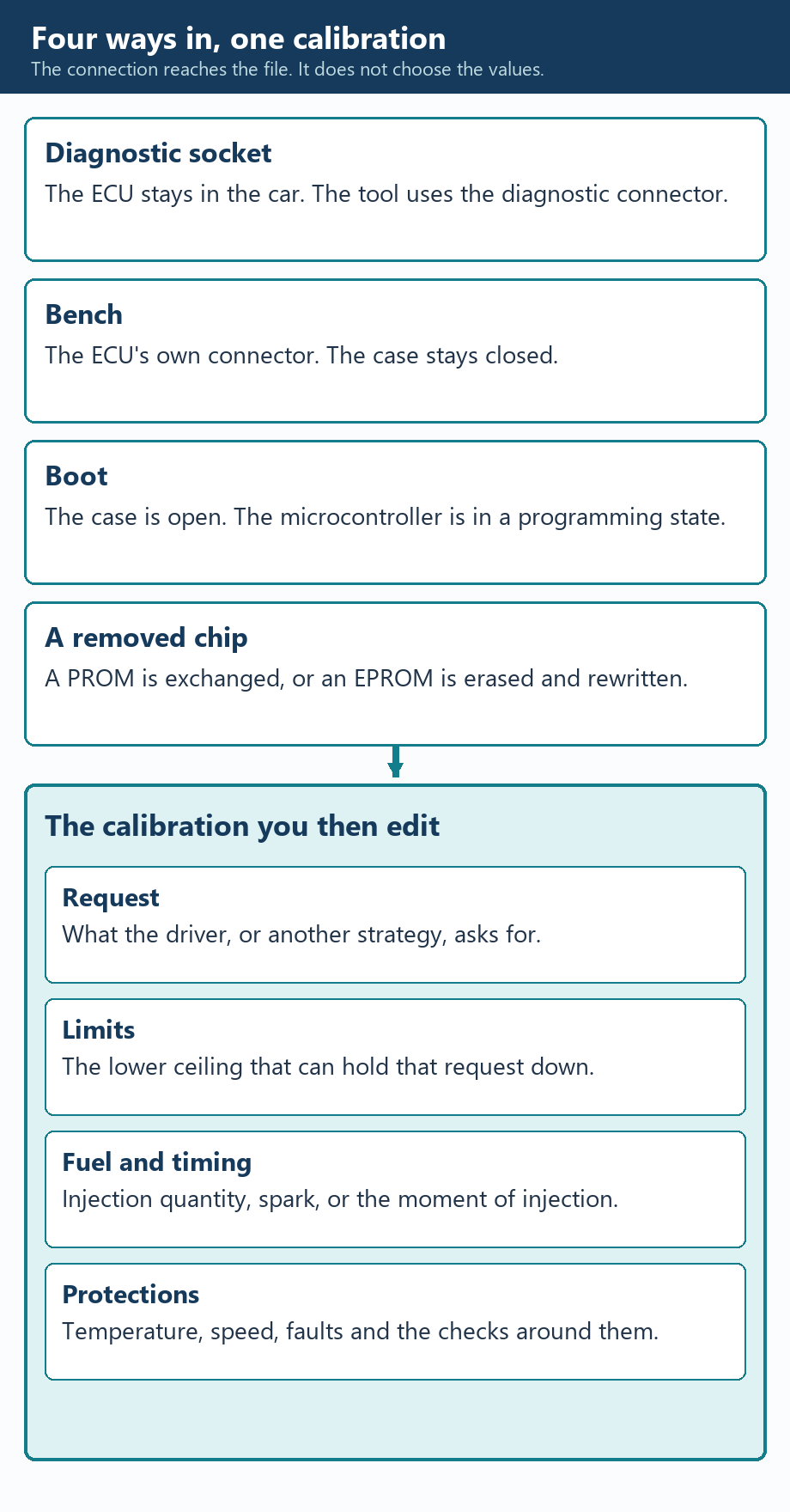
| Mode | Where the tool connects | Typical use and limits |
|---|---|---|
| Diagnostic socket (OBD) | The vehicle's diagnostic connector, ECU in place | Read and write where the ECU allows programming over its diagnostic protocol. Fastest; may be a virtual read rather than a full image. Some ECUs require programming authorisation, an access control in the protocol. |
| Bench | The ECU's own connector, case closed, unit powered separately | Used when the socket cannot do the job, a fuller image is wanted, the supply must be more stable, or the unit is to be cloned. Wiring is connector-specific; wrong pins damage units. |
| Boot | An opened ECU, microcontroller held in a programming state | Memory the other paths will not give, and recovery of a unit that no longer answers. Some applications need soldered connections. Highest handling risk. |
| Removed memory device | The chip in a programmer | The historical method: replace a PROM, or erase and rewrite an EPROM. |
Alientech's FAQ answers the question of which mode is better by saying it depends on the vehicle and the operation. The modes differ in speed, risk, image completeness and whether the unit leaves the car. They do not differ in the calibration that is subsequently edited.
Virtual reads and full images
A virtual or partial read can contain enough of the calibration to edit and write back, but it can restore only the regions it contains. A fuller image from bench or boot access is the better backup, which is why the KESS3 page notes that a virtual read is not a full physical backup. A full image may also contain coding, immobiliser data and learned adaptations outside the tables a remap changes; copying those into another unit is cloning, which Alientech lists as a separate operation and which a calibration edit does not require.
The untouched read is stored where the editor cannot overwrite it, and editing is done on a second file. WinOLS keeps an original and later versions in each project, and EVC still advises keeping a backup outside the project (WinOLS).
Editing the working copy
Editing starts after the file is on the computer; until a table, scalar or constant changes, nothing has been remapped. The editor needs a description of where each object is and how it is scaled: a definition, map pack or A2L-type description that names addresses, dimensions, data type, byte order, axes and units for this software. The editor directory separates a hex view, which shows raw bytes, from a map view, which interprets bytes a definition has claimed. Automatic map search, such as EVC's in WinOLS, proposes candidates; EVC's guidance is that each still has to be checked for address, dimensions, byte order, axes and scaling.
The edits fall into the groups set out in ECU remapping: driver request, air path, fuel, ignition or injection timing, and the limits and protections over them. A raised request has no effect while a lower limit still applies.
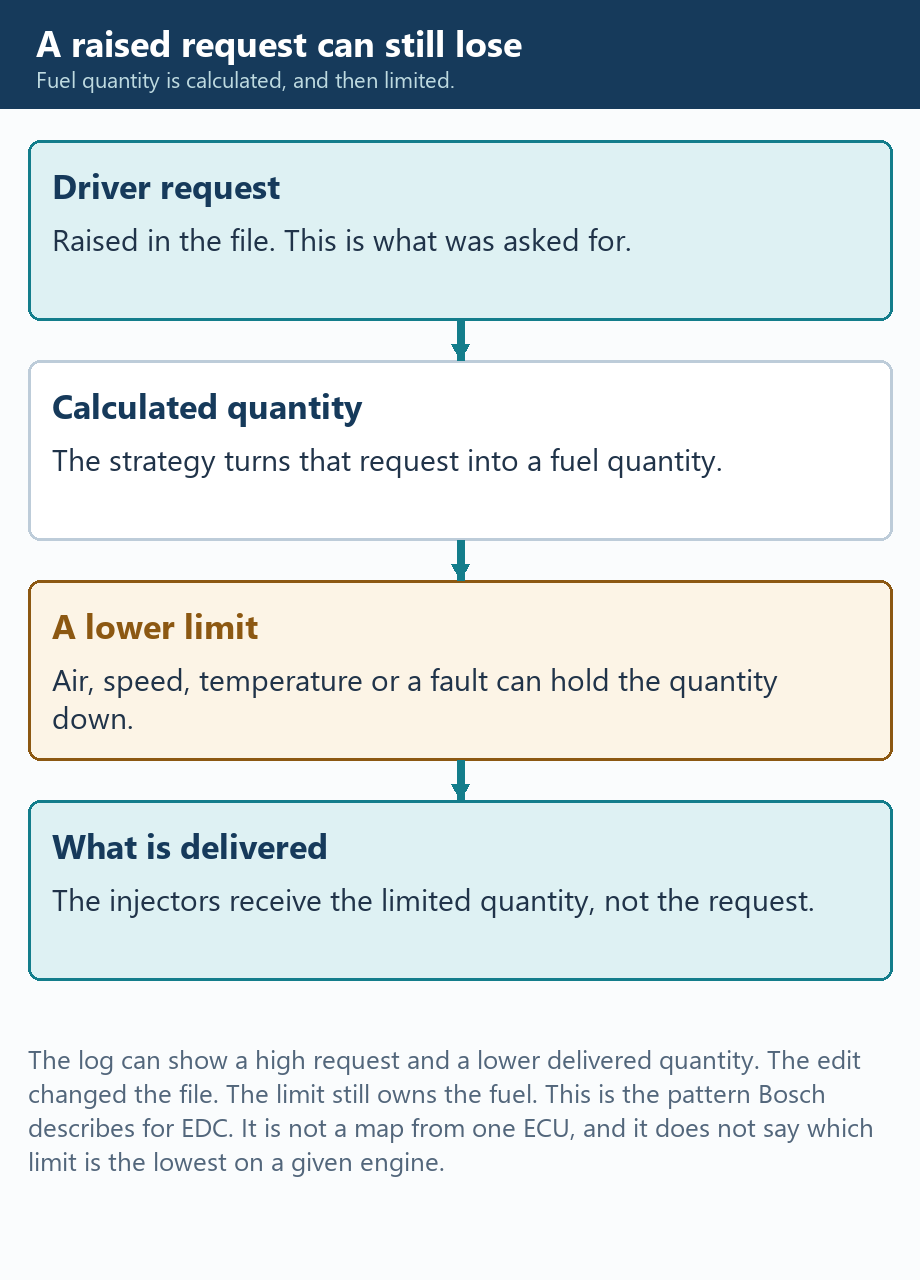
Before writing, the edited file is compared with the untouched original. The comparison should show the intended objects and nothing else; a changed byte in a region no definition names is a reason to stop. EVC documents scripts and map packs that transfer edits from earlier projects, and states that the transferred result must be checked on the destination software because neighbouring revisions differ. The exported file must be in the format the programmer expects; WinOLS imports and exports binary, Intel HEX and Motorola HEX, which are packaging of the same bytes.
Checksums
The ECU stores integrity values computed over ranges of its memory, and rejects or will not run an image whose values do not match. Editors and programming tools can recalculate them for supported files. In WinOLS this is a checksum dialog backed by separate modules, some found by sending the project to EVC's server, and some modules require the unmodified original (EVC checksums). A corrected checksum means the covered ranges are consistent. It does not mean a limit or table is appropriate, or that every integrity mechanism in the ECU was covered, so the tool that corrects checksums for this software should be confirmed rather than assumed. This page does not describe checksum algorithms.
Writing it back
The write uses a connection both the tool and the ECU allow; that is often, but not necessarily, the connection used for the read, and a virtual read and a full image are different objects that may be written differently. The supply must remain stable and the tool connected for the whole transfer; MOTOR's pass-through description and Alientech's vehicle-specific OBD precautions both rest on this. An interrupted write can leave a partial image. Recovery then depends on whether the ECU still answers and whether a backup covering the damaged region exists. Boot mode exists partly for units that no longer answer.
Where the tool can read the unit after writing, comparing that read with the intended file is a stronger check than the tool's success message.
Checking the result on the engine
A verified write is a file in memory, not a demonstrated result. The unit should identify as the written software with no fault caused by the transfer. The log then compares the request with what was delivered: boost or manifold pressure, fuel quantity or lambda, ignition or injection timing, knock correction and exhaust temperature. A higher request with unchanged delivery means a lower limit or the hardware is still in the way (logging a drivability complaint). Fuel, boost and quantity adaptations can move the result over the first drives and can carry corrections learned on the previous calibration (adaptations and calibration drift). A single full-load pull says nothing about idle, tip-in, hot charge air or return from overrun, which are part of the same calibration (drivability). Knock control and smoke limiting are protections visible in that log, not substitutes for correct tables (engine knock).
When the workshop does not make the edit
The three operations remain when the person at the car does not edit a map. In Alientech's Master and Slave arrangement the Slave reads the ECU, sends the read to a Master, and writes the encrypted, ready-to-use file returned; the Master makes the calibration decisions. Automated-solution software applies its publisher's changes to a file already read. Either way, someone or something still changed the copy before the write, and the file is a calibration of this engine only when those changes were checked against this original, software and hardware, and then against a log. The limits of ready-made and automated files are discussed in common misconceptions about remapping.
What to keep with the file
| Keep | Why |
|---|---|
| The unmodified original, stored outside the editor project | The way back, and some checksum modules require it. |
| Hardware number, software number, calibration identifier and vehicle | A definition has to match this software, not a neighbour. |
| The tool, connection mode and read scope (virtual, partial or full image) | A short file cannot restore a region it never contained. |
| The edited file and a list of objects meant to change | Gives the comparison something to be checked against. |
| The comparison | Should show those objects and no unexplained bytes. |
| The log | Request, delivered result and the limit actually in force. |
Sources
- MOTOR, Trouble Shooter, August 1998. PROMs replaced as a unit; lookup tables, calibration and strategy stored in the device; flash rewritten electrically; pass-through programming; US OBD-II reprogramming requirement from December 1997 as MOTOR stated it. PDF of the column. Trade magazine. Accessed 2026-11-12.
- MOTOR, To Flash or Not to Flash, November 1999. Early-1990s reprogramming through the diagnostic connector; the scan tool identifies the current revision before programming. Trade magazine. Accessed 2026-11-12.
- STMicroelectronics, M27C512 datasheet. Distributor PDF mirror. UV-erasable and one-time-programmable versions of a 512 Kbit EPROM. Manufacturer datasheet. Accessed 2026-11-12.
- Mister rf, M27C1001 photograph, 20 October 2018. Wikimedia Commons, CC BY-SA 4.0. Reduced for display. Accessed 2026-11-13.
- Alientech, KESS3 connection methods, FAQ and KESS3. OBD with virtual read; bench without opening the unit; boot with the unit open; cloning; Master and Slave. Tool-vendor documentation. Accessed 2026-11-12.
- EVC, WinOLS; automatic map search; checksums; reusing projects, map packs and scripts. Tool-vendor documentation. Accessed 2026-11-12.
- Bosch, Electronic Diesel Control (EDC), 2001. Independent PDF mirror. Fuel quantity calculated and then limited. Manufacturer technical text. Accessed 2026-11-12.
- ECU remapping, tuning software directory, KESS3 and AutoTuner. This wiki.
- The three process diagrams are original drawings for this article, made from the sources above.