A remap changes calibration data used by an engine control unit. Depending on the ECU and tool, the starting file may be read from the unit or obtained as a matching virtual read, and the result may be written electronically or supplied in a replacement memory device. The access method depends on the controller; it does not by itself describe the calibration changes.
What those tables do to fuel, air, ignition and the limits around them is covered in ECU remapping. This page is the job of getting the file, changing it and putting it back. The names that get used for something else are in common misconceptions about remapping.
This page does not give pinouts, programming voltages, authorisation methods or checksum algorithms. Those belong to the control unit and to the tool manual for that control unit. A road vehicle still has to meet the law where it is used, including the emissions equipment fitted to it.
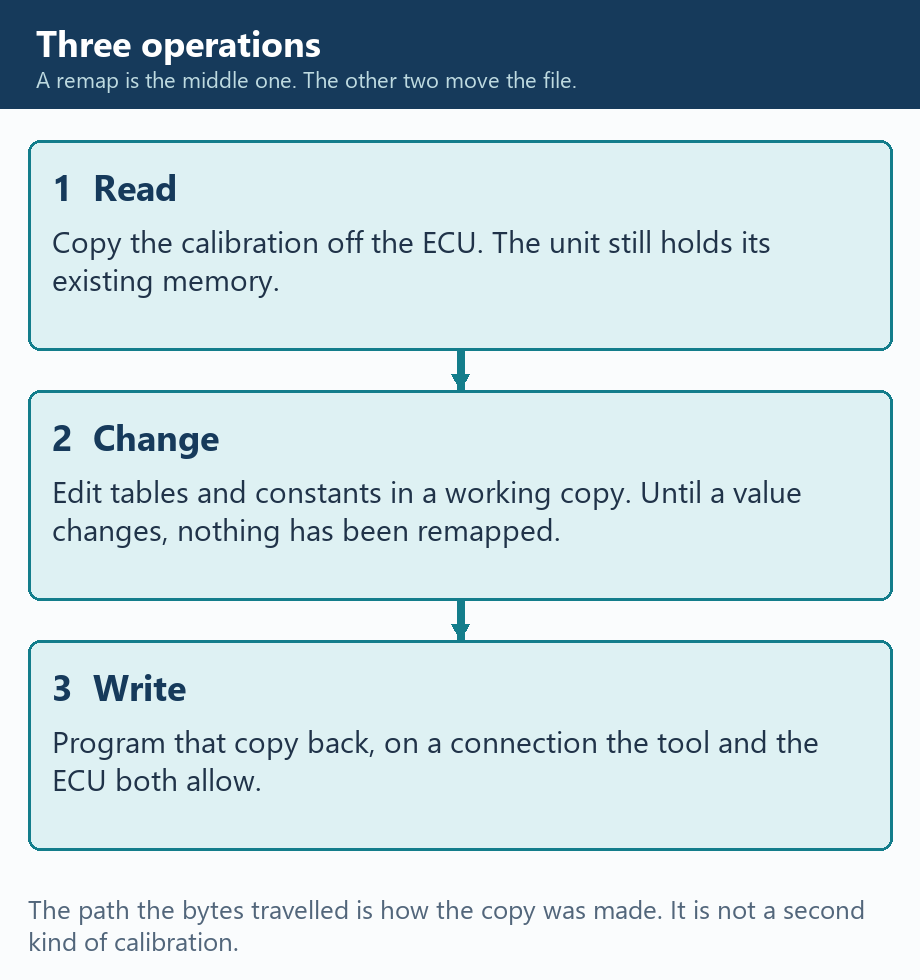
| Step | What has to be true before the next one |
|---|---|
| Record the identity | Hardware number, software number, any calibration identifier, and the vehicle they were read from. |
| Read, and keep that file | The original sits somewhere the editor cannot save over. Work on a second copy. |
| Change the working copy | The objects you meant to change are the objects that differ, and no unexplained bytes moved. |
| Correct the checksums the module supports | The file is internally consistent enough to be accepted. That is not a verdict on the calibration. |
| Write it back | The connection is one the tool and the ECU both allow, and the supply stays up for the whole transfer. |
| Verify the write, then log it | Use the verification or read-back supported by the exact tool and ECU. The log helps compare requests with measured behaviour; neither check alone proves the calibration is safe. |
The program and the calibration
The memory programmed into an engine ECU holds the lookup tables, the calibration data and the operating strategies the controller runs. That is how the US trade press described a PROM when flash reprogramming was replacing it. MOTOR, August 1998.
A remap, in the ordinary sense used on this wiki, changes the calibration the strategy looks up. Replacing the program is a different alteration, even when both travel in the same file. WinOLS searches for tables in the data and edits a defined map inside its own boundaries.
| Example: two things in the same file | |
|---|---|
| Calibration | A request, a limit, an injection or ignition table, a temperature correction, a sensor scaling. This is what a map editor is built to change. |
| Program | The strategy that reads those values and decides which of them wins. Replacing it is not a remap of the tables. |
| Why the split matters | A familiar map name is not a match. The definition has to name the addresses in this software, not in a neighbour that shares the strategy. |
Which regions a given ECU splits between program, calibration and a separate serial EEPROM is a fact about that ECU. Some reads return only a calibration area. Some return a larger image. This page does not assign a memory map to a family. The identifier in the tool, and the documentation for that software, are the source.
Why it was called chipping
The early service replaced a memory device, so the trade named the result after the device.
A one-time-programmable memory device cannot normally be erased and reused once programmed. Its storage technology depends on the part: a fuse-link PROM and a plastic one-time-programmable EPROM are not the same device. ST documents both windowed UV-erasable and plastic OTP versions of its M27C512. MOTOR describes fitting a different PROM to change the calibration on earlier controllers. The chip was the calibration. Taking one out and pressing another in was the whole method, which is why the work was called chipping and the product was called a chip.
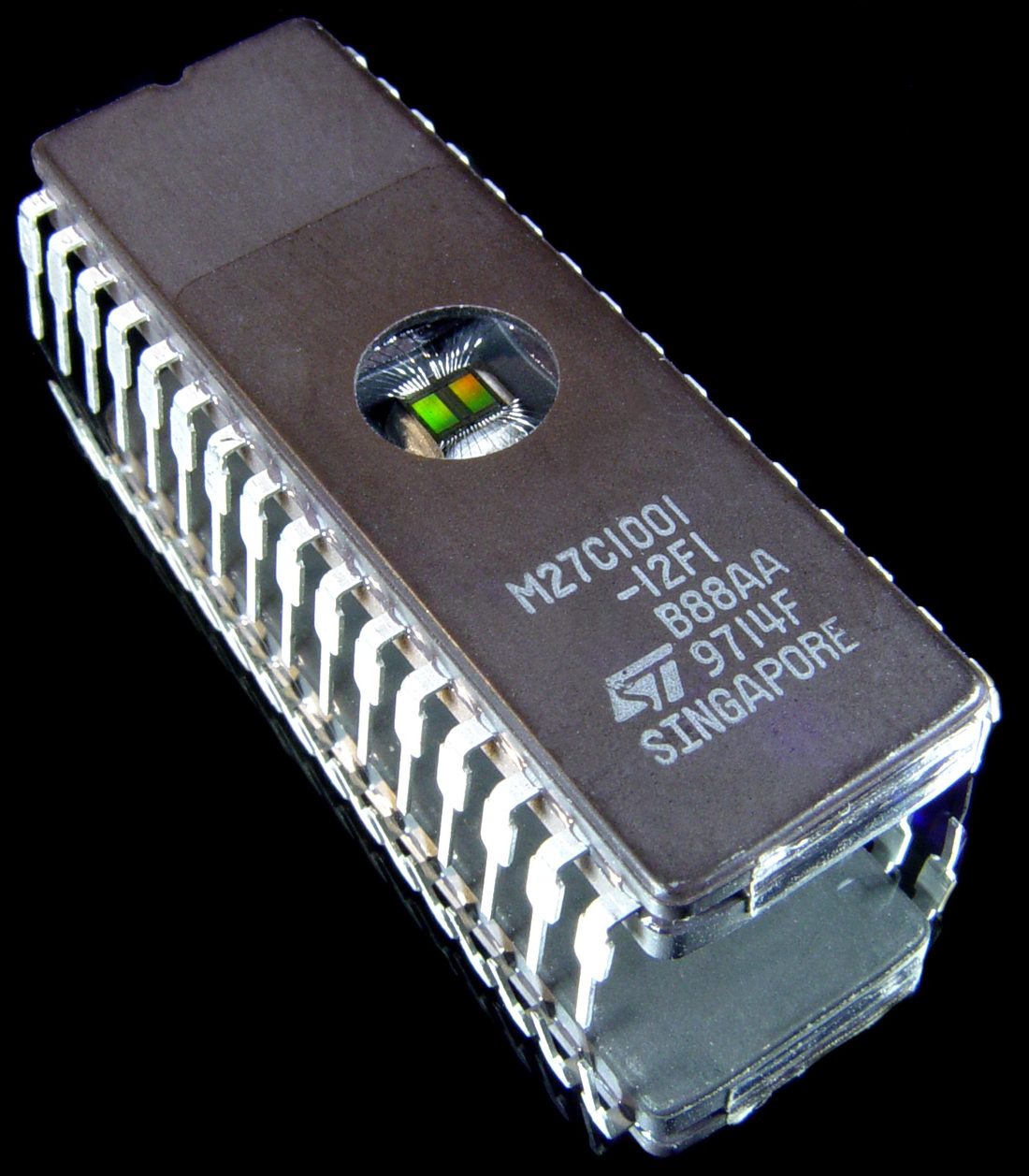

An ultraviolet EPROM can be erased and used again, and it is still a chip that has to come out of the ECU to go into a programmer. The ST M27C512 is one device of that class. The windowed ceramic package has a transparent lid. The one-time package has no such erase. STMicroelectronics, M27C512. Socketed boards made the exchange a workshop job. A soldered device made it the same job with a soldering iron. Either way the object in the programmer was a chip, and the word stuck.
Flash, and before it some EEPROMs, moved the write back into the car. MOTOR recorded in 1999 that from the early 1990s a growing number of powertrain controllers could be reprogrammed electrically through the diagnostic connector, without removing a PROM. The pass-through method keeps a computer, a scan tool and the vehicle connected for the whole transfer, and the scan tool is the gateway that carries the new programming into the flash. MOTOR, November 1999; MOTOR, August 1998. MOTOR also reported that, in the United States, carmakers were required to provide OBD-II powertrain reprogramming to independent technicians beginning in December 1997. That date is a US service rule as MOTOR stated it. It is not a date for the European aftermarket.
| Example: the word outlived the chip | |
|---|---|
| Then | A PROM came out and another went in. The chip was the calibration. |
| Now | Flash is rewritten through the connector. Every component can stay on the board. |
| What the advertisement does not say | A flash rewrite is still sold as chip tuning. Nothing in the name tells you whether a device was lifted, or whether anyone looked at a table. |
Identify the unit, then read it
The file belongs to a software identifier, not to a model name. A manufacturer flash does the same kind of check from the other direction. MOTOR's 1999 account of dealer reprogramming is that the scan tool reads the current revision before anything is programmed, so the update that is offered is the update for that revision.
| Write this down before the read | What it is for |
|---|---|
| Hardware number | The board the file came from. |
| Software number | The program a definition has to match. A familiar map name is not that match. |
| Calibration identifier | The dataset, when the label or the tool reports one. |
| The vehicle | Neighbouring software can share a strategy and not an address. |
A family guide on this wiki starts from the same place. ME7 getting started treats the original read, the part number, the software identifier and a definition matched to that exact software as the reference set.
An actual read copies the accessible data without intentionally replacing it. A virtual read supplies a matching file from a supported source rather than reading every byte from the vehicle; verify its identity and scope with the tool provider. The ECU retains its existing memory until a write or other modification changes it. Store the copy somewhere the editor cannot save over, and work on a second file. WinOLS is built around that habit: a project holds an original and later versions, and EVC still tells the user to keep a backup outside the project. WinOLS.
Taking the copy off
Programming tools group the ways of moving that copy into a few connection modes. Alientech's KESS3 documentation is a clear public statement of the three names, and other tools use the same division. The AutoTuner page on this wiki describes OBD, bench and boot for that tool. For a particular ECU the tool manual decides which of these exist. This page does not.
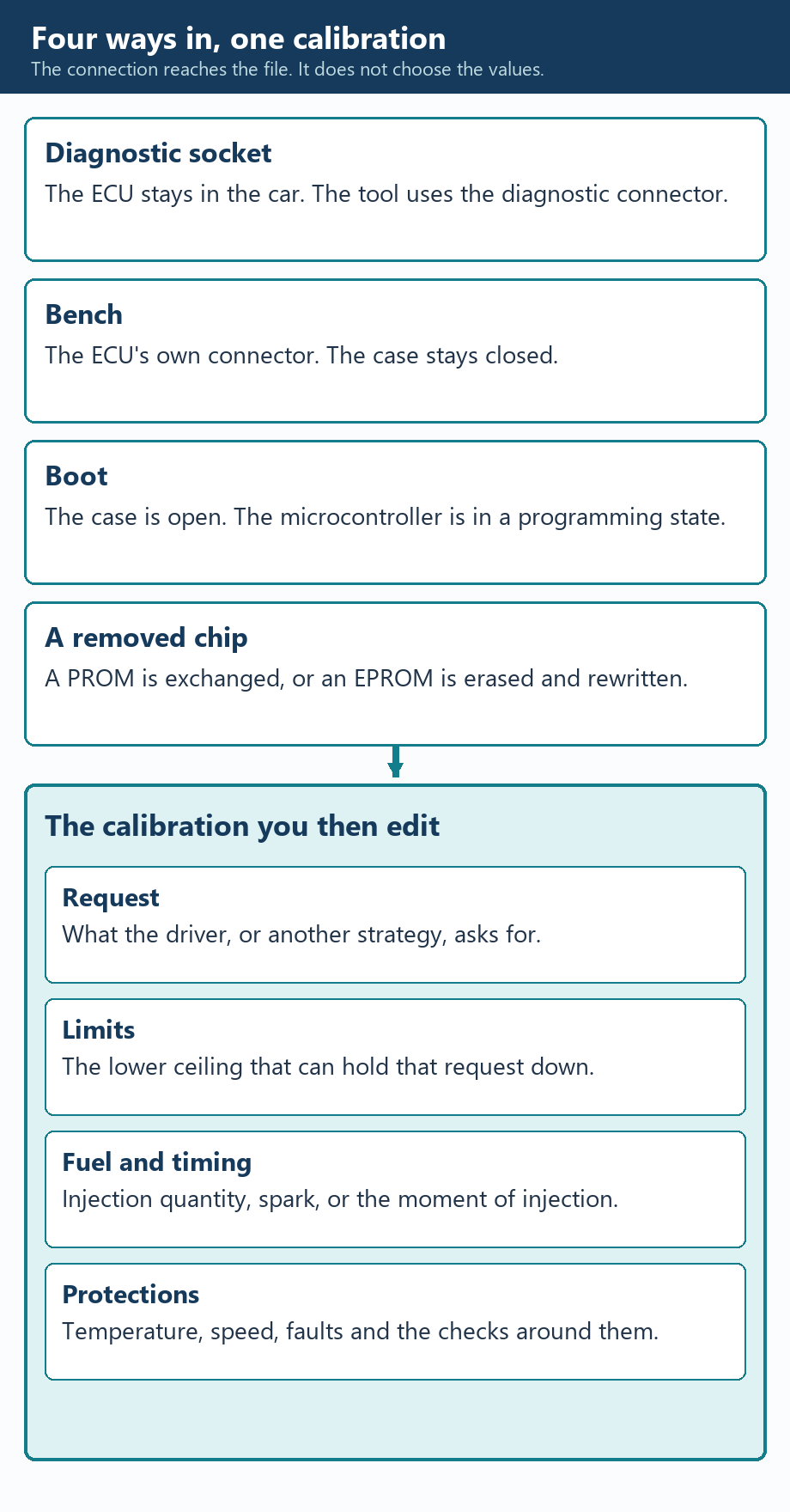
| Method | Where the tool connects | What the connection is for | What is unchanged |
|---|---|---|---|
| Diagnostic socket, usually called OBD | The vehicle diagnostic connector, ECU still fitted | A read and a write when that ECU allows programming on its diagnostic protocol. Alientech also offers this as a virtual read. | The calibration you then edit |
| Bench | The ECU's own connector. The case stays closed. The unit is powered on the bench, or sometimes from the engine bay without using the diagnostic socket. | A read and a write when the socket will not do it, when a fuller image is wanted, or when the job is cloning rather than a calibration edit. Alientech describes bench access as more complete than OBD. | The calibration you then edit |
| Boot | An opened ECU, on the board, with the microcontroller in a programming state | Memory the other paths will not give, and recovery of a unit that no longer answers on those paths. Alientech describes this as access to the internal memories. | The calibration you then edit |
| A removed memory device | The chip in a programmer | The historical method: replace a PROM, or erase and rewrite an EPROM. | The calibration written into the new device |
Alientech's own comparison is about the vehicle and the operation, not about a better map. Their FAQ answer to which mode is better is that it depends on the vehicle and the operation: OBD is faster and leaves the unit in the car, bench is direct access without opening the ECU, boot is full access with the unit open. Alientech FAQ; Alientech, connection methods.
Through the diagnostic socket
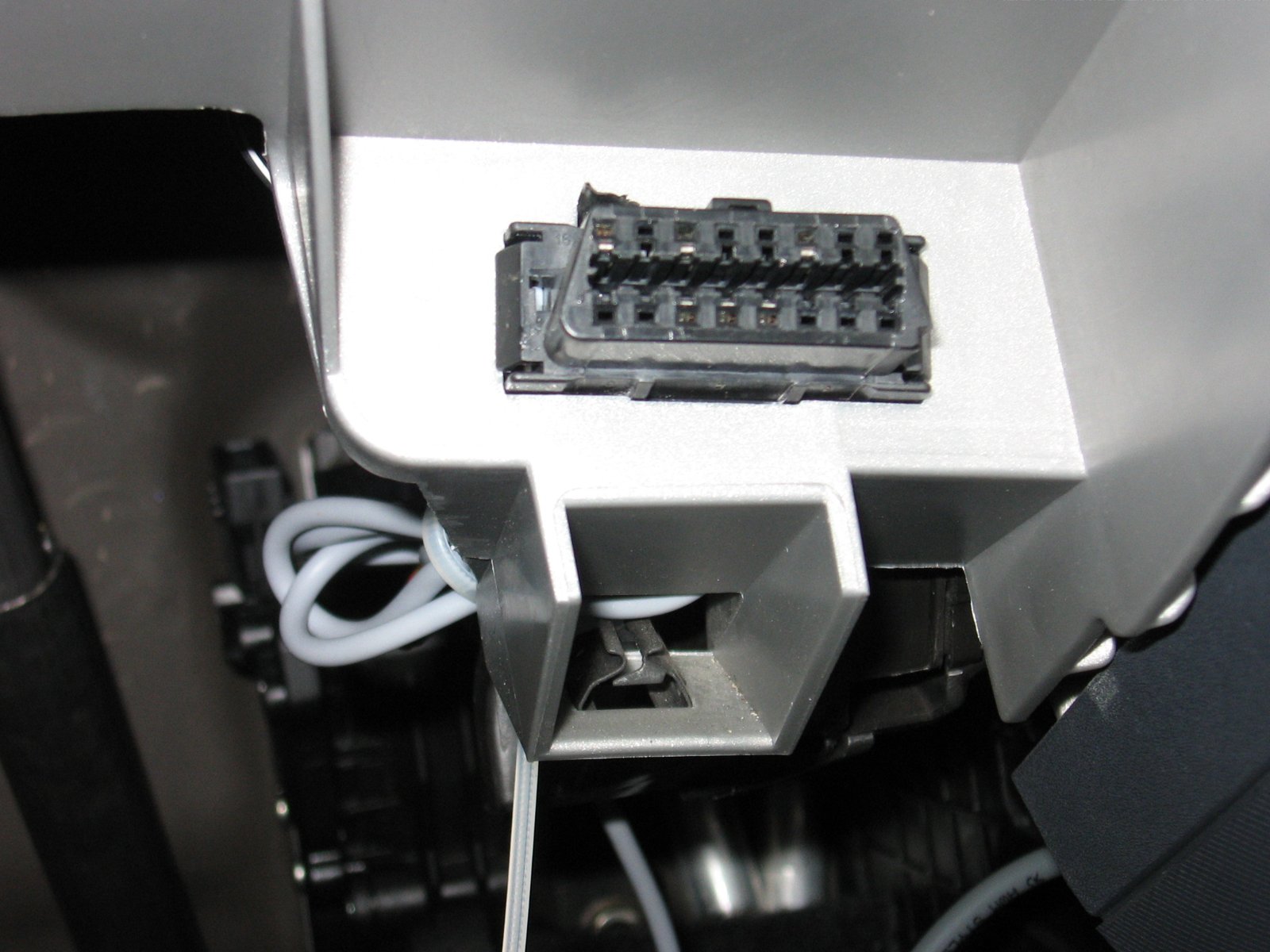

The download is a programming session on whatever diagnostic protocol that ECU speaks. The tool has to know that session. A code reader that only displays stored faults is not that tool. MOTOR's description of pass-through reprogramming is a computer and an interface staying connected for the whole transfer, with the new contents going in through the diagnostic connector. Alientech's OBD manuals, as they describe them, call for the precautions for that vehicle, including a stabilised supply. A supply that collapses mid-transfer is a failed write. It is not a judgement on the maps.
Some ECUs accept a download only after a programming authorisation. That authorisation is an access control in the protocol. It is not a calibration, and this page does not describe it.
On the bench
Bench mode, in the tool makers' usage, powers the ECU and talks to it through its connector instead of through the car. The case is not opened. Alientech describes the result as a more complete read and write than OBD, used when the diagnostic port cannot do the job, when the transfer needs a more stable supply, or when the operation is a clone of the unit. The wiring is specific to the connector. Using the wrong pins is how ECUs are damaged. The pinout belongs in the tool manual for that ECU, not here.
| Example: a programming bench is not a dyno | |
|---|---|
| Programming bench | Powers the ECU and reads or writes its memory. It measures nothing about the engine. |
| Engine test bench, or a chassis dyno | Measures a running engine. It does not, by itself, read a flash or change a file. |
| Where the two jobs meet | Someone edits the calibration from what the engine did, then writes that file. The dyno is the measurement. The write is still a write. |
Boot mode
Boot mode opens the unit and talks to the microcontroller in a programming state, so the normal diagnostic software does not have to be running. Alientech describes it as the way to reach the internal memories, including recovery of a locked or damaged unit, and some applications need a soldered connection. Their connection-methods page also calls this "work like a true tuner". That sentence ties a connection to the quality of the calibration. The connection reaches memory. It does not choose a torque limit, a smoke limit or an ignition angle.
Opening an ECU, probing a board and soldering to it are ways to destroy a unit as well as ways to read one. The procedure for a given board is the procedure in that tool's manual, followed with the supply and the handling that manual requires. It is not a style of tune, and it is not repeated here.
A virtual read and a full image
Here the files can differ, and the difference is still not a different calibration. Alientech's OBD mode includes a virtual read. Their bench and boot modes are described as reading the content of the unit, including a full read. The KESS3 page on this wiki states the same limit: a virtual read is not a full physical backup.
| The read you hold | What you can edit | What you can restore |
|---|---|---|
| Virtual or partial | The calibration the tool knows. That can be enough to change a smoke limit and write it back. | Only the regions that read contained. A later failure in a region the file never held cannot be put back from it. |
| A fuller image | The same calibration, plus more of the unit. | The regions the short file never held, which is why this is the backup. |
A full image can also contain regions that are not the engine calibration. Coding, immobiliser data and learnt adaptations sit, on some units, outside the tables a remap is meant to change. Copying those regions into another unit is cloning. Alientech lists cloning as its own operation, available on the bench and boot paths, separate from loading a file into the editor. A calibration edit does not require a clone, and this page does not describe cloning.
Two reads of one ECU can therefore differ in length. Inside both, the calibration tables are the calibration tables. Editing a smoke limit in the first file does not make it an OBD smoke limit. Editing the same limit in the second file does not make it a bench smoke limit. There is one limit, stored as numbers, reached by two cables.
The cable is not the recalibration
Recalibrating starts after the file is on the computer. Until a table, a scalar or some other calibration constant changes, nothing has been remapped. A successful read is a copy. The original calibration is still the one in the ECU, and it is still the one in the file.
| Example: one smoke limit, two cables | |
|---|---|
| Through the diagnostic socket | The file may be short. The smoke limit inside it is still the smoke limit. |
| On the bench | The file may be longer. Raising that same limit does not create a different, bench-grade limit. |
| What the engine stores | The numbers that were written. Where OBD can transfer the calibration you edited, and bench can transfer the same calibration, the engine has no way to know which plug was used. |
| When one path fails | Where a path cannot write the region you edited, the write has not landed. That is an access failure, not a higher grade of tune. |
Selling the copy as a "bench tune" or an "OBD tune" prices the access, the time, or the completeness of the backup, and presents the price as a grade of calibration. Alientech's FAQ does not claim that a map written on the bench is a better map. It claims that the available connection depends on the vehicle and the operation.
The same point covers the old chip. A windowed EPROM with a carefully chosen fuel table, and a flash image with that same table written through the diagnostic socket, are the same calibration presented in the memory the ECU happens to have. The chip was the transport of its decade. The socket is the transport of this one.
Recalibrating the copy
Open a working copy in an editor and find the objects the strategy actually uses. A definition, a map pack or an A2L-style description names addresses, dimensions, scaling and units. It has to be the description for this software. The editor directory separates a hex view, which shows the bytes, from a map view, which interprets bytes that a definition has claimed. An automatic search, such as EVC's map search in WinOLS, proposes candidates. EVC's own guidance is that a plausible shape still has to be checked for address, dimensions, byte order, axes and scaling. A smooth surface is not a name.
The edit is then a change to those values. The usual groups are the driver request, the air path, the fuel, the ignition or injection timing, and the protections that sit over them. ECU remapping sets those groups out. They are not a universal list of map names, and a name from an ME7 file is not an address in an EDC17 file.
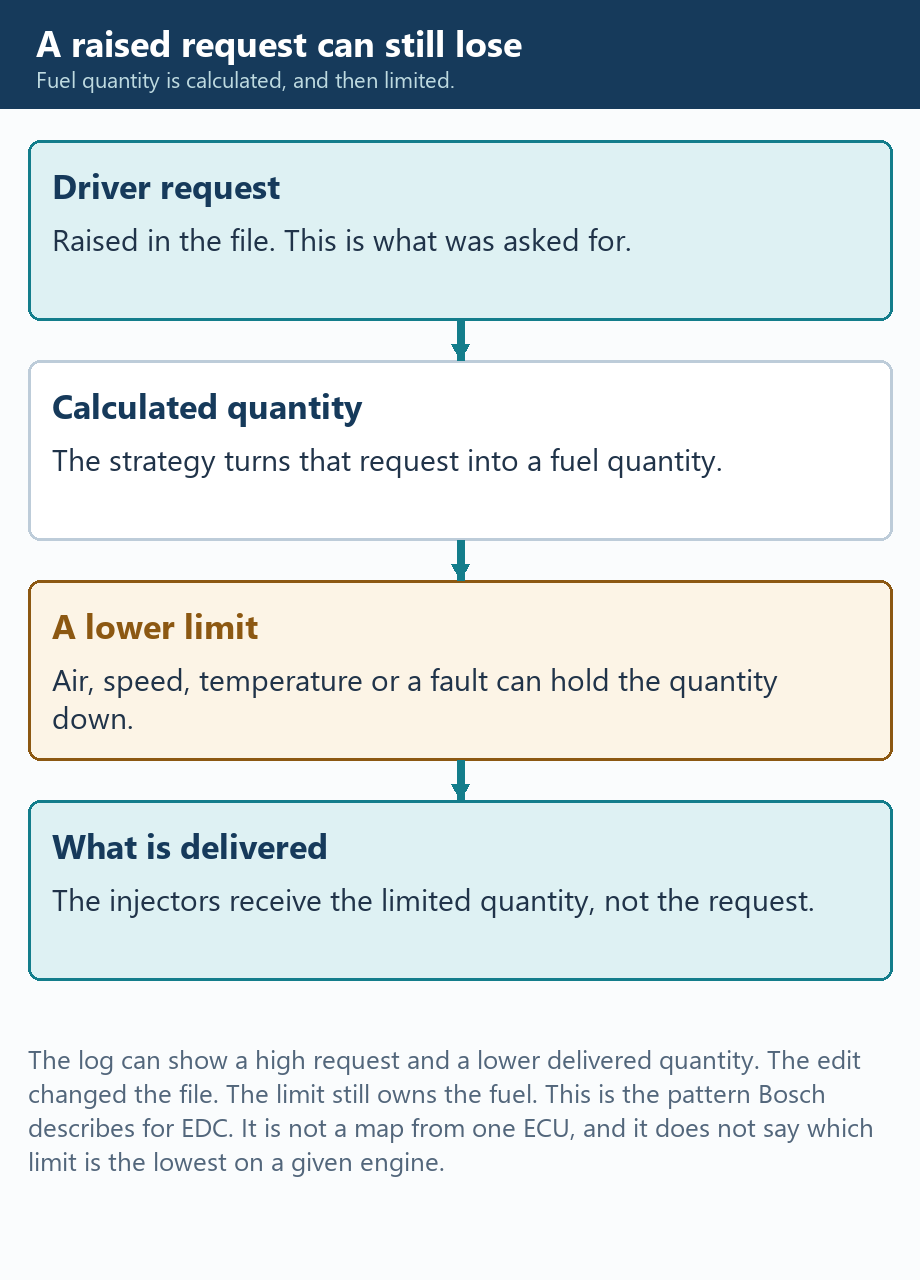
| Example: the request the engine does not use | |
|---|---|
| What changed in the file | The driver request, or the fuel quantity asked for at full pedal, was raised. |
| What Bosch's EDC account does next | It calculates a fuel quantity and then limits it. Air, speed, temperature or a fault can hold the quantity below the request. |
| What the engine does | It stays on the lower limit. On a diesel that air limit is the smoke limit, described in diesel smoke limits. The pattern is the limit that wins. |
| The same miss, with hardware | A different turbo, injector, camshaft or compression ratio changes the engine the tables describe. The strategy keeps the old description until the calibration is brought into line with the hardware. Which changes matter is the hardware list in ECU remapping. |
Before a write, compare the edited file with the untouched original. The comparison should show the tables you meant to change, and no others. A changed byte in a region the definition does not name is a reason to stop. WinOLS keeps versions for that comparison. EVC also documents scripts and map packs that transfer structure or values from an older project, and says the transferred result has to be checked against the destination, because a neighbouring software revision can differ. A script is a fast way to repeat a known edit. It is not a reason to skip the comparison.
The file you export has to be the file the programmer expects. WinOLS can import and export binary, Intel HEX and Motorola HEX. The wrapper is the programmer's packaging. Two wrappers of the same bytes are not two tunes.
What a checksum proves
The ECU stores integrity values computed over ranges of its memory and rejects, or refuses to run, an image whose values do not match. Editors and programming tools can recompute those values for the files a module supports. EVC's checksum path is a dialog in WinOLS and a separate module, sometimes found by sending the project to EVC's server, and some modules require the unmodified original to be present. EVC, checksums.
| Example: a consistent file can still be the wrong calibration | |
|---|---|
| What a corrected checksum means | The ranges that module covers are internally consistent enough for the ECU to accept the file. |
| What it does not mean | That a smoke limit, a boost ceiling or an ignition table is appropriate, or that every integrity mechanism in that ECU was covered. |
| What to do anyway | Do not assume the editor or the flasher will correct every file. Confirm which one does it for this software, and keep the original. The editor directory says the same thing. |
This page does not describe how any checksum is calculated.
Writing it back
The write uses a connection the tool and the ECU both allow. That is often the connection used for the read, and it is not a rule that every file can move from one connection to another. A virtual read and a full image are different objects. The programmer's instructions for that ECU say which object it will write, and by which mode.
Keep the supply stable for the whole transfer, and keep the tool connected for the whole transfer. That is the practical content of MOTOR's pass-through description and of Alientech's warning that the OBD procedure has vehicle-specific precautions. An interruption can leave a partial image. Recovery then depends on whether that ECU will still answer, and on whether you hold a backup it can be restored from. A virtual read that never contained the missing region cannot restore it. Boot mode exists in part for units that no longer answer. Needing it is a consequence of the failed transfer or of a unit that was already not programmable the other way. It is not evidence that the calibration was more serious.
Where the tool can read the unit after the write, compare that read with the file you intended to program. The tool's success message reports the transfer as the tool saw it. A comparison of the bytes is the stronger check. Then, and only then, the original file is still the way back.
Checking the result on the engine
A file that matches the write is a file in memory. It is not yet a shown result. Start from a unit that identifies as the software you wrote, with no fault that the transfer itself caused, and log the thing the edit was supposed to change.
| Example: a higher request the log never reaches | |
|---|---|
| Log these against each other | The request, and what was delivered: boost or manifold pressure, fuel quantity or lambda, ignition or injection timing, knock correction, exhaust temperature. |
| Request up, delivery unchanged | A lower limit, or the hardware, is still in the way. Logging a drivability complaint is the checklist. ME7 getting started is one family example of changing one system at a time and judging it from the log. |
| The first drive | Fuel, boost and quantity adaptations can move the result after the file is written, and they can keep a correction learnt on the previous calibration. Adaptations and calibration drift. A single full-load pull also says nothing about idle, tip-in, a hot charge-air temperature or the return from overrun. Those are the same calibration, under drivability. |
Knock control and smoke limiting are protections inside that log. Knock control retards after knock has been detected. It is not a substitute for an ignition table that was chosen for the fuel and the compression. The mechanism is in engine knock.
When a person does not make the edit
The three operations survive when the workshop does not edit a map. Someone, or a program, still has to change the copy before the write. The question is who looks at the change.
| Example: the person at the car did not choose the map | |
|---|---|
| Slave, at the car | Reads the ECU, sends that read to its Master, and writes the file that comes back. Alientech's FAQ describes this as starting without handling map modification. The returned file is described as encrypted and ready to use. |
| Master, somewhere else | Reads, modifies and writes, and can supply files to a Slave network. The calibration decisions happen here. |
| An automated module | Applies its publisher's solution, or raises every object it has recognised by a fixed percentage. It will do what it was built to do, including to an object that should not have moved, and including past an object it did not recognise. |
Alientech sells the split as two products. Alientech, KESS3; Alientech FAQ. The editor directory lists programs that apply their publisher's solution to a file and do not themselves read or write the ECU.
Using that tool is a normal way to avoid repeating a mechanical edit by hand. The file is a calibration of this engine only when the changes have been checked against this original, this software and this hardware, and then against a log. A ready-made file for a stock car of exactly that software can be a careful calibration. It is a careful calibration because of the work that was done when it was made and because the car matches, not because a portal returned it. The ways this is sold as something it is not are in common misconceptions about remapping.
What to keep with the file
| Keep | Why it is the way back |
|---|---|
| The unmodified original, stored outside the editor project | A later fault can be tried against it. Some checksum modules also require it. |
| Hardware number, software number, calibration identifier, and the vehicle | A definition has to match this software, not a neighbour. |
| The tool, the connection, and whether the read was virtual, partial or a fuller image | A short file cannot restore a region it never contained. |
| The edited file, and a note of which objects were meant to change | The comparison has something to be checked against. |
| The comparison itself | It should show those objects, and no unexplained bytes. |
| The log | Request, delivered result, and the limit that was actually in force. |
That set is what makes the job repeatable. The original file is a real original only if the read that made it was complete enough to restore the unit.
Sources
- MOTOR, Trouble Shooter, August 1998. One-time-programmable PROMs replaced as a unit; lookup tables, calibration data and operating strategies stored in the device; flash erased and rewritten electrically; pass-through programming through the diagnostic connector with the computer, the interface and the vehicle connected throughout; MOTOR's statement that US carmakers had to provide OBD-II powertrain reprogramming to independent technicians beginning in December 1997. PDF of the column. Accessed 2026-11-12.
- MOTOR, To Flash or Not to Flash, November 1999. Early-1990s EEPROM and flash reprogramming through the diagnostic connector without removing the device; pass-through and download methods; the scan tool identifies the current revision before programming. Accessed 2026-11-12.
- STMicroelectronics, M27C512 datasheet. Distributor PDF mirror. A 512 Kbit EPROM in UV-erasable and one-time-programmable versions. The windowed ceramic package has a transparent lid so ultraviolet light can erase the pattern before a new pattern is written. Accessed 2026-11-12. The photograph on this page is a related ST part, the M27C1001, not this device.
- Mister rf, M27C1001 photograph, 20 October 2018. Wikimedia Commons, CC BY-SA 4.0. Reduced for display. The window and the ST marking are visible on the device. Accessed 2026-11-13.
- M. Minderhoud, 16-pin diagnostic socket, 1 November 2006. Wikimedia Commons, CC BY-SA 3.0. Reduced for display. Accessed 2026-11-13.
- Alientech, KESS3 connection methods. OBD, including virtual read, from the diagnostic port; bench on the connector without opening the unit, described as more complete access; boot with the unit open for the internal memories and for recovery. Accessed 2026-11-12.
- Alientech FAQ. Which connection is appropriate depends on the vehicle and the operation. Master reads, modifies and writes. Slave sends the read to a Master and writes the returned file, described as starting without handling map modification. Accessed 2026-11-12.
- Alientech, KESS3. Master and Slave configurations. The Slave writes encrypted, ready-to-use files received from the Master. Accessed 2026-11-12.
- EVC, WinOLS; automatic map search; checksums; reusing projects, map packs and scripts. Map candidates are not identified maps. Checksum modules correct supported integrity values and can require an original file. Scripts and imported maps have to be checked on the destination software. Accessed 2026-11-12.
- Bosch, Electronic Diesel Control (EDC). Independent PDF mirror. Fuel quantity is calculated and then limited. Accessed 2026-11-12.
- ECU remapping, tuning software directory, KESS3 and AutoTuner. This wiki. What the calibration changes, how editors differ from programmers, and the connection modes already recorded for those tools.
- The three process diagrams are original drawings for this article, made from the sources above. They are not photographs of a tool, a file or an ECU.