Lomax is a British kit car: a retro-styled, two-seat glass-fibre body that bolts to the floorpan, engine and running gear of a Citroën 2CV or Dyane. It was built as a three-wheeler (the 223) and a four-wheeler (the 224), and its styling loosely recalls the Morgan three-wheelers of the 1930s. Lomax kits were made from 1982 by a succession of small firms. No company is known to be producing them in 2025–2026. The last manufacturer, Cradley Motor Works Limited, was dissolved in January 2019, and the Lomax Cars web domain now shows only a holding page.
History and status
The Lomax was introduced in 1982 by the Lomax Motor Co. of Willoughton, near Gainsborough, Lincolnshire. It is attributed to Nigel Whall. In the late 1980s production moved to the Mumford Motor Co. at Gigg Mill, Nailsworth, Gloucestershire. From the early 1990s Cradley Motor Works built it, first at Cradley Heath in the West Midlands and later at St Leonards-on-Sea, East Sussex, where it was still being made in 2009. One enthusiast history says Whall passed full control of the company to David Low in 1994. That claim is single-source and unverified. Kits were also sold in the Netherlands and Germany from the early 1990s.
The registered company Cradley Motor Works Limited (number 05019408) was incorporated on 19 January 2004 and listed vehicle manufacture as its business. Its registered office was 195 Bexhill Road, St Leonards-on-Sea, and its directors were members of the Bousell family. It was dissolved on 15 January 2019. Production had probably stopped some years earlier. A classic-car magazine says the car was still made as recently as 2014, and an enthusiast index gives 2016 as the end of the brand. An undated owner-forum report says the person holding the moulds and rights judged there was too little demand to make new kits profitable, but might make parts to order. No successor manufacturer has been identified.
Models
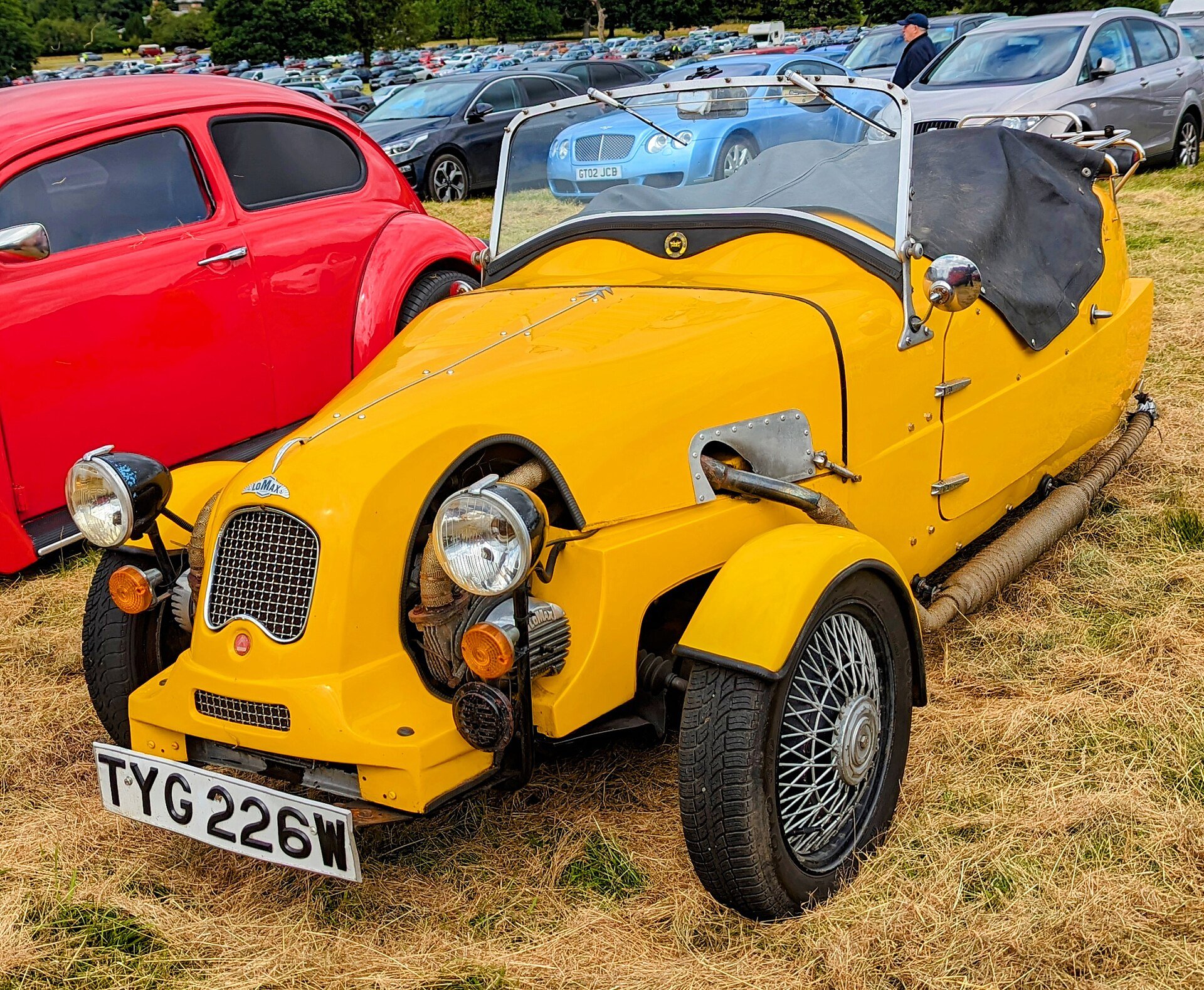

Lomax model numbers give the number of cylinders, seats and wheels, in that order.
| Model | Description | Engine |
|---|---|---|
| 223 | Two-seat three-wheeler. Early “three-wheelers” were actually four-wheelers with the two rear wheels set close together. Later cars were true trikes with two wheels at the front, which qualified for the lower UK three-wheeler road tax. | 2CV / Dyane flat twin |
| 224 | Two-seat four-wheeler on an unmodified 2CV chassis | 2CV / Dyane flat twin |
| 424 | Four-wheeler; few were built | Citroën GS or GSA air-cooled flat four |
| Lambda 3 / Lambda 4 | Rounder, restyled versions of the 223 and 224 | 2CV / Dyane flat twin |
| Supertourer | Four-wheeler styled like a 1930s tourer; kept the 2CV cooling fan and heat exchanger | 2CV / Dyane flat twin |
The body normally sits on an unmodified 2CV or Dyane floorpan. A steel tube chassis was offered later as an alternative. The 1982 prototype used a bespoke short-wheelbase four-wheel chassis with parts from the Citroën Ami. A typical car weighs about 430 kg and reaches about 140 km/h (87 mph) with the 602 cc engine.
Engines and engine management
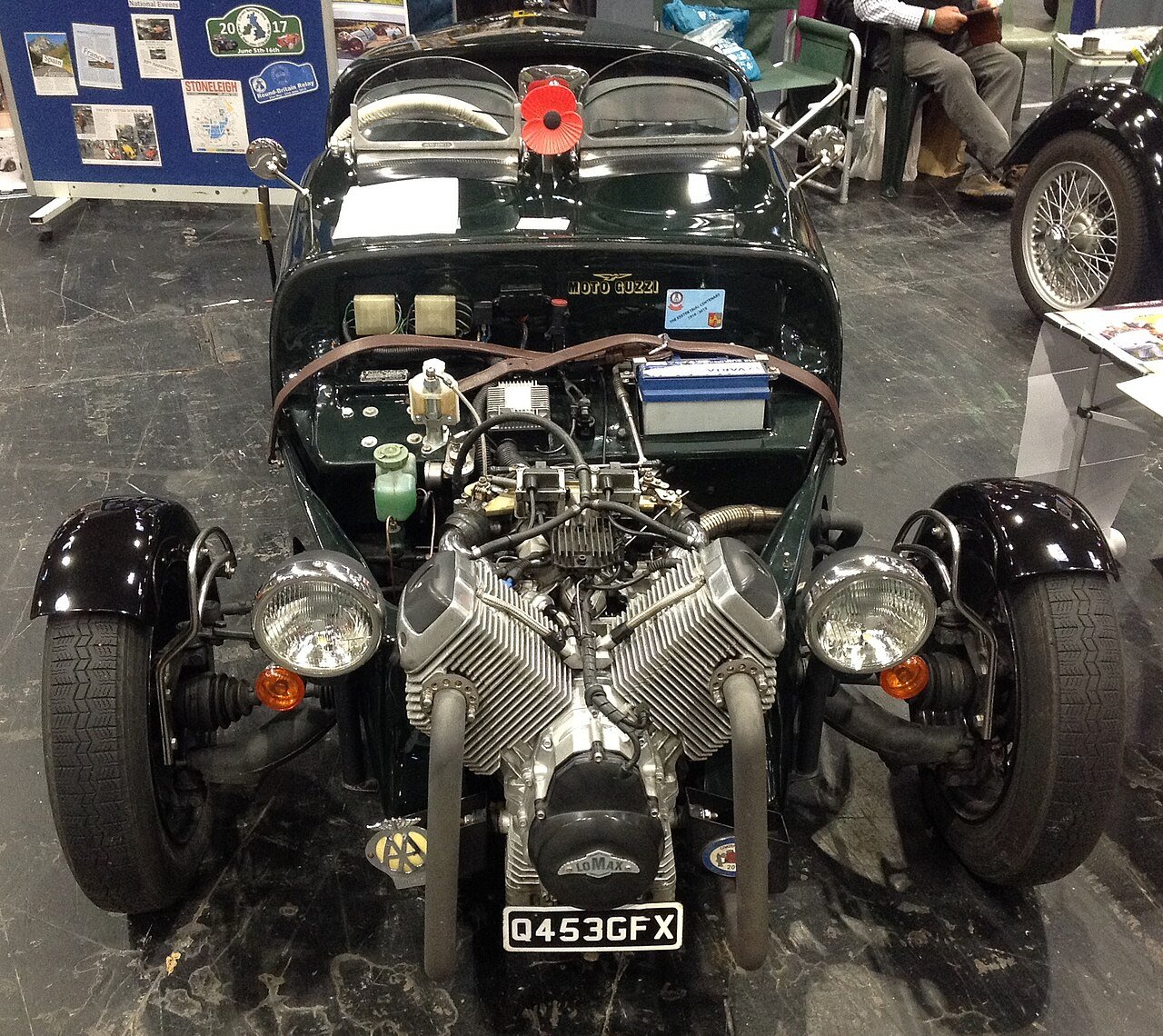
Lomax cars use the donor car's Citroën air-cooled engine and four-speed front-drive gearbox. Most have the 602 cc flat twin, rated at 29 hp in final 2CV form. Some have the smaller 2CV engines (425 or 435 cc), and the 424 used the GS or GSA flat four. The 2CV twin has a single carburettor and a distributor-less wasted-spark ignition with contact breakers and speed-controlled timing, without vacuum advance. No Lomax specification included electronic fuel injection or an ECU, so there is no factory engine-management system to tune. Owners have fitted other engines, including Moto Guzzi motorcycle V-twins, but these are individual conversions.

Not established
- Who now holds the Lomax moulds and rights, and whether any parts are still made.
- The exact year production ended, and total production.
- The ownership changes between Lomax Motor Co., Mumford and Cradley Motor Works.
Sources
- Lomax (kit car), English Wikipedia (cites Georgano, Beaulieu Encyclopedia of the Automobile, 2000, and the archived Lomax Cars “Meet the Lomax Family” page). Accessed 19 November 2026.
- Cradley Motor Works Limited, company number 05019408, and officers, Companies House. Accessed 19 November 2026.
- lomaxcars.co.uk (domain holding page, “coming soon”). Accessed 19 November 2026.
- Lomax, 3-wheelers.com (enthusiast index; ownership passing to David Low in 1994). The page refused direct access; its content was read through a search-engine summary. Accessed 19 November 2026.
- Lomax thread, Mad About Kit Cars forum (owner report on the moulds and rights; undated). The page now returns an error; its content was read through a search-engine summary. Accessed 19 November 2026.
- The Lomax 3-Wheeler: exporting a kit car, AutoShippers. Accessed 19 November 2026.
- Lomax article, Classics World (production to 2014). Read through a search-engine summary because the site refused direct access. Accessed 19 November 2026.
- Lomax (United Kingdom), AllCarIndex (enthusiast index; brand dates 1983–2016). Read through a search-engine summary. Accessed 19 November 2026.
- Citroën 2CV, English Wikipedia (engine outputs and ignition). Accessed 19 November 2026.
- Photographs from Wikimedia Commons, credited in each caption: 1981 Citroen Lomax and Lomax Moto-Guzzi Citroën Special. Accessed 19 November 2026.