Production: 1992–1994 (275–282 production cars built at Bloxham, Oxfordshire by JaguarSport / TWR). Model and production reference.
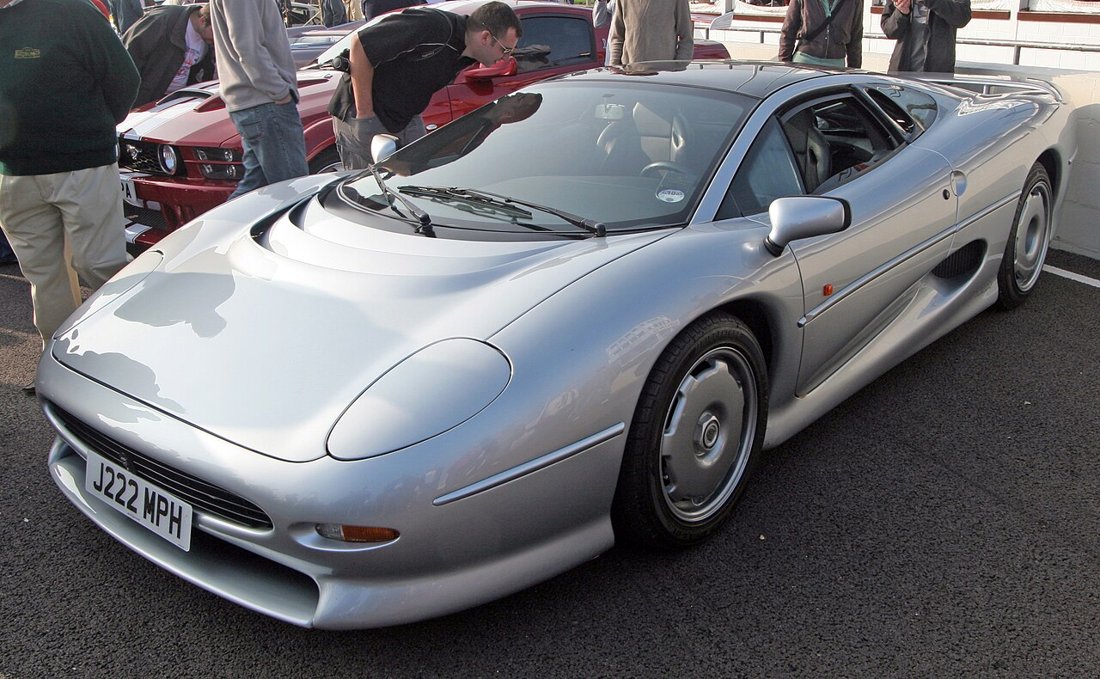

Conceived in the late 1980s by Jaguar's "Saturday Club" engineering team under Jim Randle and developed for production with Tom Walkinshaw Racing (TWR) under the JaguarSport joint venture, the XJ220 became the fastest production car in the world in 1992 after Martin Brundle recorded 217.1 mph (349.4 km/h) at the Nardò Ring. Wikipedia: Jaguar XJ220; JLR Archive: 20 years of XJ220.
Concept vs. production specifications
| Attribute | 1988 Birmingham Motor Show concept | 1992–1994 production XJ220 (plus XJ220S TWR) |
|---|---|---|
| Chassis & body | Bonded aluminium honeycomb, scissor doors | Bonded aluminium honeycomb chassis, aluminium body panels (carbon composite on 6 XJ220S road cars) |
| Engine | 6.2-litre naturally aspirated Jaguar V12 (4-valve, quad-cam) | 3.5-litre (3,498 cc) twin-turbocharged DOHC 24v JRV-6 V6 (derived from Austin Rover V64V Metro 6R4 architecture via TWR) |
| Induction & management | Multi-point injection | Twin Garrett T3 turbochargers with twin air-to-air intercoolers; Zytek electronic engine management |
| Output | ~500+ bhp (concept estimate) | 542 bhp (404 kW; 550 PS) @ 7,200 rpm; 644 N⋅m (475 lb⋅ft) @ 4,500 rpm (680 bhp on XJ220S TWR) |
| Drivetrain | All-wheel drive | Rear-wheel drive, 5-speed FF Developments transaxle manual |
Sources and related pages
- Wikipedia: Jaguar XJ220 — development, Nardò speed record and production history.
- JLR Archive: Marking 20 years since the launch of the Jaguar XJ220.
- Jaguar: history and cars and Illustrated turbocharged-car timeline.