Engine types and cycles · Two-stroke engines
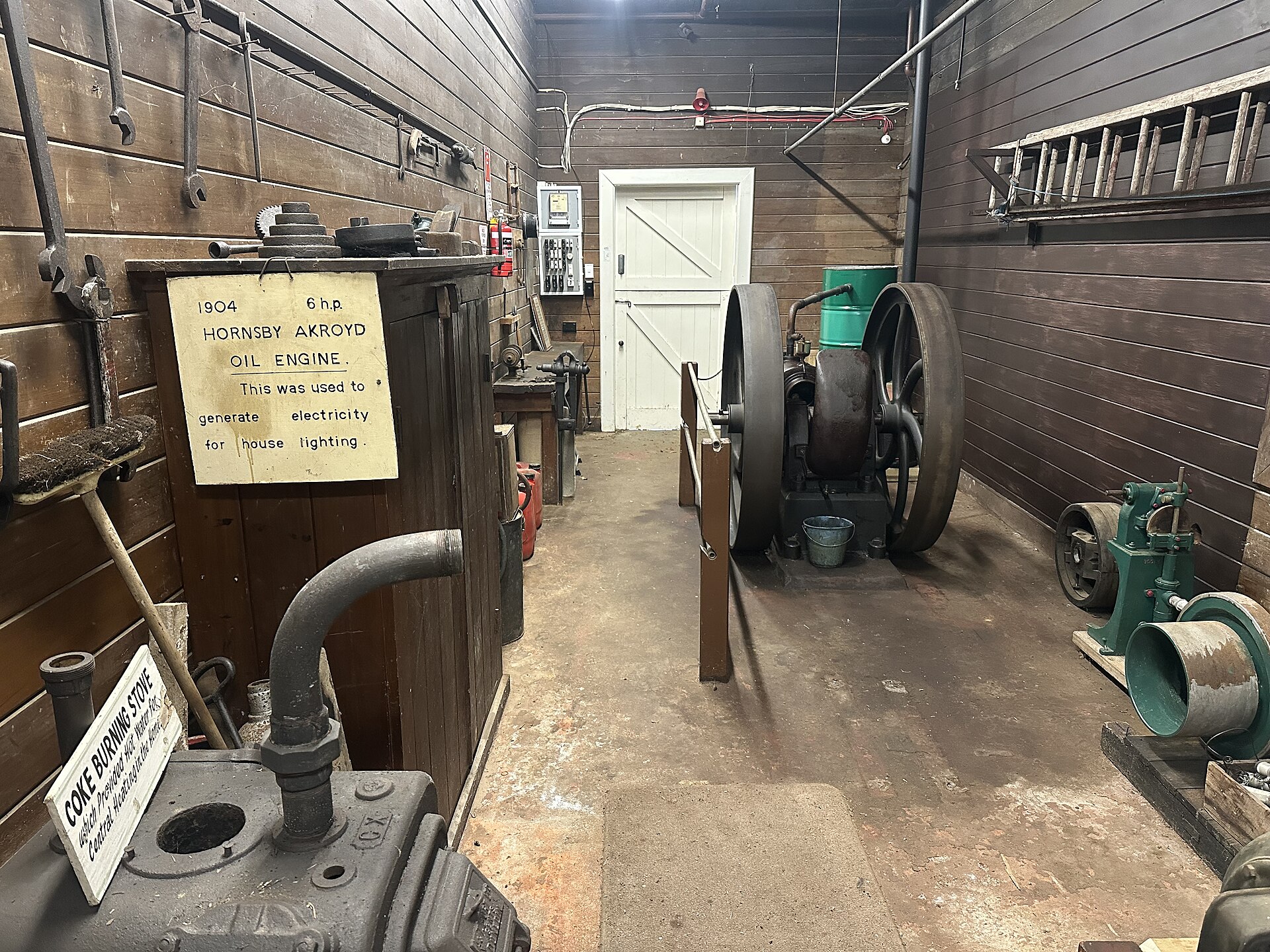

An early compression-ignition engine. A hot bulb in the head ignites the fuel. Compression is about 3:1 to 5:1, against a diesel’s typical 15:1 to 20:1 on the same article, and the fuel is injected early, around 140 degrees before top dead centre. A diesel injects near the top of the stroke and ignites from the heat of the compressed air alone.
| Use | Stationary oil engines where there was no gas supply, then farms and boats. Later two-strokes were built by Mietz and Weiss in the United States, using Joseph Day’s scavenging, and in Sweden by J. V. Svensons, Bolinders, Lysekils and AB Pythagoras. The photograph is a 1904 Hornsby-Akroyd. |
|---|---|
| First | Herbert Akroyd Stuart’s prototypes, 1886. British patent 7146, May 1890. Richard Hornsby & Sons of Grantham started production in 1891. Rudolf Diesel’s engine followed in 1892. |
| Widest use | Agricultural and marine work into the 1950s. Diesels improved from about 1910. Hot-bulb engines stayed slow: most had a maximum of about 100 rpm, against about 2,000 rpm for high-speed diesels of the 1930s. Landini tractors needed up to about 20 litres for modest power. |
| Now | The last large-scale manufacturer stopped in the 1950s. The article calls the type virtually extinct in commercial use except in remote areas, with original engines still on some European barges and narrowboats, including the Cadbury Bournville I and II, 15 hp Bolinders of 1911. |
Sources
Curated reference notes. Hardware testing by this wiki is not implied. Wikipedia text is adapted from the cited revisions under CC BY-SA 4.0.
- Hot-bulb engine, rev. 1381948942, 2026-10-25.
- History of the internal combustion engine, rev. 1377939080, 2026-10-02. Diesel, 1892.