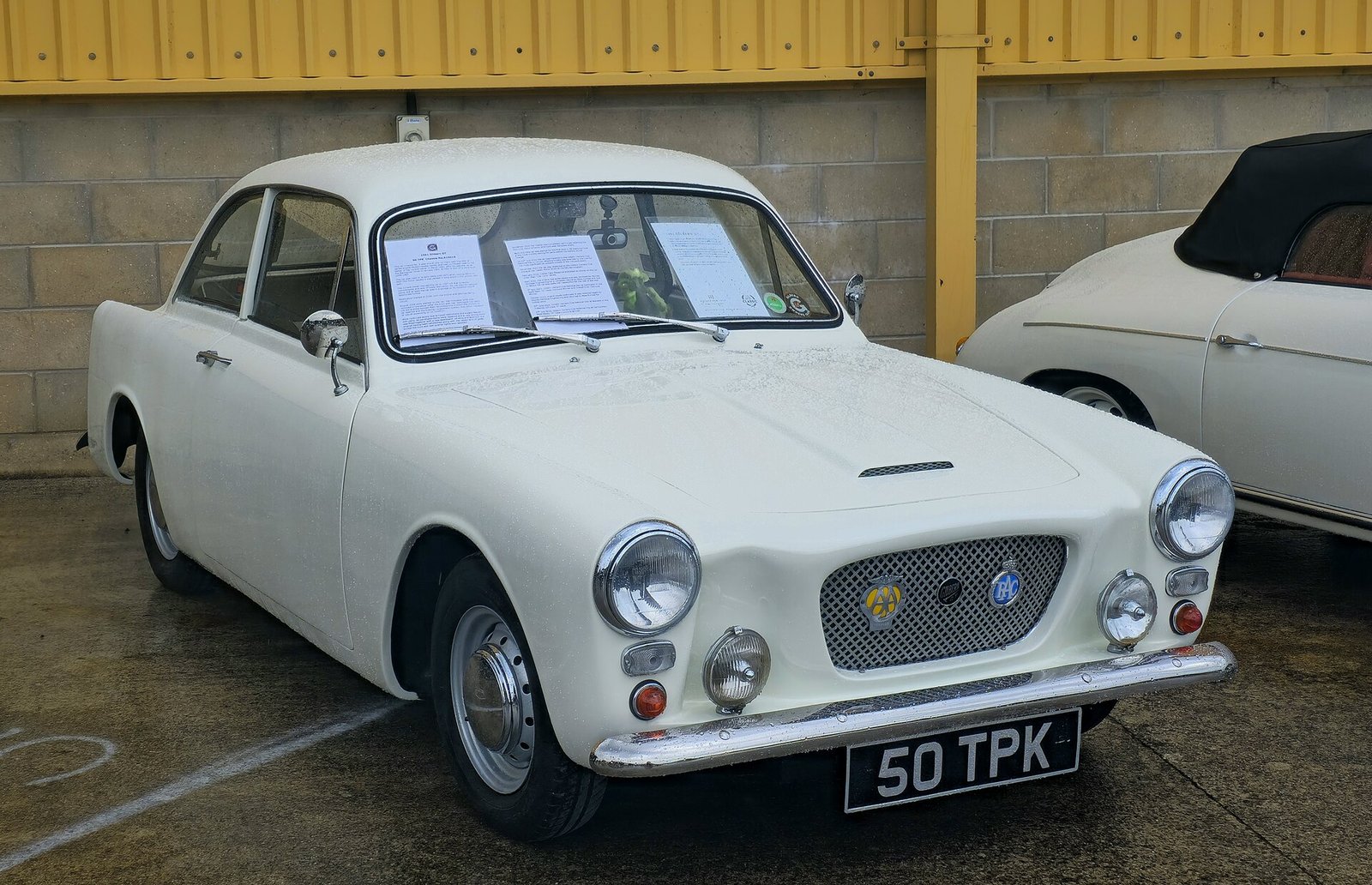
Gilbern was a Welsh car maker that built glass-fibre-bodied GT cars near Pontypridd from 1959 to 1974. The name combines the first syllables of its founders' names, Giles Smith and Bernard Friese. The company started behind a butcher's shop in Church Village and moved in 1961 to a factory on a former colliery site at Llantwit Fardre. It built just over 1,000 cars in three model lines: the GT, the Genie and the Invader. Most were sold as kits to avoid purchase tax. The replacement of purchase tax by VAT in 1973, together with losses under later owners and the 1973 oil crisis, ended the business. Several hundred cars survive, supported by an owners club that has existed since 1969.

History
Founding, 1959–1961
Giles Smith ran a butcher's shop in Church Village, near Pontypridd. He had no car-building experience but wanted to build a sports special. Bernard Friese had been a teenage German soldier, was captured in the Netherlands in 1944 and was held as a prisoner of war in Kent. After the war he stayed in Kent and learned glass-fibre moulding at a coachbuilder that made bus, fire-engine and Ford 8/10 bodies. He moved to Church Village in 1956 and was one of Smith's customers.
The two built their first car in 1959 in an outbuilding behind the shop. A pear tree reportedly had to be cut down to get it out. Peter Cottrell, a local racing driver, judged it too good to remain a one-off and persuaded them to put it into production. Gilbern Sports Cars (Components) Ltd was formed, and three more cars were built behind the shop, the second of them for Cottrell. Production began in earnest in 1960.
Llantwit Fardre, 1961–1968
In 1961 the company moved to Pentwyn Works, on the site of the former Red Ash Colliery at Llantwit Fardre. Three independent sources, including Amgueddfa Cymru – National Museum Wales, give 1961. A 1968 magazine statement that implies 1959 is the outlier. Output grew from about one car a month to about one a week by the mid-1960s, with around 20 staff. Gilbern joined the Society of Motor Manufacturers and Traders (SMMT) in 1965, which gave it a stand at the Earls Court Motor Show. Ace Motor Co of Radley Mews, Kensington, run by Emil Rossner, was the London agent and sold more than half of all Gilberns.
Ownership changes and closure, 1968–1974
In April 1968 Gilbern was sold to the ACE group of Cardiff. One source puts the price at £100,000. Contemporary reports name the buyer as Ace Industrial Holdings, while later accounts call it Ace Capital Holdings or Ace Holdings; the contemporary name is preferred here. Smith left soon after the sale, and Friese stayed for about a year. The 1968 directors were M. M. Collings and M. J. Leather, with Roger Collings managing the works. Staffing rose to between 55 and 60, but output stayed at around 100 cars a year. The Gilbern Owners Club's account is that the firm lost money every year after the takeover.
Mecca bought Ace in 1970 and sold Gilbern to Maurice Collings. In 1972 Collings sold the company to Mike Leather, reportedly for £1. Receivers were called in during 1973. A new investor kept the firm going for a short time, but it closed for good in 1974. Some references give April 1973 as the closure date. The better-supported sequence is receivership in 1973 and final closure in 1974.
The underlying causes were the following:
- VAT replaced purchase tax in 1973, which removed the price advantage of buying a car in component form.
- The 1973 oil crisis hit demand for large-engined GT cars.
- Fully built cars, especially the factory-only Invader Mk III, were priced against established makes such as Jaguar.
Giles Smith died in 2003. Bernard Friese later founded Morgan Marine, a glass-fibre company, and spent his later years in Thailand.
Models
| Model | Years | Engines | Built | Notes |
|---|---|---|---|---|
| GT / GT1800 | 1959–1967 | 948 cc BMC A-series (optionally supercharged), 1,098 cc Coventry Climax, MGA B-series 1.6, MGB 1,798 cc | About 280 | 2+2 coupé on a tubular chassis; MG/BMC running gear |
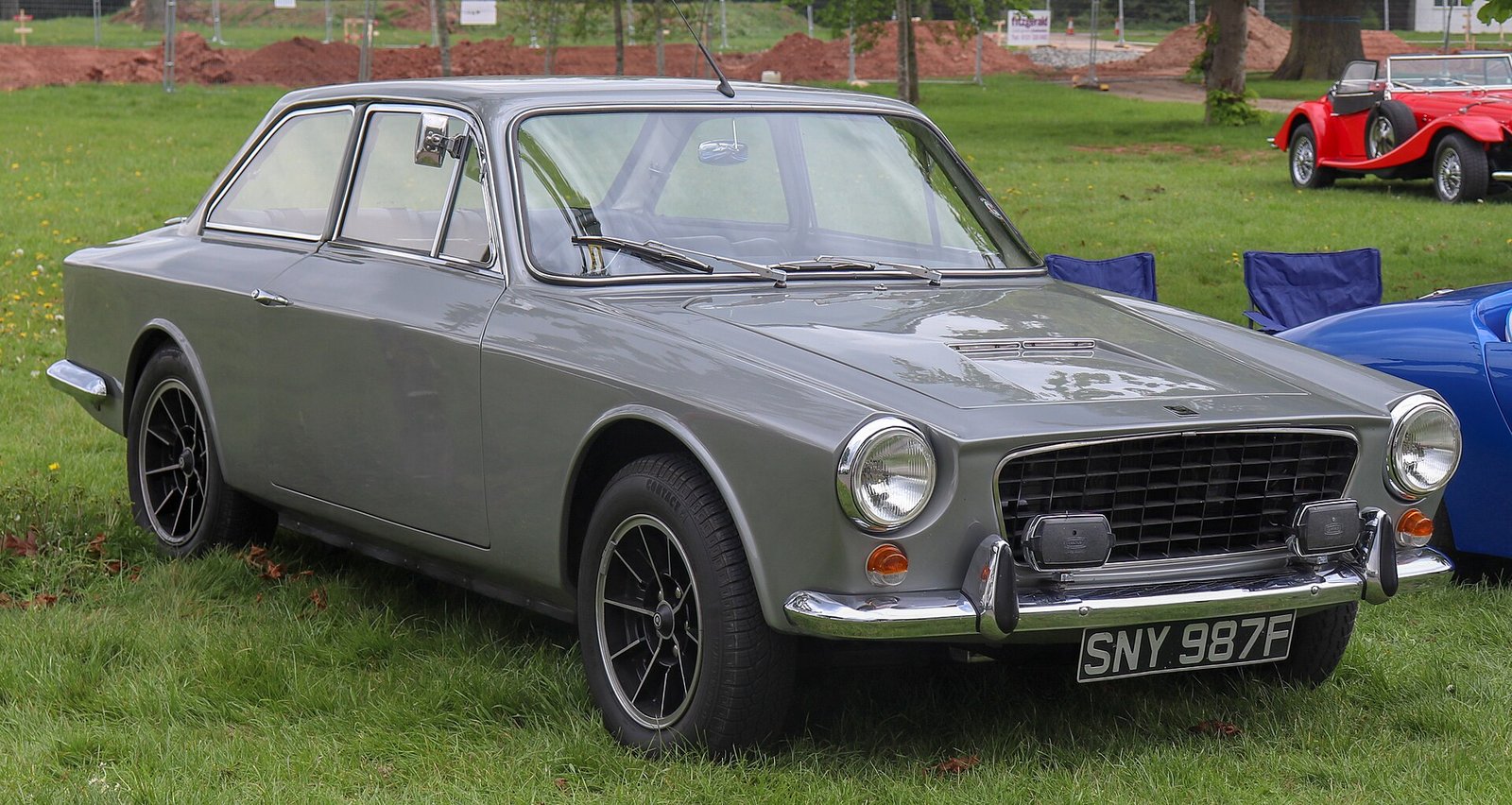
| Genie | 1966–1969 | Ford Essex V6, 2.5 and 3.0; Weber carburettor or Tecalemit-Jackson injection | About 197 | Larger four-seat GT launched at the 1966 London Motor Show |
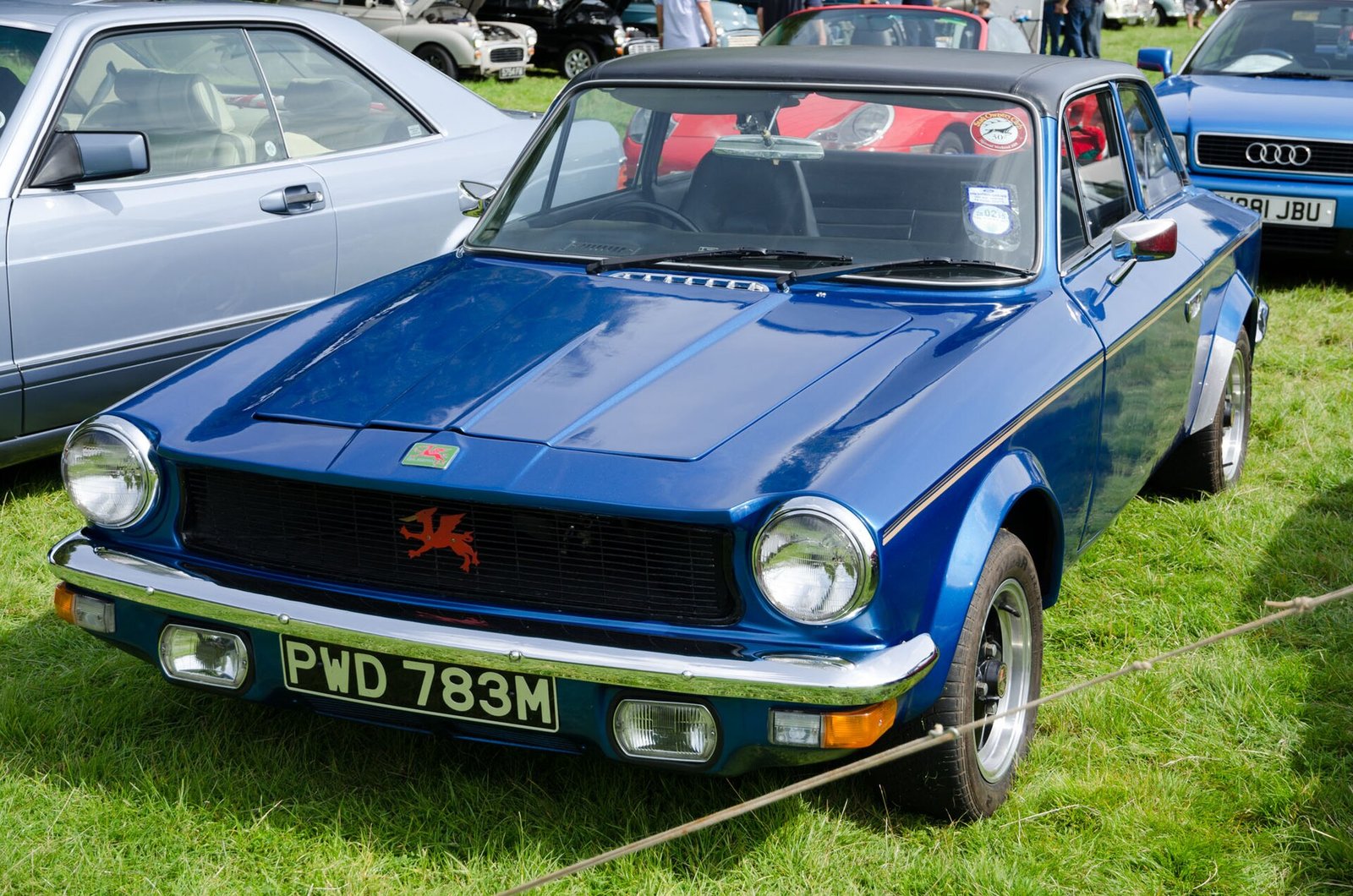
| Invader Mk I / Mk II | 1969–1972 | Ford Essex V6 3.0 | About 290 coupés and about 104 estates | Stiffened Genie development; estate from 1971 |
| Invader Mk III | 1972–1974 | Ford Essex V6 3.0 (Capri 3000GT specification) | About 212 | Wider body; Cortina front suspension; factory-built only |
| T11 | 1970 (prototype) | Austin Maxi 1,485 cc E-series, mid-mounted | None completed in period; one finished privately in 2009 | Never produced; see below |
The commonly cited model totals add up to about 1,080 cars. That agrees with the museum's and the owners club's description of "over 1,000" built. In 2010 the club estimated that more than 500 were still on the road.


T11 prototype
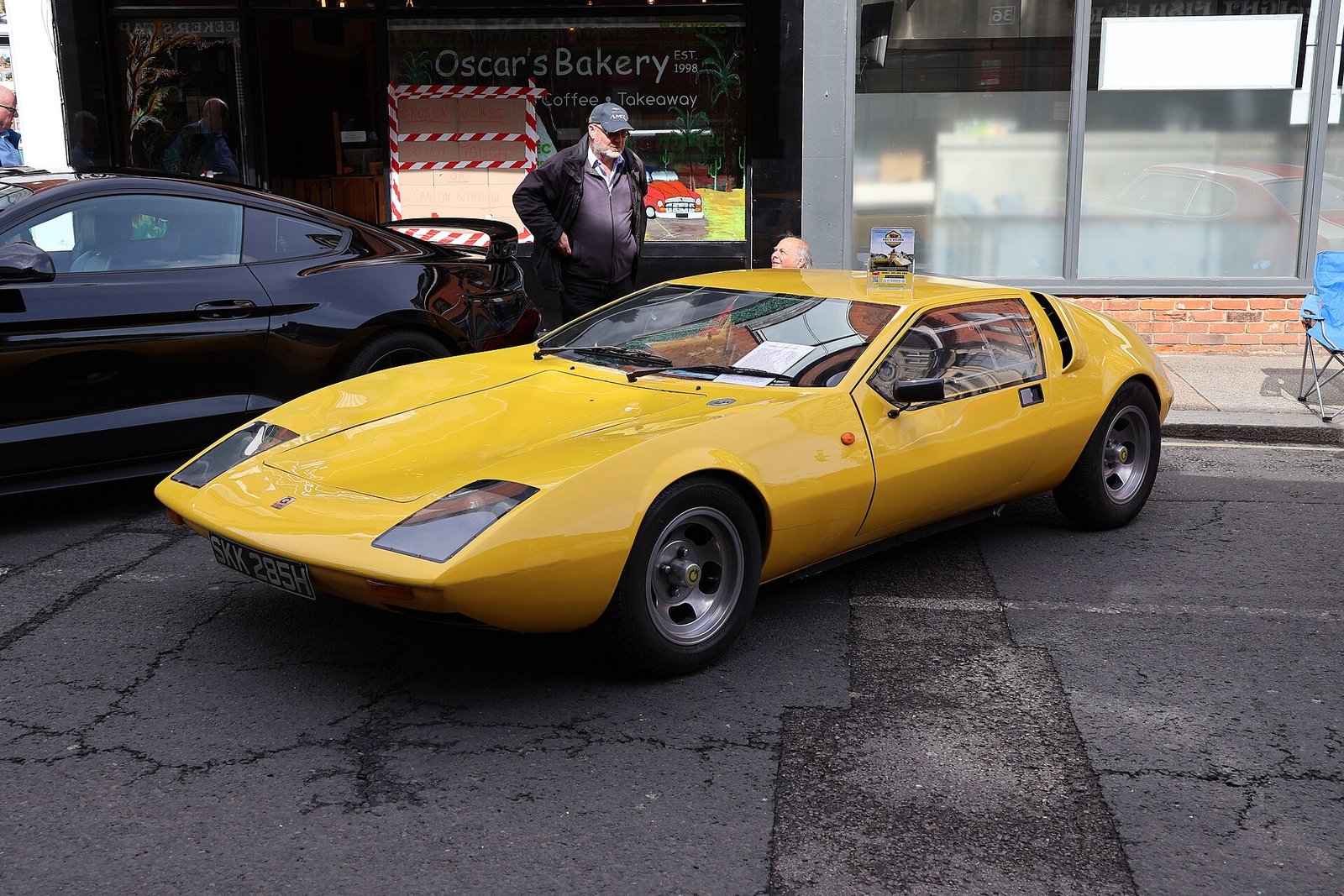
The T11 was a mid-engined two-seat wedge coupé planned at a 1969 board meeting under the Collings ownership. It was styled by Trevor Fiore, and Terry Sanger designed its space-frame chassis in 1970. It used the Austin Maxi's 1,485 cc E-series engine, turned through 180 degrees, with the Maxi five-speed gearbox. Bodies were moulded by Specialised Mouldings of Croydon. The car was intended for the 1971 Geneva show, but the project was abandoned in April 1971. Fears about United States safety regulations are the reason most often given, and the coming loss of the purchase-tax advantage is also suggested.
Gilbern never completed a T11 in period, and accounts differ on how many chassis were built. The figures given are one, or three chassis with three bodies. One surviving chassis passed through several owners from 1976. It was completed and registered in 2009 for the joint Gilbern 50th and owners club 40th anniversary event. After a road accident it was re-engined with Toyota running gear. One account says a Toyota MR2 4A-GE, and another says the MR2 unit was later replaced by a Corolla 2ZZ. Fiore later said the final shape was not his work.

Construction and the kit-car system
Every production Gilbern used a tubular steel chassis built on a jig, with a moulded glass-fibre body bonded or bolted to it. Running gear was bought in, mostly from BMC and MG for the GT, and from Ford and MG for the Genie and Invader. Until 1972, about 90 per cent of cars left the factory as kits. The owner then fitted the engine, gearbox, axle, wheels, exhaust and some trim, which meant the car avoided purchase tax. Because owners assembled the cars, engine and trim details vary between individual cars. When working on a Gilbern, check the parts actually fitted rather than relying on a catalogue specification. See MG and Ford for the donor vehicles.
Motorsport and heritage
- Peter Cottrell raced several GTs with MGA and MGB engines. Ken Wilson's GT was fitted with a 4.5-litre Chevrolet V8 and a Jaguar independent rear axle.
- Gilberns have competed at Wiscombe Park hillclimb since 1962, and club members still enter hillclimbs and sprints.
- The Gilbern Owners Club was founded in 1969 by Martin Ingall while the cars were still in production. It was incorporated as Gilbern Owners Club Limited in 1979, and Companies House lists it as active. The club has about 400 members worldwide and publishes the journal Rarebit.
- Amgueddfa Cymru – National Museum Wales holds three Gilberns: a GT Mk1 displayed at the National Waterfront Museum, Swansea, and an Invader Mk II and Mk III at its Nantgarw collections centre. It also holds Gilbern handbooks and sales literature.
Specialists, clubs and parts
Few businesses deal only in Gilberns. Most specialist knowledge, the car register and the Gilbern-specific spares are held by the owners club. Mechanical parts come from the BMC, MG and Ford supply chains. The specialists below were checked on 19 November 2026; the evidence column shows how far each Gilbern connection is confirmed. No dealer specialising in Gilbern sales was found. Cars usually change hands through general classic-car auctions and marketplaces.
| Name | Location | Gilbern work | Evidence and status |
|---|---|---|---|
| Gilbern Owners Club | UK (registered office Taunton); members worldwide | Members-only spares for all models; owns the original GT, Mk III and windscreen moulds; car register, history archive, technical advice, forum and events | Active company (01459850). Club site content read from search-engine copies because its security certificate could not be verified. |
| Sporting Classic Marques | Bancffosfelen, Llanelli, Carmarthenshire | Classic restoration, servicing and glass-fibre work. The proprietor is described in the press as a Gilbern specialist and has maintained Genies. | Trading (current website). The Gilbern connection is confirmed by third parties only. |
| Philip Ivimey | England | Marque specialist credited with GT and Invader chassis rebuilds; club archivist and co-author of Gilbern: A Dragon's Tale | Credited in sale listings. No trading website found. |
| Chris Smith Gilbern Garage | High Street Garage, Lutterworth, Leicestershire | Chassis-up restoration of a 1971 Invader estate from 2008 | Hagerty UK, 2022. Current status not confirmed. |
| Towcester Classic Cars | Towcester, Northamptonshire | Invader chassis and suspension rebuild project page | Page not directly loadable. Current status not confirmed. |
| Mev Spares | UK (online) | Gilbern Invader and Genie parts category, including Essex V6 core-plug sets | Verified on its own site. |
| Uro Glas | Bromsgrove, Worcestershire | Classic windscreens and body glass; lists Gilbern | Verified on its own site. Check availability for a specific part. |
| Vintage Tyres | UK | Tyre fitment listings for the GT, Genie and Invader | Verified on its own site. |
| Chris Knott Insurance | St Leonards-on-Sea, East Sussex | Dedicated Gilbern insurance: agreed value, spares and restoration-project cover | Verified on its own site. |
Gilbern restoration threads also appear on the PistonHeads "Classic Fibreglass" forum. Amgueddfa Cymru's Collections Online includes Gilbern owner's handbooks and brochures.
Further reading
- Martyn Morgan Jones with Philip Ivimey, Gilbern: A Dragon's Tale, Bookmarque, 2020, ISBN 9781870519793. A limited edition of 500 copies.
- Michael Burgess, Gilbern Cars, Amberley, 2019, ISBN 9781445690919. 96 pages.
- Colin Pitt (ed.), Gilbern Cars, Unique Motor Books, 2018, ISBN 9781841559247. A compilation of period road tests.
Not established
- The exact date of final closure in 1974, and the legal entity in liquidation at that time.
- How many T11 chassis and bodies were built.
- No Gilbern revival company exists. A widely circulated "Gilbern Dragon-E" electric revival story is satire, as its own publisher states.
Sources
- The Gilbern – too good to be a 'one-off', Ian Smith, Amgueddfa Cymru – National Museum Wales, 30 July 2019; republished by Nation.Cymru, 16 November 2025. Accessed 19 November 2026.
- The DIY Gilbern still lives, Jonathan Brooks-Jones, Institute of Welsh Affairs, 21 November 2010. Accessed 19 November 2026.
- Gilbern, English Wikipedia (cites The Motor, Autocar, BBC News 2003 and Brian Gent, "Gilberns at Wiscombe", 2009). Accessed 19 November 2026.
- The Gilbern, W. Boddy, Motor Sport, November 1968. Also Motor Sport, June 1963, January 1964 and December 1971. Accessed 19 November 2026.
- Gilbern, PistonHeads, 24 May 2001. Accessed 19 November 2026.
- The Gilbern Genie, Silodrome, 16 February 2022; The 1972 Gilbern Invader, Silodrome (page dated 19 November 2026). Accessed 19 November 2026.
- Welsh rarebit: Gilbern Invader Estate hits the market, Hagerty UK, 12 May 2022. Accessed 19 November 2026.
- The Gilbern T11 story, Steve Hole, Total Kit Car, 8 January 2026; The Welsh Wedge, Rare Component Cars, April 2021; One-off Welsh sports car is highlight of new festival, Wheels Within Wales, 4 June 2019. Accessed 19 November 2026.
- Vanished Wales: what happened to the Gilbern car?, ITV Wales, 2 May 2023 (read from a search-engine copy). Accessed 19 November 2026.
- Gilbern Owners Club Limited (01459850), Companies House; gilbern.co.uk (read from search-engine copies); Historic Welsh car Gilbern shines at UK's biggest classic motor show, Wales247, 12 November 2025. Accessed 19 November 2026.
- Gilbern Genie and Invader: Welsh warriors, Classic & Sports Car (read from a search-engine copy). Accessed 19 November 2026.
- Gilbern, Peel and Trident revival, Petrol Blog (self-declared satire). Accessed 19 November 2026.
- Specialist and supplier websites linked in the specialists table. Accessed 19 November 2026.
- Photographs from Wikimedia Commons, credited in each caption. Accessed 19 November 2026.