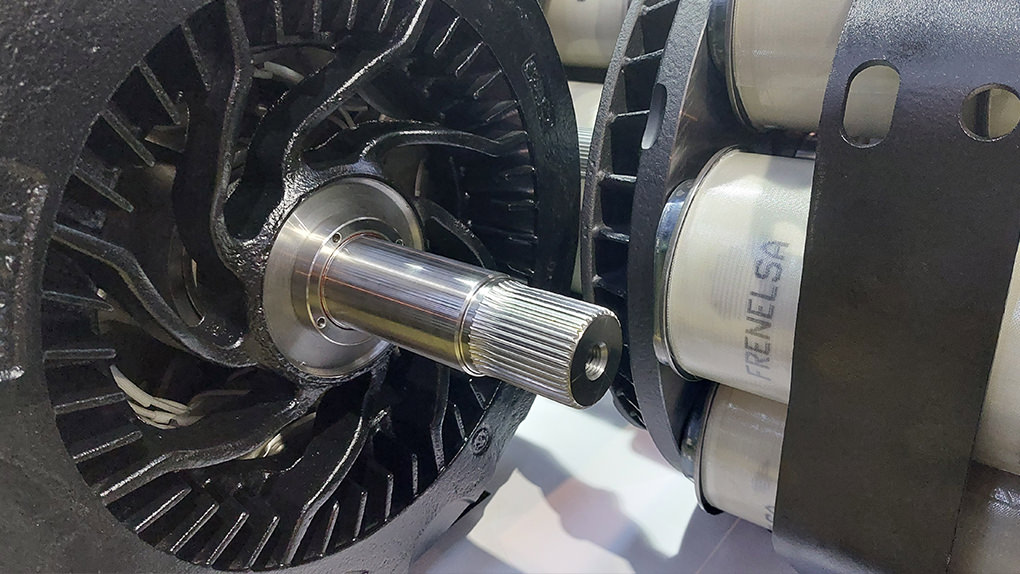
Frenelsa (Frenos Eléctricos Unidos S.A.) manufactures electromagnetic retarders used as power absorbers in dynamometers as well as brakes for commercial vehicles. Its retarder is a component in a test system: the roller, frame, sensors, brake driver and software can be supplied or integrated by another dyno manufacturer.
History and applications
According to Frenelsa's company history, Onecasa, Frenos Iruña and Superfrenos developed electric retarders in the 1960s and merged to form Frenos Eléctricos Unidos in 1974. The company describes later international expansion and a German subsidiary. Its factory address is in Orkoien, Navarra, Spain.
Frenelsa lists chassis, engine and transmission, towing, hub and agricultural dyno applications. That list identifies possible applications, not a guarantee that a particular unit suits every type of dyno. Manufacturer's dynamometer range.
How the brake loads a dyno
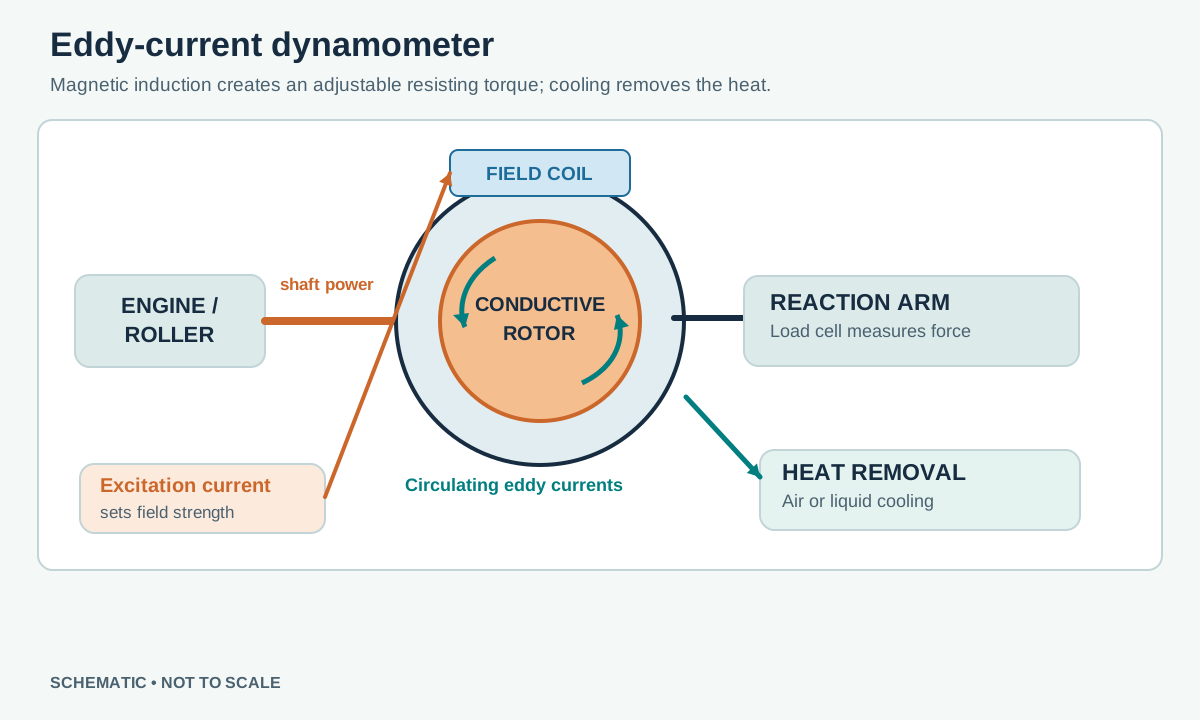
A driven shaft moves a conducting rotor relative to an electrically excited magnetic field. The changing flux induces circulating currents and an opposing torque; electrical resistance turns absorbed mechanical power into heat. Varying field excitation changes loading within the unit's speed, temperature and torque envelope. A passive eddy-current brake cannot motor an engine, regenerate energy to the grid or provide eddy-current holding torque at zero speed. See eddy-current dynamometers.
A dyno may measure reaction force via a load cell and lever arm and combine it with shaft speed to calculate absorbed power. The brake itself is not proof that a complete measurement system is fitted. During acceleration, account for rotating inertia and losses as well as measured brake reaction.
Configurations and selection
Frenelsa offers shafts made to length and diameter with features including splines, keyways and holes. It lists excitation versions at 12, 24, 36, 48, 72, 96 and 192 V, and temperature probes as an option. These are available configurations, not interchangeable electrical settings: identify the winding and rated current on the actual unit. The public dynamometer page does not provide enough model-specific torque and duty curves to assign a particular rating here. Frenelsa specifications and applications.
- Mechanical: match shaft ends, coupling, support bearings, alignment, balance and actual brake speed to the installation.
- Electrical: match the driver to winding voltage, operating current and protection requirements. Do not assume a controller's brake output can directly energise an arbitrary retarder.
- Thermal: confirm cooling arrangement, permissible temperature and continuous versus short-duration torque and power with the supplier. A large headline power figure does not establish sustained capacity.
- Controls and measurement: choose speed and torque feedback, calibration, excitation control and interlocks for the complete machine. Frenelsa's cited product page does not identify a specific factory dyno controller.
See dynamometer control systems, eddy-current hub dynamometers and Pentar Kloft dynamometer brakes.