Production: 1908–1927 (over 15 million built at Piquette Avenue, Highland Park and global CKD plants). Wikipedia: Ford Model T.
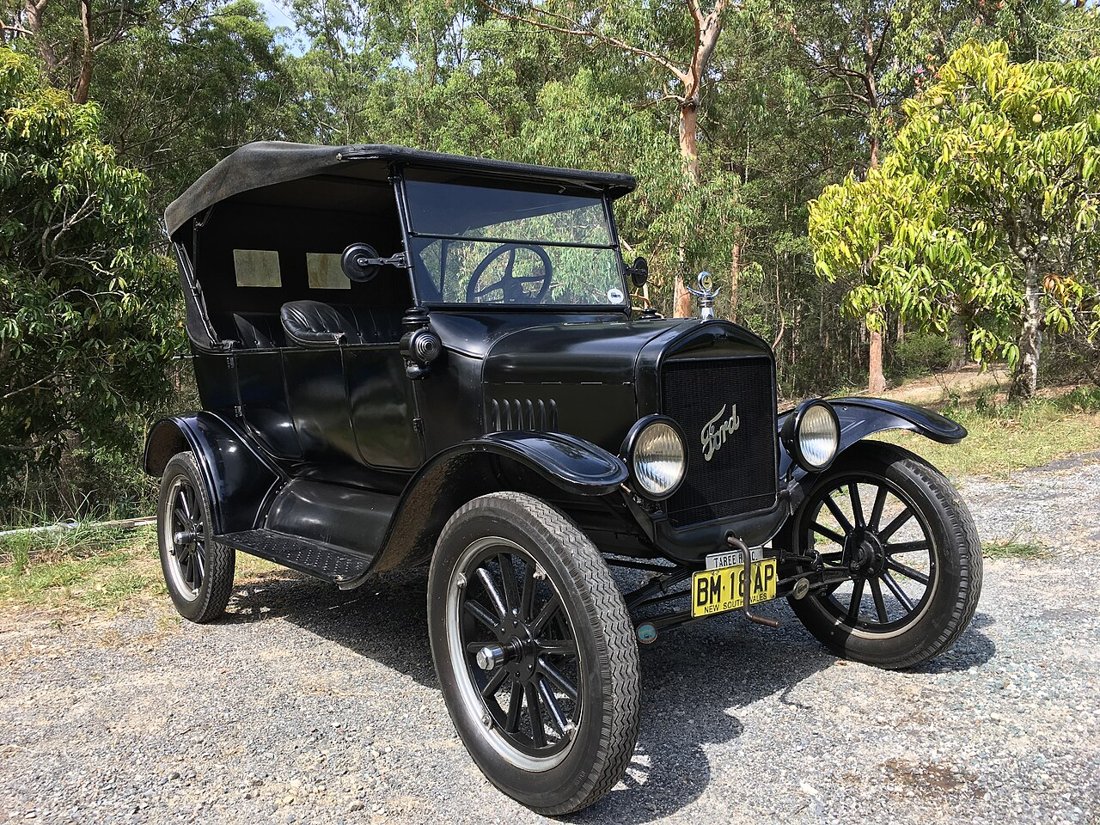

Designed by Henry Ford, Childe Harold Wills, József Galamb and Eugene Farkas, the Model T pioneered affordable mass motoring and, from 1913 at Highland Park, moving assembly-line production. Body styles ranged from Tourer, Runabout/Roadster, Coupé, Tudor and Fordor sedans to the heavy-duty Model TT one-ton truck chassis (1917–1927).
Engine, transmission and chassis specifications
| Component | Specification | Technical notes |
|---|---|---|
| Engine | 177 cu in (2.9 L) L-head (side-valve) inline-four | Monobloc cast-iron block with detachable cylinder head; splash/thermosyphon cooling (no water pump on standard production); 20 hp (15 kW) at 1,600 rpm; gravity-fed carburettor (Kingston or Holley); dual-fuel / kerosene conversions offered in agricultural markets. |
| Ignition | Low-tension flywheel magneto & four trembler coils | Battery electric starter and generator became standard on closed cars from 1919 and across the range later in production. |
| Transmission | 2-speed epicyclic (planetary) + reverse | Controlled by three floor pedals (clutch/low-high, reverse, transmission brake) and a handbrake/high-gear lever rather than a conventional H-gate gearbox. |
| Chassis & suspension | Vanadium-steel ladder frame; transverse semi-elliptic leaf springs | Solid front and rear axles; mechanical rear-wheel transmission/hub braking; wheelbase 100 in (2,540 mm) on Model T, 125 in (3,175 mm) on Model TT truck. |
Sources and related pages
- Wikipedia: Ford Model T — model history, Highland Park assembly and technical details.
- Ford Corporate History: Highland Park Plant.
- Ford: history and cars.