Flywheel behaviour depends on moment of inertia, not weight alone. Inertia describes resistance to a change in rotational speed. A mass placed farther from the axis has a greater effect than the same mass near the centre, so two flywheels with the same overall mass need not have the same inertia. OpenStax: moment of inertia and rotational energy.
The useful physics
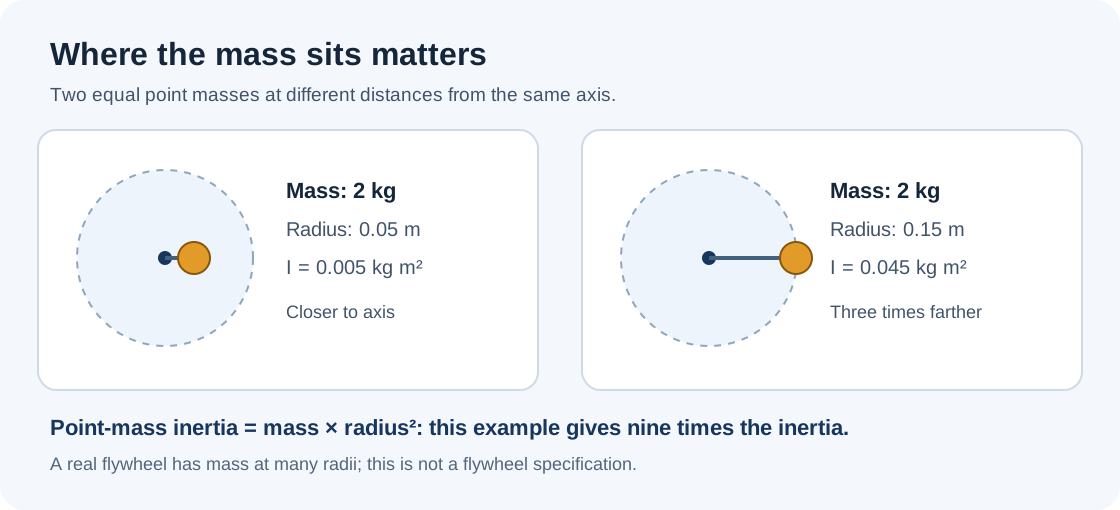
- For a small mass concentrated at radius r, its contribution to inertia is I = m × r². A real flywheel has mass distributed across many radii, and its total inertia is the sum of those contributions.
- Rotational kinetic energy is E = ½ × I × ω², where ω is angular speed in radians per second. Convert engine speed using ω = 2π × rpm / 60.
- For a given inertia, four times the speed means 16 times the stored rotational energy. This is a mathematical comparison, not a recommended operating range.
- Net torque accelerates rotational inertia according to τ = I × α. The complete vehicle includes other rotating parts, gear ratios and road load, so flywheel inertia alone does not predict acceleration.
In the illustration, moving the same 2 kg point mass from 0.05 m to 0.15 m increases that mass's contribution from 0.005 to 0.045 kg·m². Real flywheels have a complex shape; the example is not the inertia of a complete flywheel. OpenStax: rotational dynamics.
How a lighter flywheel can feel
With less flywheel inertia, engine speed can change more quickly for the same net accelerating or decelerating torque. This can make a throttle blip feel sharper and can change transient acceleration. The engine can also lose speed more quickly when the clutch is disengaged. How noticeable the effect is depends on the whole rotating assembly, gear, vehicle mass, load and engine control.
At a given speed, a lower-inertia flywheel stores less energy to help when the clutch takes up load. More careful clutch and throttle control may be needed when pulling away, particularly with a heavy vehicle, tall gearing, a low-speed manoeuvre or a sharp clutch. Idle fluctuations, gear rattle or stalling can become more noticeable in some combinations; inspect for faults and calibration issues rather than assuming every symptom is normal. RAM: flywheel weight and launch behaviour.
Power and comparison
A flywheel does not create engine torque or increase the engine's steady-state power by itself. Reducing inertia can change how rapidly the engine and driveline accelerate and can affect results from an acceleration-based dynamometer; the test method and correction procedure matter. There is no universal horsepower gain or percentage improvement that can be assigned to all lightweight flywheels.
When comparing parts, ask for the measured inertia as well as mass, and compare complete compatible clutch assemblies where possible. Consider the duty cycle alongside the response you want. See performance flywheel modifications, fault diagnosis and the flywheel overview.