European on-board diagnostics did not invent a diagnostic socket. BMW, Mercedes-Benz, Volkswagen Group and PSA cars already had their own, and a car of the changeover years often kept the old socket beside the new one. What changed around 2000 was a legal requirement: the emissions diagnosis had to be available on one standardised connector, in a place a technician could reach, using one of a short list of protocols. The protocols page is that list of wires and services. This page is the connector itself, and the manufacturer sockets that the 16-pin plug does not replace. Serial logging, and what a log can and cannot say about a prepared engine, is on the data-logging page.
The year bands below come from the directive, from a scanner vendor's connector guide, and from workshop location lists. Those guides overlap on purpose. A manufacturer could change the socket during a production run, and a car can carry two sockets. The connector in the car is the one that counts. A drawing on this page shows the shape and the contact count. Where two published pin lists disagree, neither is copied.
When the standard socket became compulsory
Directive 98/69/EC added on-board diagnostics to the European emissions rules. Commission Directive 1999/102/EC, adopted on 15 December 1999, replaced the dates and the connector rules. The dates are not a single day in 2000, and they are not the same for petrol and diesel. "New types" means a design newly type-approved. "All types" means every vehicle of that category put into service, including designs that had already been approved.
| Engines | Vehicles | New types | All types |
|---|---|---|---|
| Petrol | M1 passenger cars up to 2,500 kg, and N1 class I light goods vehicles | 1 January 2000 | 1 January 2001 |
| Petrol | N1 classes II and III, and M1 cars over 2,500 kg | 1 January 2001 | 1 January 2002 |
| Diesel | M1 cars, except those with more than six seats and except those over 2,500 kg | 1 January 2003 | 1 January 2004 |
| Diesel | The M1 cars left out of the row above, except those over 2,500 kg, and N1 class I | 1 January 2005 | 1 January 2006 |
| Diesel | N1 classes II and III, and M1 cars over 2,500 kg | 1 January 2006 | 1 January 2007 |
A diesel type-approved with an OBD system before its compulsory date still had to follow the connector and protocol rules. Vehicles outside the table were allowed to have an OBD system, and the same connector rules applied if they did. The American OBD-II requirement for the 1996 model year is a different law. A 16-pin socket on a European car of the late 1990s can be early fitment, or fitment for another market. It does not by itself put that car on a row of this table.
What the connector had to provide
Access for inspection, diagnosis, servicing or repair had to be unrestricted and standardised. The connection between the vehicle and the tester had to meet ISO DIS 15031-3 of December 1998, which the directive pairs with SAE J1962 of February 1998. The approval authority agreed the installation position. It had to be readily accessible to service personnel and protected from accidental damage in normal use. The directive does not prescribe one footwell and one orientation for every car.
The same section allows four communications links, with the restrictions written into each: ISO 9141-2, ISO FDIS 11519-4 (SAE J1850), ISO FDIS 14230-4 (Keyword Protocol 2000), and ISO WD 15765-4 (diagnostics on CAN). How those links are framed and which services they carry is the protocols page. Two further items had to come out of the serial port on that same connector, on a later timetable. The distance travelled while the malfunction indicator was on is required from 1 January 2003 for new types that have an electronic speed input to the engine management, and for all new types entering service from 1 January 2005. The software calibration identification follows the same two dates, 1 January 2003 for new types and 1 January 2005 for all types, in a standardised format.
The 16-pin socket
The socket people mean by an OBD or EOBD connector is the trapezoidal 16-pin. SAE J1962 defines two of them, type A and type B. Obdtester's summary of that standard says the difference is the shape of the alignment tab. Its location summary puts a type A socket in the passenger compartment, from the driver's end of the instrument panel to 300 mm past the vehicle centreline, attached to the instrument panel and easy to reach from the driver's seat. The preferred place in that summary is between the steering column and the centreline. Type B is allowed a wider band, out to 750 mm past the centreline, and may be reached from the driver's seat, the passenger's seat, or from outside. That is the connector standard as that page reports it. The 1999 directive still leaves the actual position to the approval authority.

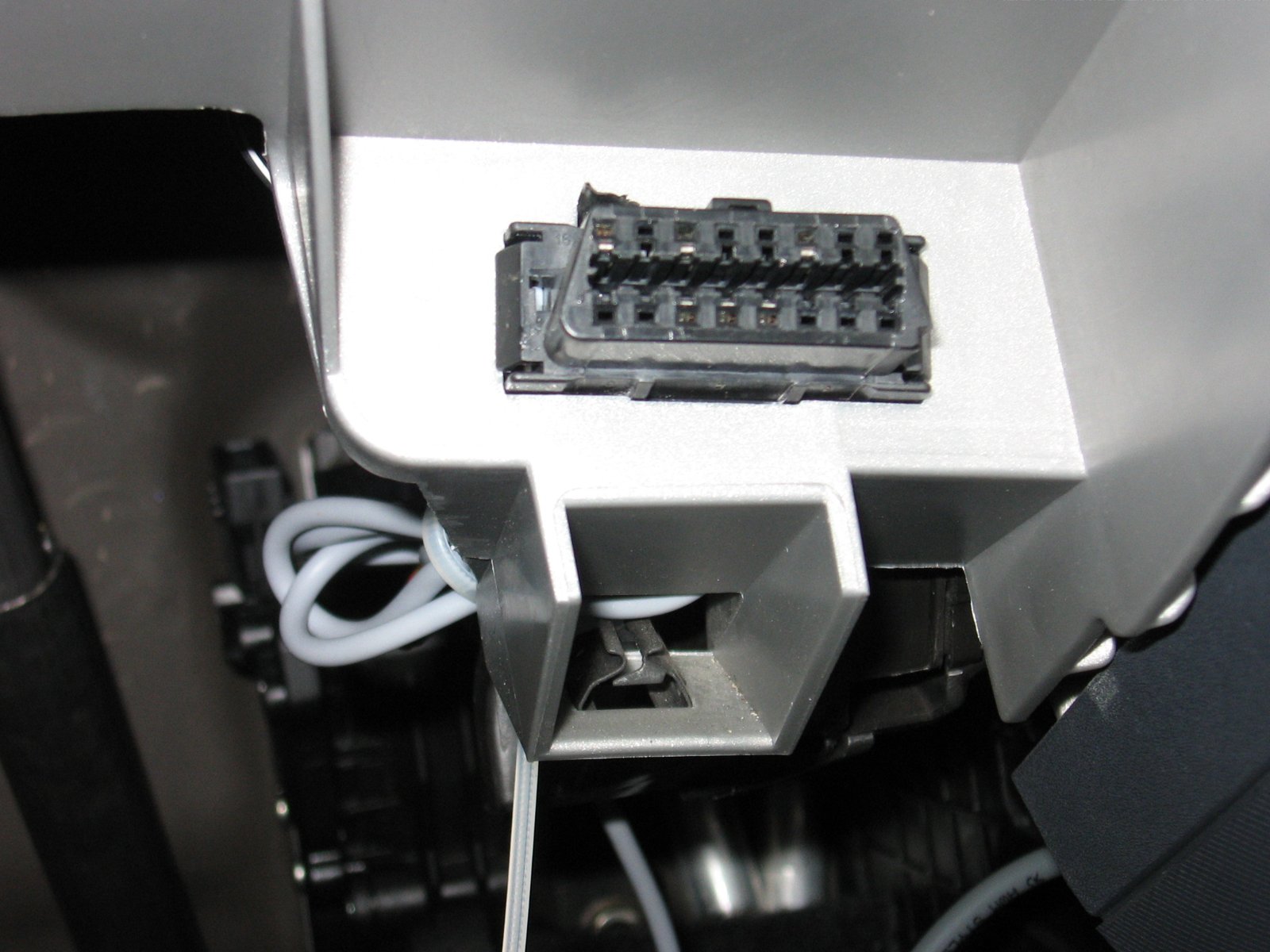
The same shape turns up on a bracket in the cabin of other cars. The contacts in the photograph below are the vehicle side of the joint. A plug pushes in from the open face. The housing is wider along one edge, which is what stops the plug going in upside down.

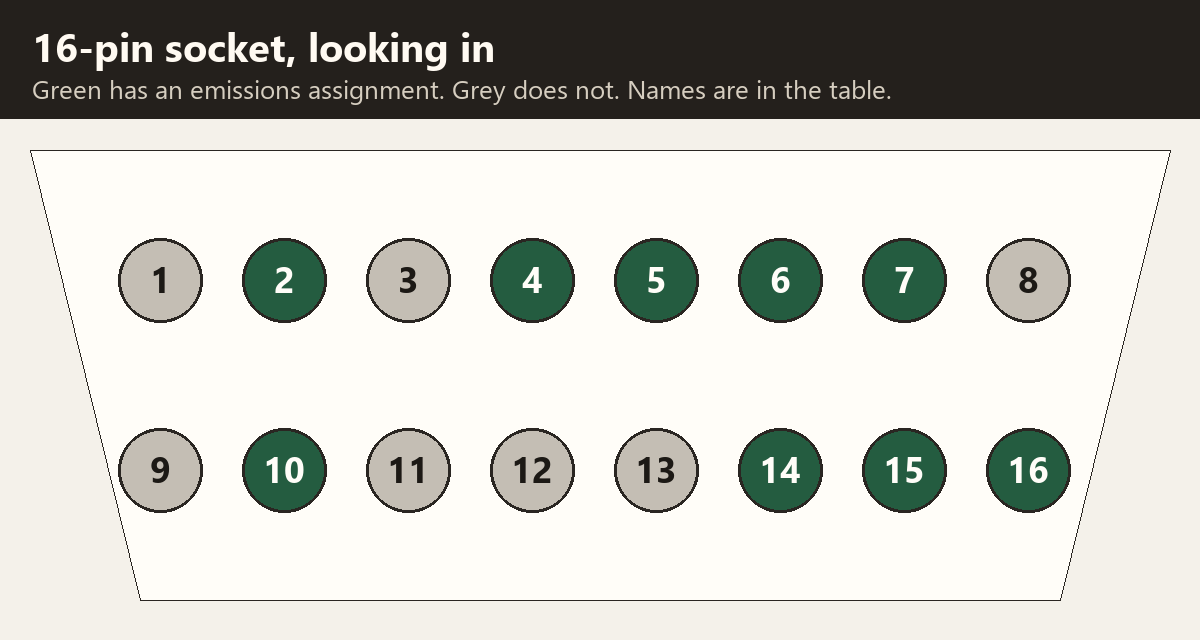
Looking into that face, the top row is pins 1 to 8 from left to right and the bottom row is pins 9 to 16. Obdtester's pin table, read against the four links named in the 1999 directive, gives the emissions assignment drawn here. Pins left grey are the ones that table does not assign. An empty cavity is normal. A contact fitted in a grey position is a manufacturer connection, or a later assignment, and it is not a fault in the emissions wiring.
| Pin | Emissions assignment |
|---|---|
| 2 | SAE J1850 bus + |
| 4 | Chassis ground |
| 5 | Signal ground |
| 6 | CAN high, ISO 15765-4 |
| 7 | K-line, ISO 9141-2 and ISO 14230-4 |
| 10 | SAE J1850 bus − |
| 14 | CAN low, ISO 15765-4 |
| 15 | L-line, ISO 9141-2. Used to wake the control unit, not as a second data wire once the session is running |
| 16 | Battery positive |
Pins 1, 3, 8, 9, 11, 12 and 13 have no function in that emissions table. A later Ethernet assignment, published by the same obdtester page as two DoIP options, uses some of them: one option puts the pairs on pins 3 and 11 and on 12 and 13, the other on pins 1 and 9 and on 12 and 13. A car uses one option. Pin 8 has no data pair in either of those columns. The Diagnostics over IP page records the activation line on that socket, and the primer cited there puts it on pin 8. On a car new enough for that link, a contact in pin 1, 3, 11, 12 or 13 can be the Ethernet pair rather than a spare manufacturer wire.

BMW
The socket on older BMWs is the round 20-pin, often under a screw cover in the engine bay. BMW diagnostic connections records BMW's own AOS guidance: on some vehicles that round socket is the one required for communication, and the ICOM C adapter joins an ICOM A to it. The 16-pin socket on later cars is a different path, and a plug that fits still does not establish which control units or operations that path supports.
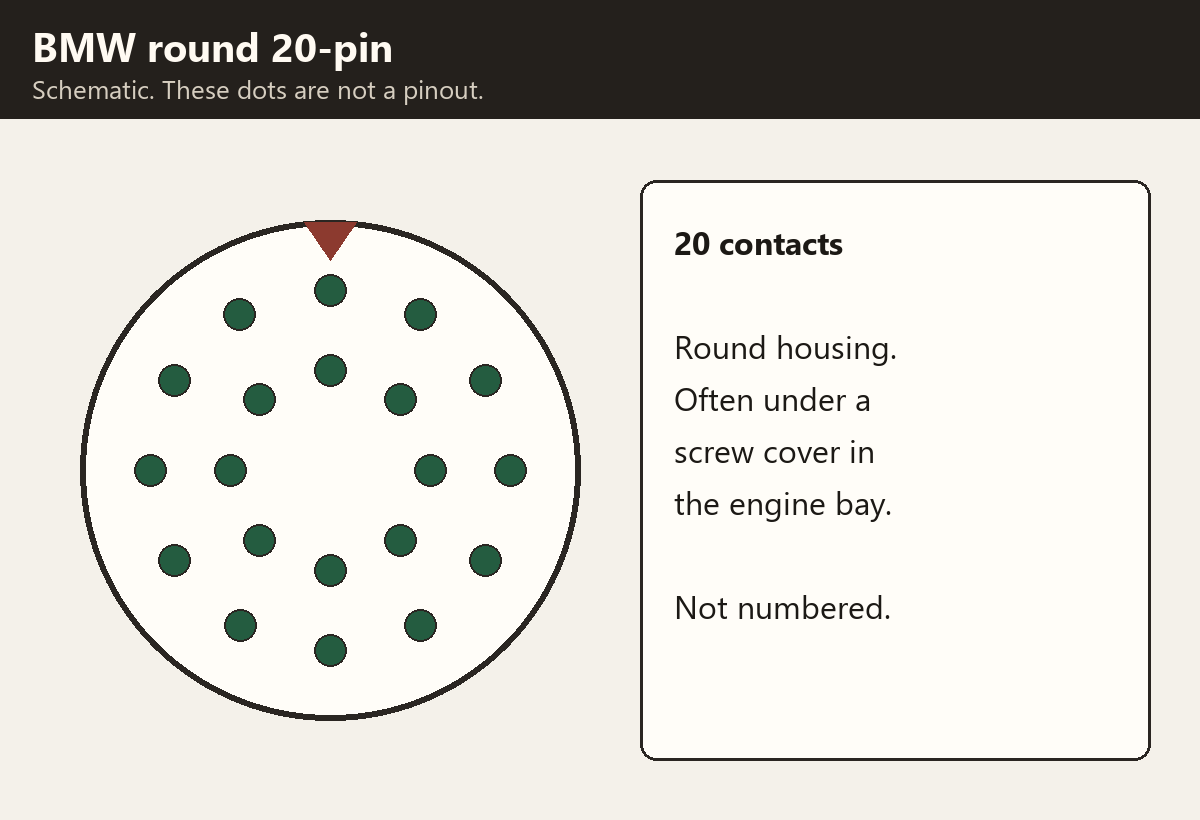
Launch's X-431 connector guide, version 1.4.2, lists a BMW 20-pin as the OEM connector up to about 2002, a 16-pin OEM connector up to about 2004, CAN phased in from 2002, and an OBD-II 16-pin from 1996. The rows overlap, and the guide says so: manufacturers phase a connector in during a model year, and the table is a guide to which plug to try. Its location note for the 20-pin is the engine compartment, under a screw-on cover. A workshop location list compiled by SEBI Diagnostic puts the 20-pin, on 3, 5 and 7 series cars up to 2000, under the bonnet above the driver's wheel arch, and the 16-pin from 2000 at the front of the centre console. That is one workshop's list. It is not a BMW fitment file, and it will not match every chassis.
Mercedes-Benz
There is no single Mercedes-Benz diagnostic socket for the 1990s. Launch's guide, which warns that it is only a guide, sorts them like this. Up to about 1993, some cars have an 8-pin or a 16-pin socket under the bonnet, usually in the cowl area on either side, and the guide treats those as flash-code sockets: the tester reads blink codes rather than a serial session. From about 1992 to 2002 the OEM connector it names is the round 38-pin, located within or beside the fuse panel in the cowl. From about 1998, where that 38-pin is absent, the guide moves on to its CAN connector. It also lists an OBD-II 16-pin from 1996. A car in the overlap can have more than one of these.
The StarCOM user manual, version 2024-05-28, section 4.2, describes the 38-pin round connector as the pre-OBD-II socket and gives it a separate K contact for each system: engine, ABS, transmission, instrument cluster, air conditioning, airbag and others. That is the software vendor's table. It is a different arrangement from the single K-line on pin 7 of the 16-pin socket, which is why a 16-pin lead plugged into an adapter can see one system while the round socket still carries the rest. The vendor's pin numbers are not reproduced here. They are not a Mercedes-Benz wiring diagram.
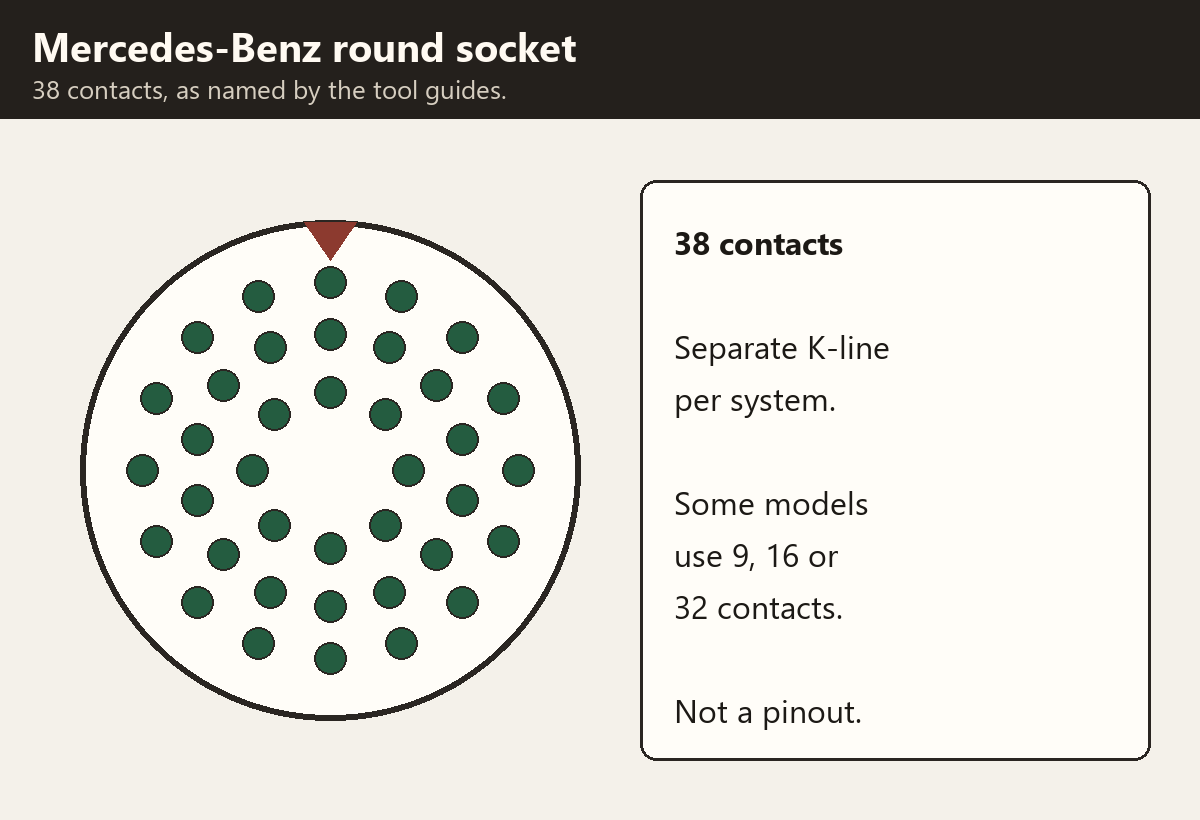
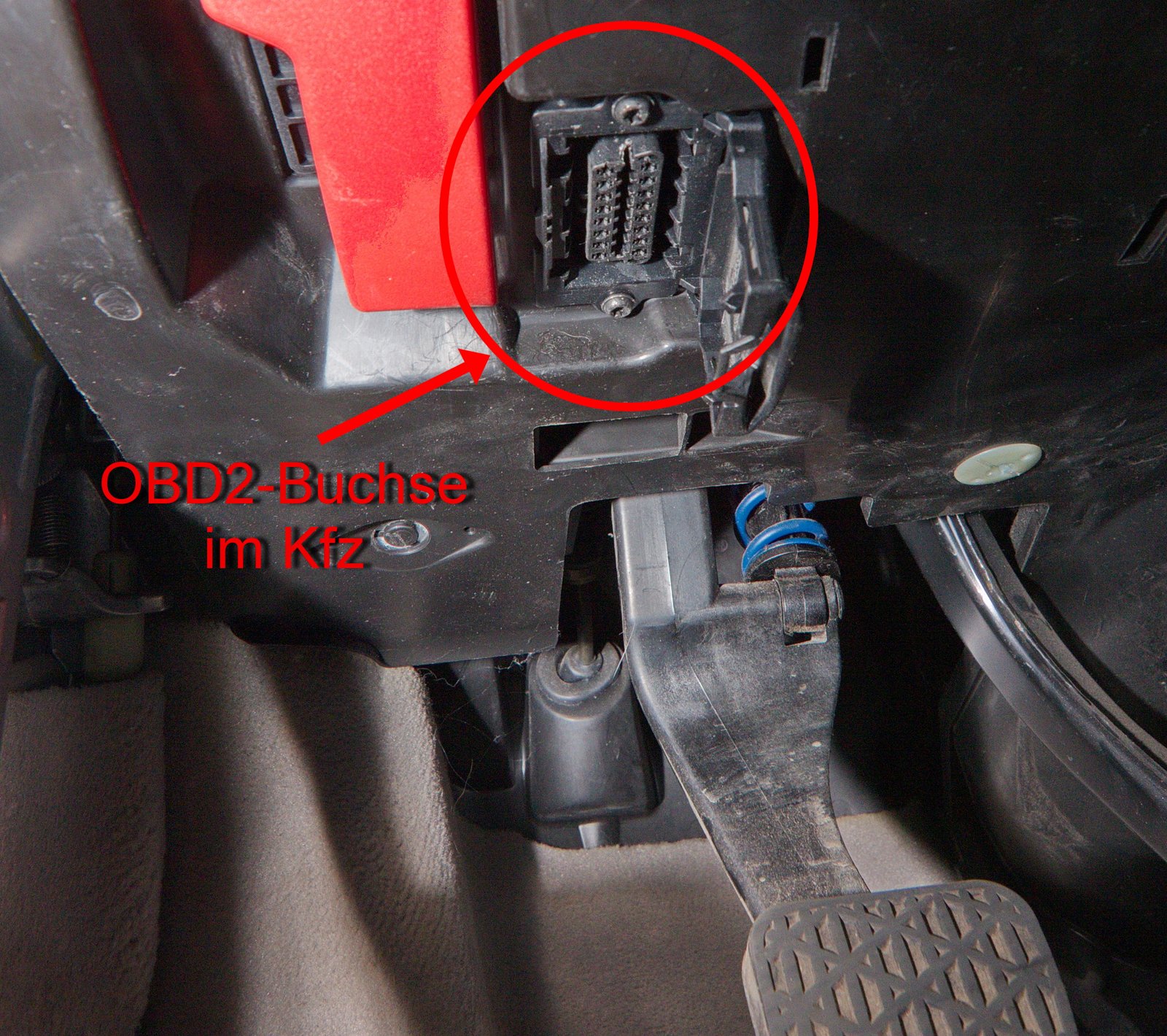
Those other counts are why the drawing is labelled as the 38-pin of the tool guides and not as every Mercedes-Benz socket. SEBI's list puts a 9-pin on the 190 E under the bonnet above the left wing. On the C 180, C 200, C 220 and C 280 it records a 16-pin or a 32-pin in the bulkhead on the right, and on some of the supercharged C-class cars a 32-pin in that same place. The A-class entries on that list are a 16-pin under the steering column. The footwell photograph earlier on this page is that later 16-pin socket, in one Mercedes-Benz, and not the round multi-pin socket. No freely licensed photograph of the round socket was found. Launch's connector list names the round cable as Benz-38 and a separate 14-pin cable; the guide's Sprinter row uses that 14-pin from 2004, and the StarCOM manual limits its 14-pin table to the Sprinter and Volkswagen LT rather than to 24 V trucks.
Volkswagen, Audi and the rest of the group
Before the 16-pin socket, the Volkswagen Group port that diagnostic tools still cater for is the 2×2. Ross-Tech describes it as four contacts. A 16-pin plug does not fit. The adapter Ross-Tech sells is the same type as Volkswagen's VAS 5051/2 adapter. On Volkswagens, Ross-Tech says the port is often under the shift boot or elsewhere in the dash. On Audis it is often in the fuse and relay box under the bonnet, or under the carpet in the passenger footwell. Ross-Tech's current interfaces cover the group's passenger cars from 1996 on the 16-pin socket, and many cars from 1990 to 1995 as well, with the 2×2 adapter required on those earlier cars that do not have the 16-pin socket. "Many" is Ross-Tech's word. It is not every car of those years.
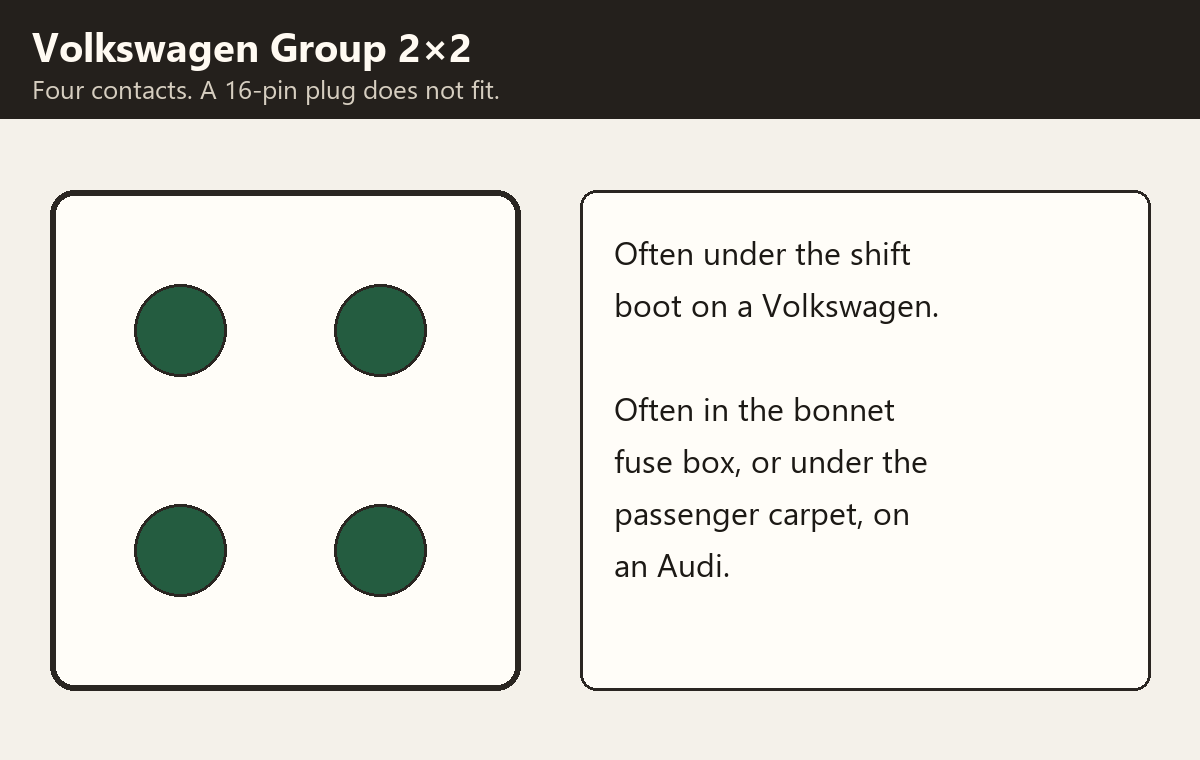
Launch's guide agrees on the broad split: an Audi/VW 4-pin connector up to about 1995, and the 16-pin from 1996, with CAN phased in later. It also says that from about 2002 some Audi systems still need a K-line converter on a car that already has a 16-pin socket. The systems it names include transmission, air conditioning, airbags and central locking on the A6, and brakes, air conditioning and the central control module on the A4. A scan tool that only speaks the emissions services on pins 6 and 14, or on pin 7, will not see those modules. SEBI's location list gives the same kind of variation car by car. Golf and Vento up to 1993 are listed with a 2×2 in the centre console, below the heater controls, behind a blank. Passat up to 1993 is listed with a 2×2 or a 3×2 behind the gear-lever gaiter. Audi 80 and Audi 100 are listed in the under-bonnet fuse box, the 80 as a 3×2 and the 100 as a 2×2. Audi A6 up to 1997 is a 2×2 in that fuse box, and A6 from 1997 is a 16-pin under the steering column. Treat each line as that list's note for that model, and look at the car.
Peugeot and Citroën
Adapter sellers describe two PSA sockets for this period, a 30-pin and a 2-pin, used on Peugeot and Citroën. Launch's own connector list includes a Citroën 2-pin cable. Autodiag Technology's description of its 30-pin cable says the 30-pin is the socket usually found on 1990s Peugeot and Citroën cars and can still be found up to about 2000, and that cars after 1989 may have either the 2-pin or the 30-pin. On that page the 2-pin reaches the engine control unit and the ABS, and the 30-pin can reach more control units, the exact set depending on how the car is wired. The same page says that from 1996 the manufacturer gradually replaced these sockets with a 16-pin socket in the cabin, within reach of the driver, and that a particular engine management system can have the 16-pin even inside the years named for the older socket.
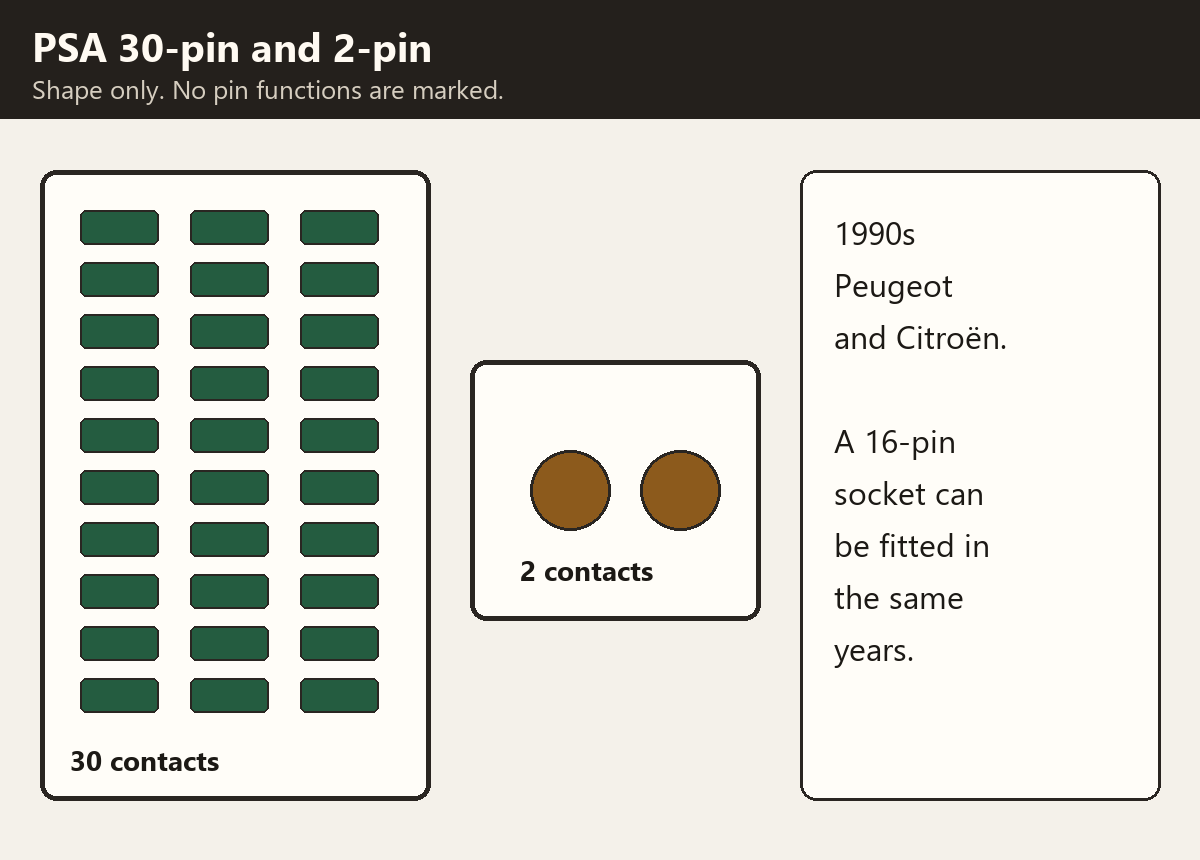
The location is not one place either. Autodiag Technology says the older sockets are mainly in the engine compartment. SEBI's list, which has no separate Peugeot heading but does cover the Citroën models that share these sockets, puts them in the cabin on several cars. Saxo up to 1997 is a 30-pin above the passenger's feet, and Saxo from 1997 is a 16-pin in the same place. Xantia is a 30-pin or a 16-pin in the fuse box at the bottom of the centre console. Evasion and Jumpy up to 1998 are a 30-pin beside the steering column, on the door side. C15, Jumper and XM are listed with a 2-pin under the bonnet, and the XM entry also allows a 30-pin or a 16-pin in the fuse box. Diag-Auto's cable listing gives Peugeot examples rather than a complete range: 106 from May 1996 to April 1998, 406 before 1998, 605, 806 before 1997, and Expert. A 406 of 1999 is outside that vendor's list and may already be on the 16-pin socket.
Two public pin lists for the 30-pin were compared and not used. OBD2-Shop's adapter page and PinoutGuide's Peugeot page both describe a separate K-line per system, which matches the way the 30-pin is sold, but they number the contacts differently. One places the engine K-line at a contact it calls A2, the other at C1. Copying either table would invent a pinout. The breakout lead, and the car's own diagram, are the way to see which contact speaks to which control unit.
Other sockets of the same years
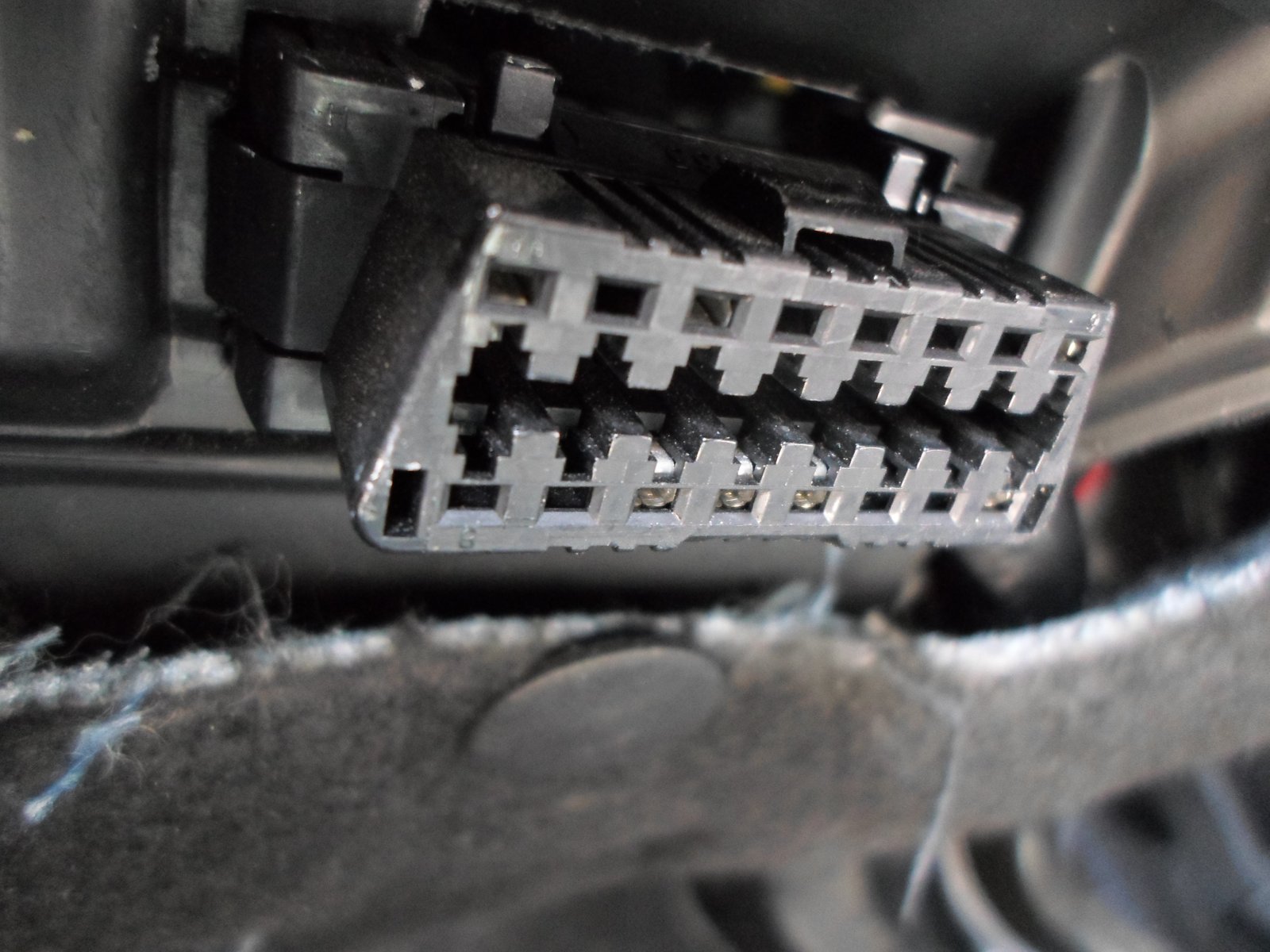
The same changeover produced a socket per manufacturer. Launch's guide is the source of the year bands, and it says the bands are a guide to a phased introduction, not a fitment list. The cable names also appear on Launch's connector list. A freely licensed photograph exists for the GM socket. None was found for the BMW 20-pin, the Mercedes-Benz round socket, the Volkswagen Group 2×2 or the PSA 30-pin, so those sections keep the shape diagrams.


| Socket | What the guide says |
|---|---|
| Fiat 3-pin | Launch lists a Fiat 3-pin cable. SEBI's location list puts a 3-pin, often in the engine bay beside the control unit or on the bulkhead, on the Barchetta, Brava, Bravo, Cinquecento, Marea, Seicento and Tempra. Alfa Romeo 145 and 146 are listed with a 3-pin in the engine bay as well. |
| Ford 6+1 | OEM connector up to about 1995, then the 16-pin. |
| GM 12-pin | OEM connector up to about 1996, shared with Daewoo on that row of the guide. |
| Honda 3-pin | OEM connector up to about 1995. |
| Mazda 17-pin | OEM connector up to about 2004. Launch's connector list calls it a semicircular 17-pin. |
| Nissan 14-pin | Listed with a 16-pin. The guide says use the 14-pin up to about 1999, and try either through about 2004. |
| Toyota 22-pin and 17-pin | A 22-pin under the bonnet up to about 1999, and a 17-pin for some systems. A separate 16-pin row covers particular models, including some Land Cruiser and LX 470 systems. |
| Subaru 9-pin | Some body systems, up to about 2004, alongside the 16-pin. |
| Mitsubishi and Hyundai 12-pin | Listed with a 16-pin up to about 2004. The guide says some models need both plugs connected at once. |
| Kia 20-pin | OEM connector up to about 2003. The guide makes an exception for the 2003 Sedona, which uses the 16-pin. |
Using the socket that is actually fitted
The useful test is which socket answers the question being asked. Launch's rule of thumb is that, where a car has both an OEM socket and a 16-pin socket, the OEM socket usually exposes more of the manufacturer's own data. The 16-pin socket is where the emissions services have to be once the directive applies to that vehicle. Modules that never joined that emissions session can remain on the older socket, or on a K-line converter behind the 16-pin, as the Audi row of the same guide describes.
A lead that fits the 16-pin does not reach a 20-pin BMW socket, a 38-pin Mercedes-Benz socket, a Volkswagen Group 2×2 or a PSA 30-pin. An adapter is a set of wires from one housing to the other, and on the round Mercedes-Benz socket and the PSA 30-pin those wires pick one system's K-line. Bridging contacts to "find" a connection, from a generic drawing, is how a flash-code socket or an airbag line gets the wrong voltage. The BMW page already says to follow the vehicle procedure rather than a generic bridging instruction. The same restraint applies to the other sockets on this page.
Sources
- Commission Directive 1999/102/EC. 15 December 1999. The dates in the table, the unrestricted standardised access, the connector requirement of ISO DIS 15031-3 (SAE J1962), the four permitted links, and the later distance and calibration-identifier requirements. Accessed 2026-11-12.
- Directive 98/69/EC. 13 October 1998. The emissions directive whose on-board-diagnostic annex is amended by 1999/102/EC. Accessed 2026-11-12.
- OBD2 connector. Obdtester / SECONS. Type A and type B, the emissions pin table, the two DoIP pin options, and the SAE J1962 location summary quoted above. Accessed 2026-11-12.
- Connector Usage and Canbus Guide, v1.4.2. Launch X-431. The year bands, the phase-in warning, the OEM-socket rule of thumb, and the BMW, Mercedes-Benz and Audi locations cited from it. A distributor copy. Accessed 2026-11-12.
- Diagnostic connectors list. Launch X-431. Cable names including BMW-20, Benz-38, Audi-4, Fiat-3 and Citroën-2. Accessed 2026-11-12.
- The 2×2 port in older cars. Ross-Tech. Shape, typical Volkswagen and Audi locations, and the VAS 5051/2 adapter. Accessed 2026-11-12.
- Communications interfaces. Ross-Tech. 16-pin coverage from 1996, and the 2×2 adapter for many 1990 to 1995 cars. Accessed 2026-11-12.
- StarCOM. SECONS Ltd, user manual version 2024-05-28, section 4.2. The 38-pin described as a pre-OBD-II socket with a separate K contact per system. The pin table is not reproduced. Accessed 2026-11-12.
- Lokalizacja złącz diagnostycznych. SEBI Diagnostic, Sebastian Andrzejewski. Workshop location notes for BMW, Mercedes-Benz, Volkswagen, Audi, Citroën and Fiat. A workshop list, not a factory fitment file. Accessed 2026-11-12.
- PSA 30-pin adapter description. Autodiag Technology. The 30-pin and 2-pin on 1990s Peugeot and Citroën, the gradual move to the 16-pin, and the warning that the socket depends on the engine management system. Accessed 2026-11-12.
- PSA 30-pin adapter cable. Diag-Auto. The Peugeot examples cited for that cable. Accessed 2026-11-12.
- BMW Group Techinfo system requirements and AOS user guide. The round 20-pin requirement cited via the BMW diagnostic connections page. Accessed 2026-11-12.
- Photographs: M. Minderhoud, OBD 002, CC BY-SA 3.0; Losch, OBD2-Buchse am Mercedes-Benz, CC BY 3.0; Alain Van den Hende, ODB-II connector, CC BY-SA 4.0; Hans Haase, GM OBD jack, CC BY-SA 4.0. The five connector diagrams are original.
For interpreting scan results after connecting, see OBD fault codes and readiness monitors.