

Car Remapping Wales
Custom ECU calibration at Llandow
Custom ECU calibration for supported standard and modified vehicles at our Llandow workshop.
A remap changes the engine control software. We check the vehicle at Llandow, develop the calibration in-house and record how it responds. We have calibrated vehicles since 2004.
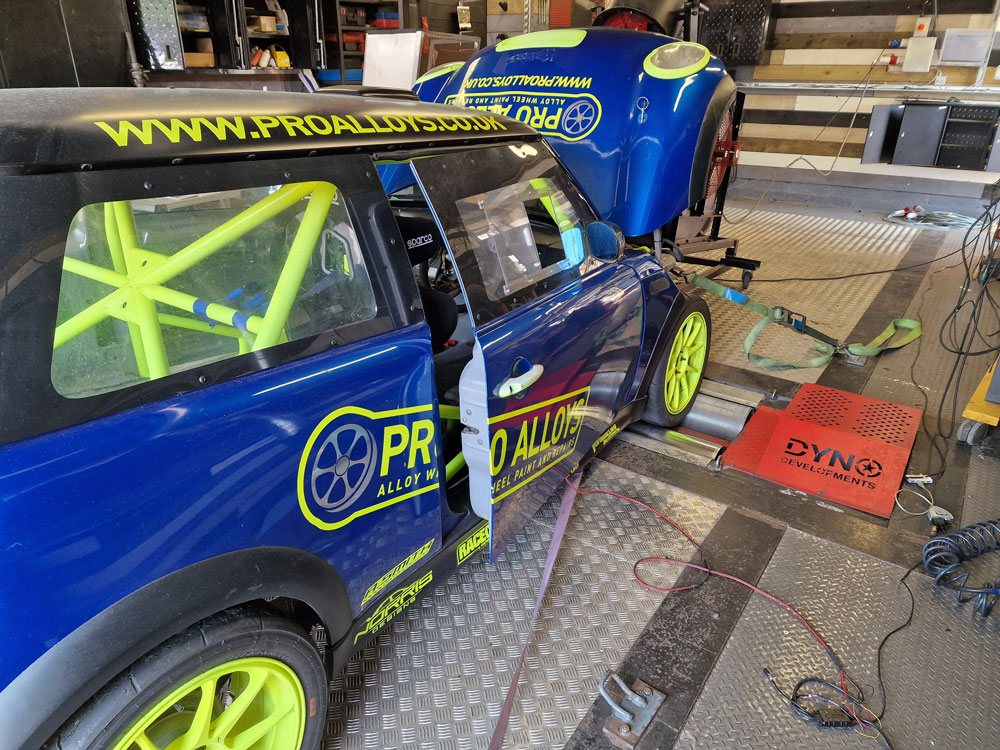
The car stays at Llandow while we check the setup, write the calibration and see how it responds.
Custom car remaps in Wales
Remapping for South Wales
We regularly work with customers from Cardiff, Bridgend, Swansea, Newport, Cowbridge, Barry, Llantrisant, the Vale of Glamorgan and surrounding areas.
What can a remap change?
On a suitable engine, calibration can change torque delivery, throttle response and available power. Results depend on the engine, fuel, hardware and condition. Fuel consumption may change with use; we do not promise an MPG gain.
Tell us about hesitation, flat spots or an existing warning before choosing a package. Those symptoms may need fault diagnosis first.
The remapping appointment
- Identify and check the vehicle. Review the engine, ECU, gearbox, service history, modifications and intended use. Existing faults can require separate investigation.
- Read the software. Use the supported OBD, bench or boot method for the ECU. We confirm access requirements before the job.
- Develop and write the calibration. Work from our in-house tuning data and the fitted specification, then write the agreed changes.
- Log and review. Check the response with suitable data logging and, where included in the agreed work, dyno testing. Revise the calibration from the measurements before handover.
Send the registration, engine, fuel normally used and existing modifications for a quote. Software access, preliminary checks and the testing required affect the appointment length.
Custom, off-the-shelf and file-agent tuning
We develop the calibration at Llandow with the car available for measurement and revision. An off-the-shelf product is developed for a defined specification; a file agent installs software supplied by another business. Read our comparison of these services, including the checks to ask about.
What Stage 1, Stage 1+ and Stage 2 mean
These are the packages we publish. Prices are starting prices. Some ECUs and vehicle combinations cost more. Check the car for the exact figure.
Stage 1
A calibration for a healthy standard car. No hardware changes are required. It is the usual starting point for an unmodified car, van or motorhome.
From £250, normally £400.
- Balanced power and torque
- Everyday drivability
- Possible efficiency improvement, depending on the car and how it is driven
Stage 1+
A higher-output calibration for a suitable standard car. It does not require an exhaust, air filter, or any change to the emissions equipment. We check the car's health, the fuel and the logged data before offering it.
From £250, normally £400.
- Higher output than Stage 1 where the standard car can support it
- Vehicle health checked first
- Fuel quality and logging considered
Stage 2
For a car that already has supporting hardware, such as improved airflow, cooling or exhaust. The calibration is written for the parts fitted to that car. We confirm the requirements before the work is agreed.
From £350, normally £500.
- Mapped to the installed hardware
- Developed with dyno and logging work
- Not a published package for a standard car
Stage 3
Stage 3 is a quoted build, not one of the published packages. It usually means major hardware such as a different turbo, injectors, fuel pump or internal engine parts, with the calibration written for that specification. It is discussed per car.
Aftercare, warranty and tuning risks
If the car develops a running problem after our work, contact us and bring it back for assessment. We correct a problem caused by our calibration or workmanship. This does not provide a warranty on every part of the vehicle.
Stage 1 and Stage 1+ are for healthy standard cars. Pre-existing wear remains the owner’s responsibility. We offer free diagnosis of concerns involving pre-existing weaknesses, but do not cover worn components.
Stage 2 and hardware builds increase the load on components such as the turbo, clutch and cooling system. Those parts have no tuning warranty. Mileage, condition and use affect the risk: a high-mileage performance car used hard differs from a van tuned for practical torque. We discuss suitability before proceeding.
We can assess faults and recommend repairs. If you dispute our findings, we obtain an independent assessment of the vehicle, modifications and reported issue to determine the next action. Read the full workshop terms and FAQ before authorising work.
Changes within the engine calibration
The changes depend on the ECU strategy and engine. They can involve fuelling, ignition timing on petrol engines, boost control, torque requests and their interaction with the gearbox. Sensor readings and thermal or mechanical limits need to be considered together.
A shared model badge or engine size does not prove that two cars have identical hardware. We check the fitted specification rather than assume that a lower-output version can use another model’s calibration.
For an existing remap that drives poorly, we can investigate the vehicle and review logs before recommending a revision. A warning or loss of power can also have a mechanical or electrical cause.