High-purity urea
The source of ammonia used by the SCR catalyst. Automotive fluid quality is specified by ISO 22241.


Common issues guide
AdBlue gives a modern diesel the chemical reducing agent it needs to convert harmful nitrogen oxides into nitrogen and water. When the fluid, dosing hardware, sensors or control strategy fail, a small fault can become a countdown warning, a no-start condition or an expensive chain of misdiagnosed parts.
Diagnose the system first. Repair the cause where practical. Only discuss restricted-use modification with the full vehicle and legal context understood.
A useful distinction
People often say that AdBlue reduces “nitrous oxide”. More accurately, an automotive SCR system reduces nitrogen oxides (NOx)—principally nitric oxide (NO) and nitrogen dioxide (NO₂). Nitrous oxide is the separate compound N₂O.
The fluid and the job
AdBlue is the VDA trademark for AUS 32: a tightly controlled solution of 32.5% high-purity urea and 67.5% demineralised water. It lives in a separate tank. It is not a fuel additive and should never be put in the diesel tank.
The source of ammonia used by the SCR catalyst. Automotive fluid quality is specified by ISO 22241.
Allows safe storage and accurate dosing, then evaporates in the hot exhaust.
High-temperature diesel combustion creates NO and NO₂. SCR treats these gases after combustion.
With the correct temperature, dosing and catalyst activity, NOx is converted mainly into nitrogen and water.
Inside the exhaust
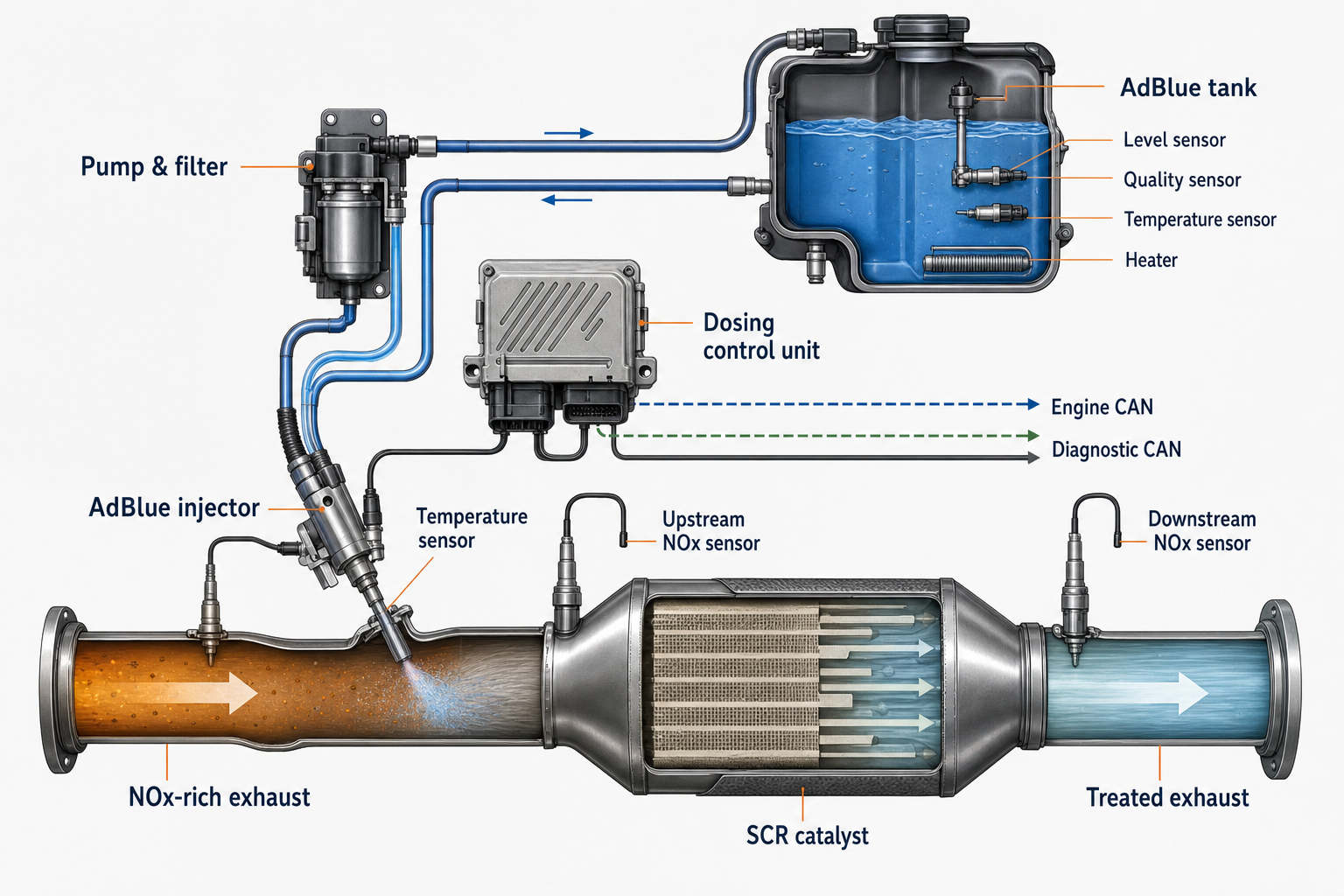
The ECU or dedicated aftertreatment controller does not simply switch an injector on. It estimates engine-out NOx, checks exhaust temperature, controls dosing pressure and compares sensor feedback to decide when and how much fluid to inject.
The pump supplies fluid at controlled pressure. The dosing injector atomises it ahead of the SCR catalyst. Exhaust heat evaporates the water; spray pattern, mixer design and temperature determine whether the fluid distributes cleanly.
Urea first decomposes, then the intermediate reacts with water. The useful product is ammonia (NH₃), delivered in a safer liquid form rather than stored on the vehicle as ammonia.
Ammonia adsorbs onto the SCR catalyst and reacts selectively with NO and NO₂. A representative standard reaction is 4NO + 4NH₃ + O₂ → 4N₂ + 6H₂O. The downstream sensor then checks whether conversion is plausible.
Too cold and the injected fluid may not fully evaporate or decompose, encouraging deposits. Inside the effective window, dosing and conversion can be controlled. Excess heat can age or damage the catalyst. Exact thresholds vary by system and catalyst formulation.
Common AdBlue and SCR faults
A countdown or SCR-efficiency code only tells you what the control system could not achieve. It does not prove which part caused it. Reading the code, replacing the named component and hoping is not a test plan.
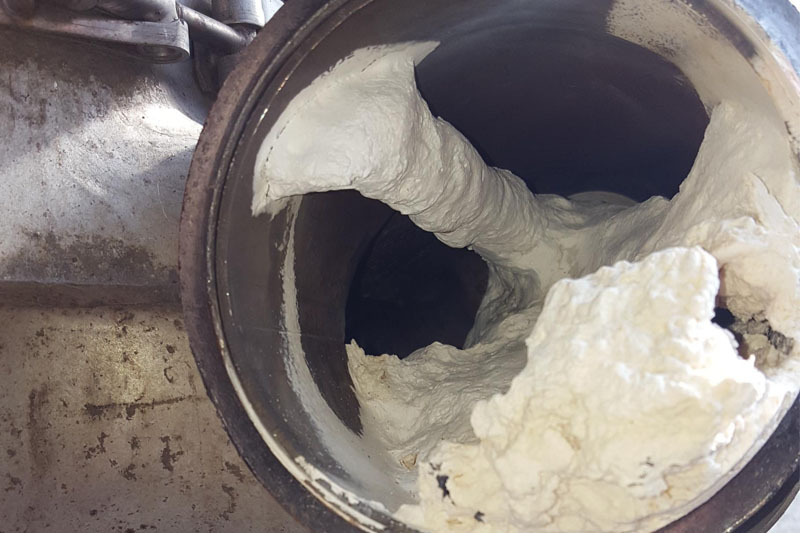
White crystals around a filler or dried spill are urea left behind as water evaporates. Inside the exhaust, more serious deposits can form when fluid impinges on a cold surface, atomisation is poor, the injector dribbles or exhaust temperature is repeatedly below the dosing strategy's useful window.
Wrong urea concentration, minerals from tap water, dirt, diesel, oil or unsuitable transfer equipment can damage precision components and reduce catalyst performance. A dashboard “quality” message can also be inferred from poor NOx conversion, so it does not prove the fluid itself is bad.
The supply module may combine a pump, filter, pressure sensing, heating and purge functions. Electrical failure, contamination, restriction, internal leakage or a heater fault can stop the system reaching or holding its commanded pressure.
A dosing valve can block, stick, leak, dribble after shutdown or lose its intended spray pattern. The controller may command the correct quantity while the exhaust receives too little, too much or badly distributed fluid.
Many systems use one NOx sensor before the SCR catalyst and another after it. Their heated sensing elements and electronic control modules live in a harsh thermal environment. A biased or intermittent signal can make good hardware appear ineffective or cause incorrect dosing.
AdBlue freezes at about −11 °C, so vehicles are designed with freeze-tolerant tanks and heating. Frozen fluid on a cold morning is not itself a defect. Failed heaters, wiring, temperature or level sensors, exhaust leaks and a genuinely aged or contaminated SCR catalyst can all prevent correct operation.
Cheap AdBlue vs quality AdBlue
Sometimes poor fluid is diluted with too much water, but price alone is not a quality test. Properly manufactured budget AdBlue that genuinely meets ISO 22241 should meet the same chemical specification as a more expensive branded product.
Cheap does not automatically mean bad. The real distinction is in-spec versus off-spec. When suspiciously cheap AdBlue is poor, the simplest problem can be exactly what many drivers assume: too much water and too little urea. It may also be contaminated, incorrectly concentrated, badly stored or sold through dirty transfer equipment.
How does a car know it has cheap or watered-down AdBlue?
The vehicle cannot identify a retailer, brand or receipt. Depending on its design, it can check AdBlue quality directly in the tank, infer it from NOx conversion across the SCR catalyst, or use both methods.
Some vehicles have a urea-quality sensor in the tank or supply module. It estimates whether concentration is plausible. Fluid with too much water may be recognised as having insufficient urea concentration and can produce a quality warning.
When the exhaust is hot enough and dosing is active, the controller compares expected engine-out NOx with the NOx remaining after the SCR catalyst. If a normal commanded dose produces less reduction than expected, weak fluid is one possible explanation.
On systems that adapt dosing from feedback, weaker fluid may lead to a higher dosing request or greater consumption as the controller tries to reach its target. That correction is limited: if conversion remains implausible, the system records a fault instead of increasing the dose indefinitely.
After the monitor fails under the required test conditions, the vehicle may show an AdBlue-quality or SCR-efficiency message and begin a restart countdown or performance inducement, depending on the manufacturer.
A failed NOx sensor, incorrect dosing quantity, injector deposits, low exhaust temperature, an exhaust leak or an aged catalyst can all make SCR conversion look poor. The fluid should be tested and the complete system diagnosed before a tank, catalyst or sensor is condemned.
Not necessarily. If the sealed product genuinely complies with ISO 22241 and has been stored and handled correctly, the selling location or lower price does not by itself make it inferior.
It can on systems that adapt dosing using NOx feedback, because each millilitre supplies less urea. However, not every strategy compensates in the same way, and the vehicle may set a quality or efficiency fault before a large consumption change is obvious.
No. Correct AdBlue is clear, but clear fluid can still have the wrong concentration or invisible chemical contamination. A suitable concentration or quality test is required when the fluid is suspect.
A proper diagnostic route
The exact test plan is manufacturer-specific, but the logic is consistent: establish what the controller commanded, what the hardware delivered and what happened to NOx across the catalyst.
Capture fault codes, freeze-frame data, countdown state and software identity before clearing anything.
Look for the wrong fluid, contamination, leaks, crystal tracks, damaged wiring, exhaust leaks and signs of previous tampering.
Test quality where suspect, commanded and actual pressure, pump operation, injector quantity, leakage and spray pattern.
Check whether the exhaust reached the required window and whether upstream and downstream sensors behave plausibly.
Run the manufacturer's reset, priming or adaptation procedure where required, then confirm stable pressure, dosing and SCR conversion under suitable load.
Reduce the avoidable failures
Not every electronic or mechanical failure can be prevented, but fluid handling and early diagnosis make a substantial difference.
Buy sealed AdBlue that states ISO 22241 compliance from a reputable source. Do not dilute it or add improvers.
Use a clean, dedicated spout or funnel. Keep diesel, tap water, dust, oil and workshop chemicals away from the filler and container.
Keep containers sealed, out of direct sunlight and away from prolonged heat. Follow the product's storage life and temperature guidance.
Do not overfill. Rinse external spills promptly with plenty of water and keep the filler cap and seal clean.
A pressure, quality or efficiency fault can progress into a restart countdown. Early testing is usually cheaper than repeated emergency top-ups or guessed parts.
Removing crystals is only half a repair. Confirm injector leakage and spray, exhaust temperature, mixer condition and the dosing strategy that created them.
Restricted-use modification
For a vehicle that will not be used on public roads and has a legitimate export, motorsport, diagnostic or controlled testing purpose, a software modification may be considered. This is not the same as clearing a fault code or applying an automated “AdBlue off” patch.
On some platforms the engine ECU owns the main SCR strategy, or acts as the coordinating controller. For a permitted non-road application, we may be able to modify that ECU calibration so it no longer requests AdBlue dosing, no longer expects the dosing control unit to remain connected, and no longer applies the former AdBlue-related warning or restart-inducement response.
The exact scope depends on the ECU, software version and the way the manufacturer distributes SCR functions across the vehicle network.
On other vehicles the dedicated dosing control unit (DCU) contains enough of the aftertreatment strategy to be reprogrammed directly. In suitable permitted applications, its calibration can be changed so it no longer commands AdBlue injection and no longer reacts to the former dosing, level, quality or SCR-monitoring conditions in the same way.
Some architectures still require coordinated changes or validation in the engine ECU, instrument cluster or other networked modules. Reprogramming one box and assuming the job is complete is not acceptable.
We identify which modules control dosing, monitoring, network communication and restart restrictions for the fitted software. Any permitted modification is checked at module, network and operating level.
Many file portals and automated tools search for familiar patterns, switch off diagnostic trouble codes and return a modified file without the installer understanding the underlying SCR state machine.
If the person installing the file cannot explain its scope, they cannot sensibly verify its side effects.
A competent specialist identifies the actual controller architecture and software version, understands how the engine ECU, SCR module and instrument cluster coordinate, and scopes only the functions relevant to the legitimate test purpose.
The important product is not a file labelled “AdBlue off”. It is accountable engineering for the exact controller and permitted use.
This page explains the engineering standard a responsible service should meet. It does not provide instructions, switch locations or code changes for defeating an emissions system.
Technical references
Start with evidence
Send us the vehicle details, dashboard message and any fault codes already supplied. We can discuss the sensible diagnostic route and whether the vehicle's intended use changes the available options.