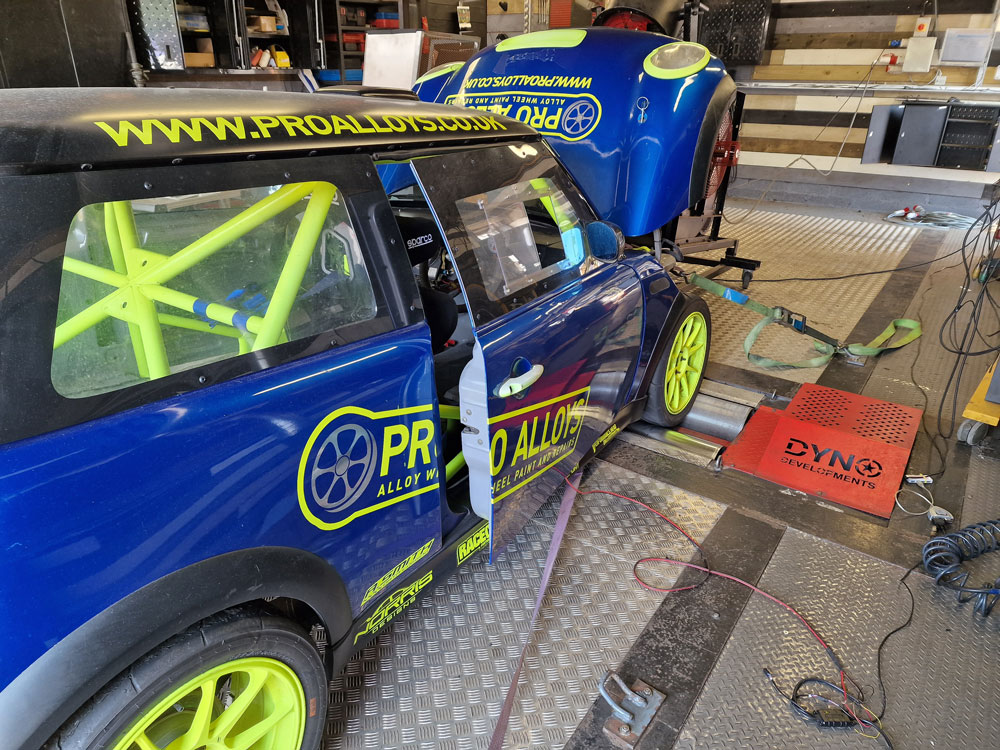

A map can fit the model.
A custom tune fits the car.
A reputable off-the-shelf map can deliver a real performance increase, but it has to work across many cars, fuels and conditions. Even with deliberate headroom, its generic target may sit beyond the actual safety boundary of an individual vehicle. Custom tuning starts with the car in front of us and uses measured data to keep the result within a safe, useful operating margin.
No invented power promise. No one-size-fits-all answer. Just the right questions, the right measurements and an honest target.
CALIBRATION ENVELOPEThe real limit belongs to the car.
Conceptual view
Safety boundary OTS may exceed Cheap map: small gain Safe custom stays below
The short answer
OTS is a delivery format. Development and verification decide whether it is good.
A proven OTS product and an unknown file may both be installed through the diagnostic port. That does not make them equivalent.
Three routes. Three different products.
What are you actually buying?
The same type of flashing tool can install all three. The difference is who developed the calibration, what was measured and what happens when the car does not match the assumption.
Tested product
Well-developed OTS
A calibration created for a defined engine, ECU software and hardware combination, then validated across representative vehicles, fuels and operating conditions.
Development
Built and revised on test vehicles. Supported software revisions, fuel modes and hardware requirements should be documented.
Risks
Generally lower when the car matches the declared specification and the installer checks its condition, ECU identity and fuel.
Gains
Strong, repeatable gains published as a realistic range, with deliberate margin for differences between cars and conditions.
Good OTS engineering trades some vehicle-specific optimisation for broad, proven coverage.
File supplied remotely
Cheap OTS from a slave network
The workshop reads the ECU, sends the original file to a portal or master supplier, then flashes back the returned file. It may have little visibility of what was changed or tested.
Development
Often a template selected by ECU identity and stage. The file origin, change log and test history may be opaque to both customer and installer.
Risks
Highest when diagnosis, logging and revision are absent. Wrong assumptions can affect boost, fuelling, torque, smoke, EGT and protection strategies.
Gains
May be small, inconsistent or made to feel larger through pedal rescaling. A low file price does not prove a strong result.
The slave tool is not the danger. The danger is treating an unverified file as a verified result.
Vehicle measured
Custom tune
The calibration is matched to the actual vehicle, its condition, hardware, fuel, intended use and the data available during controlled testing.
Development
Inspect, establish a baseline, calibrate, log, revise and verify as appropriate to the vehicle and the work requested.
Risks
Controlled by competent measurement and judgement. A bad custom tune can still be worse than a proven OTS product.
Gains
The best opportunity for the strongest useful and repeatable result, with power delivery, response and safety margin shaped around the car.
Custom should mean measured and revised—not simply a different file name.
Pedal position vs engine output
A sharper pedal is not more power.
A tuner can make a car feel much faster at part throttle simply by requesting more output earlier in the pedal travel. The full-throttle result may barely change.
Progressive pedal-to-power curve
Useful control across the full pedal.
A progressive calibration builds the requested engine output as the pedal is pressed, leaving the driver meaningful control between gentle driving and full demand.
Progressive requestFull pedal = full available output
Cheap OTS pedal rescale
The pedal trick front-loads the response.
The calibration requests nearly all available output much earlier. The car jumps forward at part throttle, but both curves still reach the same peak at full pedal.
Progressive reference Cheap OTS rescale
It feels faster because the pedal is more sensitive.If peak output is effectively unchanged, the early surge is a pedal-response gimmick—not a meaningful power gain.
Smoke and thermal load
More smoke is not more power.
On a diesel, visible black smoke is usually soot from fuel that has not burned cleanly. An over-rich petrol calibration can also waste fuel and create heat even when the smoke is less obvious.
Stock or validated calibration
Fuel demand follows the available air.
Smoke tendency remains controlled. EGT rises progressively with engine load while the calibration and factory protection strategies retain a thermal margin.
Smoke rises sharply as load increases. The extra fuel may add soot and exhaust heat without adding proportional power, pushing EGT into a damaging operating region.
Fuel that cannot burn cleanly does not become useful power.It can become soot and heat instead. Exact safe EGT varies by engine, fuel, sensor location, turbocharger, catalyst or DPF and exposure time, so these graphs show the relationship rather than a universal temperature limit.
Safety margin is working space
Headroom is not wasted power.
It is the tolerance that lets a calibration keep doing its job when the real world stops looking like the test cell.
A well-developed OTS map cannot assume every supported car will have the same fuel, temperature, altitude, maintenance history or production tolerance. It therefore targets a performance level that can remain dependable across its declared operating envelope.
Hardware baseline: this comparison starts with a healthy, standard car. Stage 1 and Stage 1+ are shown against stock hardware; Stage 2 and Stage 2+ only make sense against the uprated hardware specified for that vehicle.
STOCK HARDWAREStage 1 / Stage 1+
STAGE 1
A properly developed Stage 1 assumes healthy standard hardware. It aims to stay well inside the available turbo, fuel, thermal and torque capacity so the result remains repeatable across everyday fuel and weather variation.
STAGE 1+
Stage 1+ remains a stock-hardware calibration. It requests a little more than Stage 1 when the vehicle condition, fuel quality and measured data support it, so it keeps a slightly smaller buffer while remaining within the stock components' validated capacity.
UPRATED HARDWAREStage 2 / Stage 2+
STAGE 2
Stage 2 assumes specified supporting hardware such as an uprated intercooler, induction system or exhaust system. The exact combination depends on the vehicle, but better airflow or cooling creates a different usable envelope than stock hardware.
STAGE 2+
Stage 2+ uses more of the remaining capacity on a correctly matched hardware package. It sits closer to the measured boundary, making cooling, fuel quality, clutch or gearbox capacity, logging and verification more important.
Closer to the limit is not automatically unsafe when the hardware and measured data support it, but it usually leaves less tolerance for heat, poor fuel, wear or an unexpected vehicle fault. A bad Stage 1, Stage 1+, Stage 2 or Stage 2+ can cross a real limit—the badge does not make the calibration safe. A custom tune should set the right margin for the car, not simply chase the edge.
Stage names are not an engineering standard. One provider's Stage 1 can resemble another provider's Stage 2, so the declared hardware, fuel, test data and operating limits matter more than the badge.
OPERATING MARGINHardware-relative concept, not a power scale
Stage 1Broader bufferStage 1+Stock hardwareStage 2Uprated hardwareStage 2+Closer to boundaryBoundaryDo not crossBad calibrationBeyond the limit
01 Fuel quality
02 Intake temperature
03 Altitude and weather
04 Engine condition
05 Hardware specification
06 ECU software revision
What custom should mean
From calibration file to verified result.
The exact checks depend on the vehicle and the work requested. Llandow Tuning can use diagnostics, baseline runs, data logging and rolling-road verification where appropriate.
01
Inspect
Confirm the specification, modifications, intended fuel and any faults that could distort the result.
02
Measure
Establish how the vehicle behaves before chasing a headline figure.
03
Calibrate
Shape load, boost, fuelling, ignition and torque requests as the ECU strategy and vehicle require.
04
Log and revise
Review the parameters the vehicle makes available, then revise instead of assuming the first flash is finished.
05
Verify
Confirm delivery, repeatability and a sensible operating margin for the agreed use.
A bad custom tune can be worse than a proven OTS product.The advantage only exists when “custom” includes measurement, judgement and verification.
Where unverified files create risk
Unknown inputs. Unknown margin.
More power is created by changing interacting requests and limits. If the file's assumptions are wrong—or important protections are altered to hide problems—the vehicle carries the consequence.
BOOST
Air and cylinder load
Requested pressure must agree with turbo capability, airflow, temperature and fuel.
FUEL
Fuelling under load
Delivery capacity and mixture targets need to remain appropriate throughout the operating range.
IGN
Ignition and knock control
Fuel quality, temperature and combustion variation all influence safe ignition demand.
EGT
Exhaust temperature
Thermal protection matters to the turbocharger, catalyst, DPF and surrounding hardware.
TRQ
Torque modelling
The engine ECU, gearbox and stability systems need a coherent view of delivered torque.
SAFE
Factory protections
Faults and limiters should not be disabled simply to make an unsuitable calibration appear clean.
Evidence, not slogans
What the market's own pages tell us.
Published ranges and conditions are not weakness. They are a more honest description of how cars and environments vary.
Third-party source capture. REVO Scirocco 2.0 TSI Stage 1 page, accessed 10 July 2026.
REVO / PUBLISHED RANGE
211 PS stock. 254–284 PS tuned.
For this Scirocco application REVO publishes a 30 PS output range and a 40 lb-ft torque range, then notes that power depends on fuel quality, performance settings and conditions.
The point: even a large, established OTS developer does not pretend that one vehicle name guarantees one exact result.
Third-party source capture. REVO Fiesta ST Stage 1 page, accessed 10 July 2026.
REVO / RESPONSIBLE OTS
Good OTS engineering is more than peak power.
REVO describes retained factory safety mechanisms, fuel-specific modes and development across different conditions. That is the useful distinction: a supported calibration envelope, not simply a downloadable file.
Third-party source capture. Jorvik dealer page, accessed 10 July 2026.
JORVIK / FILE ECONOMICS
£25 can be the advertised file price.
That statement is useful context, not proof that a file is good or bad. It shows why the customer must ask what the fitting workshop adds: vehicle checks, correct matching, logging, revisions, verification and accountability.
The point: the cost of access to a file is not the value of a complete tuning service.
The screenshots and figures above are attributed factual examples from the linked third-party pages. They may change after the stated access date. Llandow Tuning is not affiliated with REVO or Jorvik Tuning.
Before anybody touches your ECU
Ask five questions.
A capable tuner should be able to answer these without hiding behind a stage number.
01
Who developed the calibration?
Ask whether it was written in-house, supplied by a known developer or simply purchased from an anonymous portal.
02
What was it tested on?
The same badge can hide different engines, ECUs, software versions, gearboxes and hardware revisions.
03
What fuel and hardware does it assume?
A map is only suitable when its stated requirements match how the vehicle will actually be used.
04
What data will be checked on my car?
Ask what is inspected, measured or logged before the tuner decides the result is acceptable.
05
What happens if the data is wrong?
A real service includes judgement, revision and a clear response when the car does not behave as expected.
Straight answers
OTS and custom tuning FAQs.
Is an OTS map automatically unsafe?
No. A properly developed OTS map can be an excellent choice for a healthy vehicle that matches its supported specification. Development history, matching, requirements and validation matter more than the label.
Why does advertised power come as a range?
Because measured output changes with fuel, temperature, altitude, vehicle condition, dyno method, software settings and production variation. A range can be more credible than a single guaranteed number.
Will a custom tune always make more power?
Not necessarily, and maximum power should not be the only target. Custom tuning is valuable because delivery, torque, response and safety margin can be judged using the actual vehicle and the owner's goal.
Does leaving headroom mean the tune is weak?
No. Headroom is what accommodates changing conditions and normal variation. The correct amount depends on the engine, hardware, fuel and intended use.
When is custom tuning most useful?
It is especially useful when hardware has changed, the vehicle has unusual requirements, the owner wants a particular delivery characteristic, or the result needs to be measured and refined rather than assumed.
Bring us the car, not just the model name
Let's choose the right calibration for your vehicle.
Tell us the model, engine, modifications, fuel and what you want to improve. We will talk through the sensible route before making a promise.