
ECU Tuning & Remapping
Unlock Performance and Economy Gains
Is your vehicle held back by frustrating lag, slow response, or flat spots? Are you looking to unlock extra power and performance?
Struggling with downshifting on uphill drives? Or perhaps you just want to make driving your vehicle a lot more fun and enjoyable.
ECU remapping, formerly known as chiptuning, involves modifying or tuning the software of your Engine Control Unit (ECU) to achieve increased performance, improved drivability, and even lower fuel consumption. At Llandow Tuning, we strive to deliver the perfect balance of all these benefits.
With over 22 years of experience, we're proud to be one of Wales' most trusted tuners. We've been providing custom, tested remaps for a wide range of vehicles, ensuring every tune meets your expectations.
Every Llandow tune is a custom tune tailored to your vehicle—not an off-the-shelf or bought-in solution like those you will find at other tuning centres in Wales.
ECU Remapping Benefits
A modern vehicle is capable of so much more but is limited thanks to Red Tape, Emissions Targets and the need to protect profit margins of high performance models, as such manufacturers detune their engines.Thankfully with a few focused tweaks superior performance, enhanced fuel efficiency, and a more thrilling driving experience await.
Better Performance
Unlock significant BHP gains and enjoy a more exhilarating driving experience with enhanced power delivery and seamless performance.
More Torque
Unlock greater torque and power output across the rev range, making towing, overtaking, and daily driving effortless.
Better MPG
Enhance fuel efficiency with precise adjustments to your engine's parameters. Customers report gains of up to 5 MPG, saving money on every journey.
Improved Throttle
Enjoy sharper throttle response and a more connected driving experience with remapping designed to suit your style.
How does Remapping work?
Engine remapping, also known as ECU tuning, is the process of modifying the software within a vehicle's Engine Control Unit (ECU) to optimise its performance. The ECU acts as the brain of the engine, controlling vital functions such as fuel injection, ignition timing, turbocharging, and emissions systems. By remapping the ECU, we can unlock your car's hidden potential. Here's how it works at Stage 1:
1. Reading the Original ECU Calibration
The process begins with connecting to your car's ECU using specialist tools. These tools extract the original software calibration, which contains all the parameters and settings that control your engine's performance. This step is crucial, as it provides a blueprint of your car’s current setup.
We might read the ECU via the internal diagnostic port (OBD) or we might need to remove the ECU to access it within our fully equipted electronics lab. Full ESD precautions are followed
2. Analyzing the Calibration
Once the original calibration is extracted, it is carefully analysed by experienced tuners and software specialists. We typically use WINOLS for this process. Analyzing and identifying the maps is a critical step. Most modern ECUs contain around 10,000 to 50,000 maps and switches, and understanding what they do and how they impact the engine is what makes the difference between how much power the engine will produce and how safe it will be.
3. Creating a Custom Map
A new, optimised version of the calibration is created based on the desired outcomes. Whether the goal is increased horsepower, better fuel efficiency, or a smoother driving experience, the calibration is customized to suit your vehicle and your preferences.
The kind of things modified might include:
- Fuel Delivery: Adjusting the amount and timing of fuel injection for better combustion.
- Boost Pressure: For turbocharged engines, optimizing turbocharger settings to increase power.
- Ignition Timing: Fine-tuning when the spark plugs ignite for better performance.
- Torque Limiters: Increasing or adjusting factory torque limits to maximise output.
4. Uploading the New Calibration
The modified calibration is then uploaded back to the ECU. This process ensures that the new settings take over, effectively reprogramming your engine's behavior.
5. Dyno Testing, Data Logging, and Fine-Tuning
Once the new calibration is installed, the vehicle is thoroughly tested to ensure everything runs smoothly and as expected. We use dynos, data log the engine's performance, and, if needed, make additional tweaks to perfect the tune and deliver optimal results.
We also provide a full after-sale service to ensure your engine continues to perform at its best. Whether you need additional advice or adjustments, we’re here to support you every step of the way.
WINOLS: The software used to modify the calibration on your engine ecu
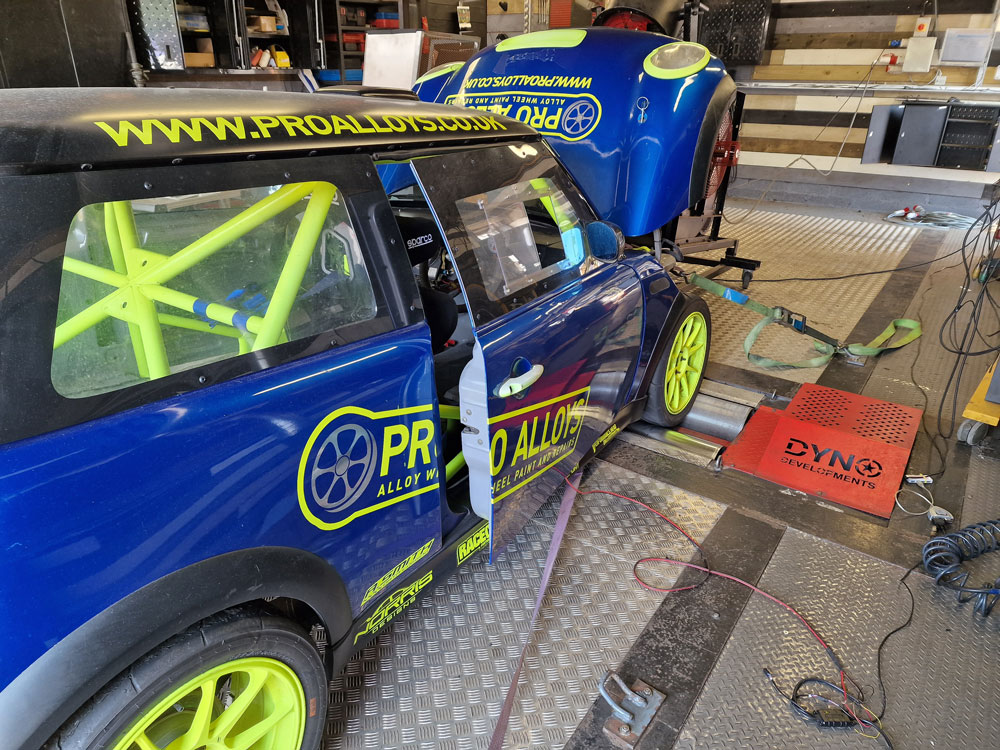
Vehicle undergoing dyno testing at Llandow Tuning Wales
Exhaust Gas Analysis - Emission, AFR and Gas Analysis
Vehicle Datalogging and Analysis
Custom Tuning vs. Off-the-Shelf (OTS) Tunes
At the time of writing, we are proud to be the only dyno tuning centre in Wales that provides 100% custom tuning. Unlike our competition, who either offer OTS tunes or have done so in the past, we deliver bespoke solutions tailored specifically to your vehicle and your needs. Here’s why custom tuning is the better choice and the risks of off-the-shelf tunes:
The Risks of Off-the-Shelf (OTS) Tunes
Off-the-shelf tunes are pre-made software calibrations that are designed to work across a wide range of vehicles of the same make and model. While this may sound convenient, OTS tunes come with significant risks, including:
-
Lack of Customization
OTS tunes are generic and fail to account for differences in individual vehicles. Variations in engine wear, modifications, or even factory tolerances mean that an OTS tune may not work as intended and could lead to poor performance or reliability issues. -
Potential Engine Damage
Without tailoring to the specific characteristics of your engine, an OTS tune can push components beyond their safe limits, increasing the risk of engine or transmission failure. -
Missed Potential
OTS tunes are often conservative to ensure they work on all vehicles, meaning you may not get the full power, efficiency, or drivability improvements your car is capable of achieving. -
One-Size-Fits-All Approach
They do not consider additional modifications such as upgraded exhausts, turbos, or injectors, leading to an unoptimised and inefficient tune for your setup. -
Popularity of Cloned Tools
OTS tunes have become popular in recent years thanks to cloned Chinese tools and untrained operators pushing remaps at very low prices. -
Lack of Support
Typically, when the remap goes wrong or problems develop after the remap, support is very limited. We often receive enquiries to repair the damage done by tuning cowboys. -
Untrained Operators
Most people installing an OTS map simply don't know about engines or computers. After only a week or so of training, they can read and write calibrations, and because they buy in OTS maps, they don't need any engine skills or software/reverse engineering expertise to understand the installed calibration. -
File Factory
The best way to sum up OTS tunes is you get what you pay for. Ultimately, the OTS is sold to the Amateur Tuner for around £25, the rest being their markup. For £25, are you really getting a decent remap or just an unknown? -
Inability to Fix Issues
Even when you might have found someone half decent doing OTS tunes, maybe a reputable garage or an OTS tuner with a dyno, they will be completely unable to tweak a map if it goes wrong. They won't understand the modifications or what impact they might be having on error codes or odd symptoms you could be experiencing.
The Benefits of Custom Tuning
Custom tuning is designed specifically for your vehicle. At Llandow Tuning, we create bespoke calibrations tailored to your car’s unique characteristics and your driving goals. The advantages of custom tuning include:
-
Precision Tailoring
Custom tunes are built around your vehicle’s specific engine, modifications, and condition, ensuring optimal performance and reliability. -
Maximised Performance
Every map is fine-tuned to extract the best possible power, torque, and efficiency from your engine without compromising safety. -
Enhanced Safety
With custom tuning, we ensure that no component is pushed beyond its limits, reducing the risk of mechanical failure. -
Flexibility for Modifications
Whether you’ve upgraded your turbocharger, exhaust system, or intake, custom tuning can adapt to these changes, delivering the best results for your setup. -
Highly Skilled Tuners
Those modifying the calibration have advanced automotive, electronics, and reverse engineering skills, ensuring precise and safe results. -
Immediate Feedback
Because the tuner is the one installing the calibration, they will know immediately if something needs further adjustment, as opposed to a tuner working remotely or at another site. -
Genuine Master Tools
During the reading and writing phase of the calibration, real tuners like us use genuine Master Flashing tools from MPPS, Magic Motorsport, Alientech, or Flashtec. Sometimes, there are issues with tuning protection, and these firms offer remote assistance to ensure the ECU isn’t bricked. You don’t get this level of support with cloned tools. Indeed you can expect a man in a van to drive off at the first sign of a problem
What does Stage 1, 1+, 2, 3 etc mean?
In the world of vehicle tuning, the terms Stage 1, Stage 2, Stage 3, and beyond are used to describe different levels of performance upgrades. Each stage represents a combination of modifications and tuning aimed at enhancing your vehicle's power, torque, and drivability. Here's a breakdown of what these stages typically mean:
Stage 1
Stage 1 refers to a software-only remap that requires no physical modifications to the vehicle. It is designed to safely optimise the engine's performance within the limits of the factory components.
- Increased horsepower and torque.
- Improved throttle response and drivability.
- No hardware changes required.
- Ideal for those looking for a noticeable boost in performance without the need for additional upgrades.
- Unmodified Every day cars, vans or plant
- Campervans or Motorhomes
- People that want a decent fuel economy boost
- If you've never had a remap before, Stage 1 is certainly where to start.
Stage 1+
Stage 1+ builds on the foundation of Stage 1 but may require minor hardware changes, such as upgraded air filters or a performance exhaust. These changes allow the engine to breathe better and deliver slightly more power. On diesel vehicles, Stage 1+ will also require a DPF (Diesel Particulate Filter) and EGR (Exhaust Gas Recirculation) to be disabled or removed.
- Further improvements in power and efficiency.
- Enhanced reliability with minor supporting mods.
- DPF and EGR removal or disablement for diesels.
- Drivers wanting more performance without committing to major upgrades.
Stage 2
Stage 2 introduces more significant hardware modifications alongside a custom remap to make the most of the new components. These changes often include an upgraded intercooler and the kinds of modifications associated with Stage 1+, such as an induction kit. On petrol vehicles, Stage 2 will typically require removing or replacing the catalytic converter, as it is a significant source of heat and restriction. However, we can work around this as all our maps are completely custom.
- Substantial power and torque gains.
- Enhanced cooling and airflow for better engine efficiency.
- May disable or replace the catalytic converter on petrol engines.
- Stage 2 is ideal for enthusiasts seeking a dramatic performance improvement but is about as far as it is wise to push a daily driver.
Stage 3
Stage 3 tuning is a more extreme level of modification that typically involves replacing or upgrading major engine components, such as turbochargers, injectors, fuel pumps, or even engine internals. A Stage 3 tune is tailored to these upgrades to ensure the car runs reliably with significantly increased power. However, in our opinion, Stage 3 is not really suitable for a daily driver due to its high-performance focus and the potential impact on reliability.
- Massive power and torque increases.
- Custom-built solutions for your vehicle.
- Reduced practicality and reliability for everyday use.
- Hardcore enthusiasts and track-day drivers who want the ultimate in performance and are prepared for the additional maintenance and cost.
Things to Keep in Mind
- Component Compatibility: Higher stages require supporting hardware to handle the increased power safely.
- Costs: As you progress through the stages, both the cost of modifications and potential maintenance increase.
- Purpose: Higher stages are often less practical for daily driving, so consider your goals before deciding.
Our Guarantee & Warranty Claims
At Llandow Tuning, our priority is your motoring pleasure. We want you to enjoy your remap with confidence, refer us to your friends, and return to us with your next vehicle.
If an issue arises, the first step is to bring the car back to us. We will assess the vehicle and create an action plan to diagnose and resolve the problem.
Stage 1 Remaps – Our Commitment
For Stage 1 tuning, our remaps are designed within safe tolerances. If the remap itself causes an issue, we will fix it. However, tuning does not make a car immune to problems—wear and tear still apply.
In 22 years of experience, we have never seen a Stage 1 remap applied by us cause hardware damage.
That said, high-mileage vehicles (e.g., 100k+ miles on a turbo) are more susceptible to pre-existing weaknesses. We diagnose such cases for free, but we do not cover worn-out components.
Stage 1+ & Above – Motorsport Basis
For Stage 1+ and above, tuning exceeds factory parameters, increasing mechanical stress. At this level, there is no warranty as it falls under motorsport use.
Example – Golf R:
- Stock: 300HP
- Stage 1: 360HP – No known issues with well-maintained cars.
- Stage 1+ / Stage 2: 400HP – Expect turbo wear to accelerate.
High-Mileage Vehicles & Tuning Risks
Any car over 100k miles is inherently riskier to tune. Even without tuning, wear and tear will take its toll. Vehicles used aggressively will see parts degrade faster.
If tuning is for practical reasons (e.g., improving torque in a van), we may tune even at 180k+ miles. However, for high-performance cars driven hard, we will only assist in identifying issues, not provide a warranty.
Our After-Sales Support
Let’s be frank—for a £350 remap, we are not providing a full warranty on every part of the car, except, of course, where it is directly related to something we've done wrong. Our priority is to ensure you have confidence in our tuning, and in the unlikely event of an issue, we will assist as follows:
- A professional diagnostic assessment if an issue arises.
- Support in identifying faults and recommending solutions.
- Guidance on next steps to get you back on the road.
The responsibility for vehicle wear and tear remains with the owner—whether the car is tuned or not. As with any mechanical component, parts will degrade over time, and tuning does not prevent natural wear.
However, should you not accept our findings, we will obtain an independent assessment of the vehicle, its modifications, and any issues that have arisen. Their findings will be used as the basis for determining the next course of action.
We aim to provide reliable tuning that enhances performance while keeping risks in mind. Our goal is for you to enjoy your tuned car worry-free, recommend us to others, and come back to us for your next vehicle.
Where do the Performance Gains come from?
Performance tuning involves optimizing various aspects of the engine calibration to extract more power, torque, and efficiency. Whether it’s a petrol or diesel engine, we can fine-tune multiple areas to suit your driving needs.
At Llandow Tuning, we offer custom tuning solutions tailored to your requirements. Whether you're looking for a safe and efficient Stage 1 remap or a more aggressive Stage 1+ or Stage 2 tune, we can adjust the calibration to match your goals—within the limits of mechanical reliability.
Why Are These Gains Possible?
Manufacturers don’t always release vehicles at their full performance potential. There are multiple reasons why a car may be software-limited from the factory:
- Emission Regulations – To comply with strict environmental laws, manufacturers may tune an engine to produce lower NOx or CO2 emissions, often sacrificing power and efficiency. We can optimise fueling, boost pressure, and ignition timing to improve power while maintaining compliance where necessary.
- Built-in Safeguards Against Driver Abuse – Many manufacturers limit power output to protect clutches, gearboxes, and other drivetrain components from premature wear due to aggressive driving. We can safely increase these limits while considering hardware longevity.
- Detuning for Market Positioning – To differentiate models within a lineup, manufacturers often detune an engine to prevent it from competing with their more expensive performance models. In many cases, the higher-powered variant uses the same engine hardware but with a different software calibration. This means we can unlock significant power gains without needing mechanical modifications.
- Large Price Gaps Between Models – A common example is a car model available in 150HP and 200HP versions—where the only real difference is the ECU calibration. Rather than paying a large premium for the more powerful model, tuning can often unlock that extra power for a fraction of the cost.
Fuelling Adjustments
- Optimizing fuel delivery to match air intake for better combustion efficiency.
- Adjusting injector timing and duration for improved power and response.
- Enhancing fuel pressure in direct injection systems for better atomization.
- Restoring full fuel enrichment – For over 30 years, production cars have had fuel mixture limitations imposed by emissions regulations, often to the detriment of power and engine longevity.
- We can reintroduce proper fuel enrichment, particularly on turbocharged engines, where additional fuel can provide better cooling, protection against detonation, and improved power output.
- By carefully adjusting the fuel mixture, we can maximise power safely without excessive emissions or engine stress.
- In diesel engines, we can enrich the fuel mixture, increasing power but also generating more black smoke. However, this comes with increased Exhaust Gas Temperatures (EGT) and cylinder stress, which must be considered before opting for a high-power tune.
Ignition Timing (Petrol Engines)
Higher octane fuels allow for ignition timing adjustments to increase power safely. We can:
- Advancing or retarding ignition timing for optimal power and efficiency.
- Adjusting knock control strategies to allow for safer ignition timing improvements.
- Adapting ignition timing for higher octane fuel – Higher octane fuel resists detonation (knock), which is a major limiting factor in tuning. By adjusting ignition timing to take advantage of high-octane fuel, we can safely extract more power and efficiency from the engine.
Boost Pressure (Turbocharged Engines)
Turbocharged vehicles can see major gains from proper boost adjustments, such as:
- Increasing turbo boost levels within safe limits to enhance airflow and power.
- Optimizing wastegate control to improve turbo spool and boost response.
- Adjusting boost pressure targets based on load and RPM for better drivability.
- Modifying Variable Valve Timing (VVT) to improve turbo spool – By adjusting camshaft overlap and intake timing, we can improve exhaust scavenging, allowing the turbo to spool faster and more efficiently. This helps reduce turbo lag and provides a more responsive power delivery, especially at low RPM.
Torque Management & Limiting Maps
Modern ECUs have multiple torque limiters in place to protect components such as the turbo, gearbox, and clutch. These limits are based on various parameters, including:
-
Exhaust Gas Temperatures (EGT)
Protects the turbo and exhaust system. -
Diesel Particulate Filter (DPF) temperatures
Ensures emissions compliance
and prevents overheating. -
Gearbox Torque Limits
Protects DSG, Tiptronic, and automatic transmissions. -
Drivetrain Protection
Prevents excessive torque delivery in low gears. -
Engine Coolant Temperature Torque Limits
Limits engine output if coolant temperatures exceed
safe levels to prevent overheating and engine damage. -
External Temperature Torque Limits
Some ECUs reduce torque in extreme weather
conditions to prevent stress on components. -
We can modify these limits to maximise performance
while ensuring safe operation for the vehicle.
Understanding ECU Complexity
ECUs have evolved significantly over the past few decades. A Lucas 14CUx ECU from 1990, for example, had only a handful of maps and relied on basic airflow sensors from Bosch and Hitachi to determine fueling needs. These early ECUs were relatively simple in terms of function but were not as easy to modify as modern ECUs.
The process of tuning them required a deep understanding of electronics and software at the hardware level, as dedicated tuning tools and software were not yet widely available to enthusiasts. Unlike today’s plug-and-play tuning solutions, modifying these early ECUs often meant physically replacing or reprogramming EPROM chips and working with limited diagnostic feedback.
In contrast, modern ECUs from manufacturers such as Siemens, Continental, Bosch, Denso, Hitachi, and others can have anywhere from 10,000 to 50,000 individual maps, each controlling different aspects of engine performance.
What Do Modern ECUs Control?
- 2D and 3D calibration curves – Used for boost pressure, fuel delivery, ignition timing, torque requests, and many other parameters.
- Switches and limiters – Enable or disable features like start-stop, speed limiters, or emission-related functions.
- Torque models and driver behavior adaptation – Many ECUs dynamically adjust performance based on driving style, requiring careful tuning to maintain consistency.
Some high-performance cars, like the BMW M5, take this complexity even further—running a dedicated ECU for each bank of cylinders to ensure precise fuel and ignition control across the entire engine. This level of control allows for highly optimised performance but also means tuning requires a much deeper understanding of how all the systems interact.
Because of this complexity, every remap we create is custom-tailored to the vehicle and the driver’s requirements. We carefully analyse how all the maps work together to ensure the best balance of performance, efficiency, and reliability.
The Difference in Tuning Approach
Not all tuners are the same. Understanding the differences helps in choosing the right tuning approachWe encourage potential customers to examine the competition, ask them about how they tune the car, what is the process, what are their skills and expertise and then ask us the same questions, compare and make an informed decision
Dealer Network Tuners
Some tuners simply resell off-the-shelf tuning files developed by others. While these may work, they are not customized to your car and often fail to maximise performance.
Even reputable brands like REVO and APR create quality tunes, but they assume all vehicles behave identically, which is rarely the case. These dealer network tunes are installed by tuners who cannot develop software themselves.
Self-Developed Software
Some tuners develop their own software, with varying levels of quality. A few are highly skilled, but many make changes without fully understanding the consequences.
- Has the software even been tested?
- Have they used a dyno to develop it, or is your car the test subject?
- Poorly developed software can lead to instability.
- Excessive stress on components reduces reliability.
- Inconsistent power delivery and drivability issues.
Llandow Tuning’s Approach
At Llandow Tuning, we offer a different approach. Our background in electronics, software development, reverse engineering, and advanced software engineering gives us a unique advantage.
We don’t just modify maps—we understand the logic behind ECU programming, allowing us to create bespoke solutions tailored to your vehicle.
We are not aware of any other tuner in Wales with our level of experience and skillset who has been independently tuning cars for as long as we have.
Our goal is to provide custom, high-quality remaps that ensure the best balance of performance, reliability, and drivability.
Your Vehicle, Your Tune, Your Choice
A well-executed remap can dramatically improve performance while maintaining reliability. However, pushing an engine beyond safe limits increases wear and risk of failure. We can help you find the right balance.
If you have any questions about tuning your vehicle, get in touch—we’d be happy to advise on the best solution for your car!
Already had a remap? But is it the best it can be?
Many remaps on the market are generic, one-size-fits-all solutions that fail to maximise your car’s true potential. A proper custom calibration ensures better performance, drivability, and safety.
At Llandow Tuning, we create bespoke remaps based on real-world testing and development, ensuring your car gets the best possible tuning—not just a basic file upload.
Why Upgrade to a Custom Remap?
Even if your car has already been remapped, a true custom calibration offers multiple advantages over generic files:
- Highly Tested – All our maps are developed using extensive R&D on your specific engine, ensuring maximum performance and reliability.
- Better Gains – A custom map typically delivers higher power and torque than a generic remap, as it’s optimised specifically for your vehicle.
- Enhanced Safety – Our tuning is properly data-logged and tested to ensure all parameters remain within safe limits.
- After-Sales Support – Running our map means you get ongoing support. If a warning light comes on or you have questions, we’re here to help.
Unlike many generic tuning solutions, our custom remaps are designed for maximum performance without compromising longevity. Get in touch today to find out what your car is really capable of!
Compare us to Local Tuners OTS Maps vs Custom Tuning