
DPF Tuning, Exhaust Temperatures and Why Bad Diesel Mapping Destroys Engines
Diesel tuning is easy to talk about and much harder to do properly.
Anybody can download a file, flash it into an ECU, make the car feel quicker and tell the customer it is fine. The problem is that a diesel engine does not care how confident the tuner sounds. If the calibration is wrong, exhaust gas temperatures rise, combustion quality falls, and the damage is often cumulative rather than instant.
Gale Banks puts this very plainly: overfuelling raises EGT, and excessive EGT can mean eventual death for the engine or turbocharger, with damage building up over time.
That is why DPF tuning and diesel performance tuning should never be treated like a file-sharing exercise.
Why exhaust temperatures matter so much on a diesel
Exhaust gas temperature is not just an abstract number. It is a window into what is happening during combustion.
Banks describes EGT as an indication of how hot the combustion process is in the cylinders and how much afterburning is occurring in the exhaust manifold. He also points out that EGT is directly related to diesel air-fuel ratio: the richer the mixture, the higher the EGT, and richness can come from either too much fuel or not enough air.
That matters because a diesel can still run while being badly calibrated. It can still pull well enough to impress the owner. It can still make smoke that some people mistake for power. Meanwhile, cylinder temperatures, exhaust temperatures, piston crown temperatures and turbocharger heat load may all be climbing into dangerous territory.
If you add fuel without doing it properly, exhaust gas temperatures can quickly move into dangerous territory. That can spell eventual death for the engine or turbocharger.
Why heat melts engines
People often say too much heat melts engines, but it is worth being clear what that actually means.
When combustion is poor and EGT rises, the engine and turbo are exposed to more thermal stress. Exhaust valves, turbine housings, manifolds, pistons, ring lands and cylinder heads all have to live in that environment. If that heat is excessive, repeated and uncontrolled, components fatigue, distort, crack or fail.
HELLA technical guidance on exhaust gas temperature sensors also notes that excessively high exhaust temperatures can result from defects in injection or the air-fuel mix, and that the ECU uses exhaust temperature monitoring to protect components from overheating.
So when a diesel tune is overfuelled, smoky and untested, the risk is not just that it may get hot one day. The heat is part of the problem from the moment the calibration is wrong.
Why tuning for smoke is stupid
There is still an old-school mentality in some parts of diesel tuning that smoke equals power.
It does not.
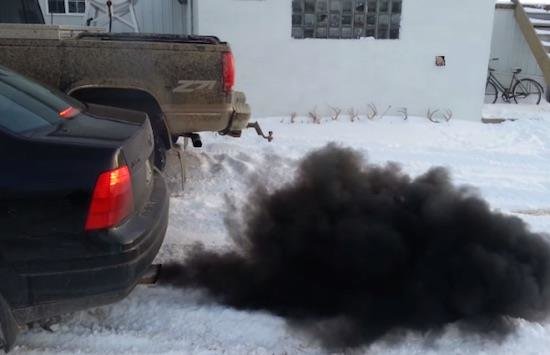
Banks is clear on this. Diesel smoke is soot from unburned or partially burned fuel. Black smoke is the byproduct of incomplete combustion. Unless you also add enough air, a lot of incompletely combusted fuel, and therefore horsepower, goes out of the tailpipe as smoke.
Smoke is not proof of a clever tune. Smoke is usually proof that fuel is being delivered that cannot be burned properly with the air available. That means wasted fuel, dirtier running, more soot, more heat and less margin.
Put simply: more smoke usually means less quality.
Why simply downloading an unverified file is madness
This is one of the biggest problems in diesel tuning now.
Files get copied, sold, resold, shared, renamed and flashed into cars that the file writer has never seen. No live data. No logging. No verification. No idea what the actual boost control is doing. No idea what intake temperatures are doing. No idea what fuelling deviation is doing. No idea what exhaust temperatures are doing.
That is madness because the tune is being trusted blindly.
Even if the file was originally okay on one vehicle, that proves absolutely nothing about another vehicle with different hardware condition, boost leaks, tired injectors, sticky vanes, poor airflow, previous repairs or undiscovered faults. A diesel map is not safe because it was emailed over with a confident name.
It is safe only when the vehicle itself has been tested and the results support it.
Why tuned diesels need EGT monitoring
If you are increasing fuelling on a diesel, you need to know what the exhaust temperature is doing.
That should not be controversial.
Modern engines often have exhaust gas temperature sensors at key points in the exhaust system so the ECU can monitor and protect components. HELLA notes that in modern vehicles, exhaust gas temperature sensors may be fitted in front of the turbocharger, catalytic converter and DPF, and that the control system can switch to substitute values or emergency operation to protect components from overheating if readings become implausible or a sensor fails.
That is exactly the point: the manufacturer monitors heat because heat matters.
On tuned diesels, EGT monitoring gives you visibility into whether the calibration is still within a sensible thermal window under real load. Without it, you are tuning one of the most failure-sensitive parts of the diesel combustion process while effectively blind.
Why this is especially important on VW PD engines with EDC15
Older VW PD engines running EDC15 are a good example of why blind tuning is dangerous.
Volkswagen self-study material for the 1.9 PD engine lists inputs such as air-mass flow, coolant temperature, intake manifold temperature and fuel temperature in the engine management system overview, but it does not list an exhaust gas temperature sensor as part of that system overview.
That does not prove every PD variant never had any exhaust temperature sensing in any application, but it does support the practical point that these older EDC15 PD systems do not have the sort of built-in exhaust temperature feedback strategy people now take for granted on later diesel platforms.
That is why, on tuned PD engines, an external EGT probe is such a sensible safeguard.
If the ECU is not natively giving you turbine-inlet temperature feedback in the way later platforms can, then the tuner needs another way to know what the engine is actually doing under load. An external EGT sensor and live monitoring is the obvious answer.
Unless it is tuned live with EGT hooked up, you are taking a risk
That is the uncomfortable truth.
A diesel can look fine in the workshop, feel fine on the road and still be running excessive EGT under sustained load, uphill work, towing, hot weather, repeated acceleration or higher-speed use. Brief abuse may not kill it immediately, but EGT damage can be cumulative.
So if somebody is tuning an older diesel live without EGT measurement, or worse, flashing in a generic file without any meaningful data logging at all, they are taking a gamble with somebody else engine.
Not a calculation. A gamble.
PD engines, cracked heads and poor-quality tuning
PD engines have a reputation for being tough, and they are. But tough is not the same as indestructible.
When a diesel is repeatedly overfuelled, run hot, smoked up and never properly logged, the engine spends its life under unnecessary thermal stress. On a PD, that means the head, gasket area, exhaust side and cooling system are all being asked to absorb abuse they were never meant to see day after day.
It would be wrong to claim every cracked PD head is caused by tuning. That would go beyond the evidence. But it is fair to say this: bad tuning, excessive EGT and lack of live testing are exactly the sort of conditions that increase the likelihood of expensive failures.
So when people see tuned PDs with cracked heads, coolant pressurising issues, overheated turbos or other heat-related problems, it should not be dismissed as bad luck. In many cases, the real question is whether the vehicle was ever calibrated and tested properly in the first place.
DPF tuning makes this even more important
Once DPF-related strategies are involved, the need for proper calibration goes up, not down.
DPF systems are heavily linked to exhaust temperature, soot loading and regeneration behaviour. Exhaust gas temperature sensors are part of how modern control systems monitor the relevant components and manage protection strategies.
That means poor DPF tuning is not just about warning lights or smoke. It can alter how the engine handles heat, soot and regeneration-related behaviour. If that work is carried out badly, or with a lazy downloaded file that has never been verified on that car, the result can be a vehicle that drives okay while the thermal strategy is no longer where it should be.
That is one reason proper diesel work needs testing, logging and real understanding rather than copied files and guesswork.
What Gale Banks gets right
Gale Banks main points are simple and hard to argue with:
- Smoke is unburned or partially burned fuel.
- Too much fuel or not enough air increases EGT.
- High EGT can damage engines and turbochargers, and the damage is cumulative.
- The goal should be to make diesel engines run clean, fast and live a long time, not just make them smoke.
That is the difference between engineering and ego.
The bottom line
If you are tuning a diesel properly, you do not chase smoke.
You chase clean combustion, controlled temperatures, measured airflow, repeatable power and verified results.
If you are tuning an older VW PD with EDC15, you should be especially cautious because those systems do not give you the kind of modern factory EGT protection strategy that later diesels use. On that type of platform, fitting and using an external EGT sensor during live tuning is simply good sense.
And if somebody is flashing unverified files into tuned diesels without proper logging, without real testing and without EGT visibility, then yes, disaster is absolutely on the table.
Diesel tuning is not dangerous when it is done properly.
It is dangerous when people guess.
Sources
KLAUS NIELSEN
22.5K Followers
At the bleeding edge of tuning and ICE development
Motorsports & Fast Road Tuning Specialist
Software Skills: Reverse Engineering - Assembler(IDA Pro - OllyDbg - WinDbg etc)
C/C++ - Pascal - Java - C#/VB.Net - Python - Perl
Experience on PowerPC, x86/64, Motorola, Infineon TriCore etc