
OTS remapping investigation
A tuning company may advertise “in-house files”, “experienced calibrators” and rapid worldwide support, but those phrases do not tell you who altered your file, what experience that person had, whether your order was matched automatically from a database, or who accepted responsibility for the final calibration.
“Written in-house” sounds reassuring. What does it actually mean?
The remapping industry is extremely good at selling confidence. A dealer plugs a tool into a car, reads the original software and uploads it to a branded portal. A modified file arrives a few minutes later. The customer is told that the map was created by an expert calibration team, developed in-house and backed by thousands of successful vehicles.
Some providers undoubtedly employ knowledgeable engineers and experienced vehicle technicians. Some operate rolling roads, development workshops and structured training programmes. Some off-the-shelf calibrations are polished, repeatable products that produce worthwhile results on the standard hardware for which they were developed.
None of that answers the central question: who actually wrote the tune supplied for your car?
Was it developed originally by a senior powertrain calibrator and merely retrieved from a validated library? Was your file adjusted by a supervised trainee? Was it matched automatically against a previous file? Did a support operator apply a known set of changes? Did anyone examine data from your particular engine? Was the person who flashed the ECU also the person who understood the calibration strategy? Most importantly, who reviewed the finished result and decided that it was suitable for release?
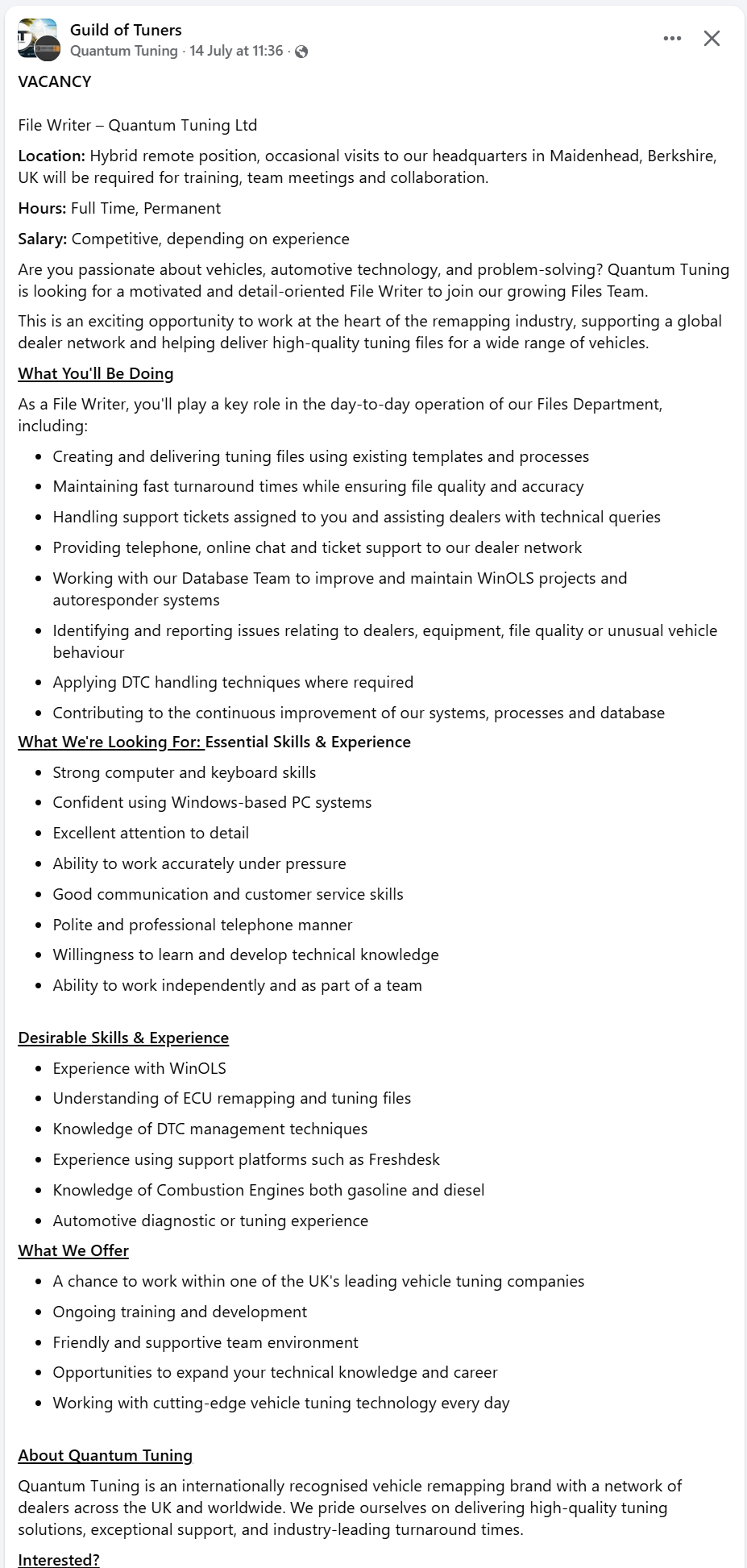
We examined recruitment material and company pages associated with Viezu Technologies, Quantum Tuning, Celtic Tuning and Avon Tuning. The evidence is more nuanced than the familiar online accusation that “the people writing these files know nothing about cars”. That sweeping claim cannot be proved from a vacancy page, and in several places the published evidence directly contradicts it.
What the material does reveal is still significant. Entry into a file-writing pathway does not always require previous ECU tuning experience. Academic or technical computing ability can be treated as a suitable starting point. Dealer-network software can automate part of the file-supply process. Job titles that sound relevant to calibration may actually describe portal development, customer support or file installation. Meanwhile, public-facing claims about an “in-house team” often tell the buyer very little about the individual authorship, supervision, testing and sign-off behind a particular file.
First, separate the five jobs that marketing often rolls into one
Customers frequently use the word “tuner” for everyone involved in a remap. That makes the supply chain sound much simpler than it is. In a modern file-service network, at least five distinct roles may sit between the vehicle and the finished calibration.
01
The dealer or installer
This is normally the person who meets the customer, connects the diagnostic or flashing tool, identifies the ECU, reads the original software and installs the modified file. A good installer may be an excellent technician who checks vehicle condition, recognises mechanical faults and captures useful logs. Another installer may have received only enough training to operate the tool and submit a ticket.
Crucially, flashing a supplied file is not the same as understanding how its torque model, load targeting, ignition, fuelling and protection strategies were altered. The installer can be highly competent without being the calibration author, and the author can be remote from both the installer and the car.
02
The portal or software developer
Large tuning networks need websites, databases, file-transfer systems, customer accounts, automated matching, billing, tool updates and dealer-management software. The people building those systems may be C#, .NET, database or web developers.
Those are valuable technical jobs, but they do not establish that the developer writes engine calibrations. A vacancy asking for programming experience is not evidence that “computer programmers tune the cars” unless its stated duties actually include calibration work. This distinction becomes especially important when examining Celtic Tuning’s archived vacancies.
03
The support operator or trainee file writer
This role can sit between customer service and calibration. The employee may identify ECU software, locate an existing solution, handle dealer questions, compare binary files, apply documented changes and gradually progress towards more independent file development.
There is nothing inherently wrong with a trainee pathway. Every experienced calibrator was inexperienced at some point. The meaningful questions are how long the training lasts, who supervises the trainee, which tasks require approval, what test evidence is reviewed and when that person becomes authorised to release work without senior intervention.
04
The development calibrator
A development calibrator should understand far more than the location of several familiar maps. The role can involve torque structure, air-path and load control, combustion, knock response, lambda targets, fuel-system limits, exhaust temperatures, boost control, diagnostic interactions, transmission requests and component-protection logic.
Good calibration also demands a disciplined test process. The calibrator has to interpret noisy data, distinguish a software problem from a mechanical one, understand the limitations of the measuring equipment and decide where repeatable performance ends and unnecessary risk begins.
05
The reviewer and sign-off owner
This is the role customers are least likely to hear about and arguably the most important. Someone should decide whether the evidence is sufficient to release the calibration. That person should be able to challenge unsafe targets, inconsistent logs, unsuitable hardware, poor fuel, uncontrolled torque or unexplained intervention.
A trainee can produce good work under rigorous review. A long-serving employee can produce poor work without it. Competence is therefore not demonstrated solely by the person’s title; it is also demonstrated by the organisation’s validation and approval process.
What may happen after a dealer uploads your original file
Branch A
Branch B
-
Read and identify
The dealer reads the ECU or retrieves its software identification. The portal records the vehicle, ECU family, software version and requested service.
-
Search the library
The system or an operator searches for an exact or closely related original file. If a previous modified version exists, the order may be fulfilled from that library rather than developed from a blank starting point.
-
Match automatically or send for manual work
An automated platform can match a recognised file and return an existing solution. An unmatched file may be routed to a file writer, who could adapt a known solution, transfer calibration changes between compatible versions or perform more extensive manual development.
-
Check integrity and release
Checksums, file size and software structure may be verified before download. These are important integrity checks, but they do not prove that the performance changes are appropriate for the condition, fuel, hardware or environment of the individual vehicle.
-
Flash and assess
The dealer installs the file. Depending on the service, the assessment may range from confirming that the engine starts and no immediate fault appears to a full baseline comparison, logging session and rolling-road revision loop.
An existing library is not automatically a negative. Manufacturers themselves reuse validated strategies across appropriate applications. A mature base calibration can be safer than improvising every job from scratch. The problem is pretending that file delivery and bespoke calibration are the same service. Reuse becomes concerning when the match is poorly understood, when vehicle differences are ignored or when nobody can explain the validation history of the base file.
Case study one
Viezu: a documented route from technical support into ECU calibration
A recruitment post published through Viezu’s official LinkedIn presence advertised an ECU Tuning File Writer position with full training provided. A later recruitment post by Viezu chief executive Paul Busby described a trainee file-writer opportunity focused on PC literacy, learning quickly and methodically, and having a genuine interest in the automotive sector.
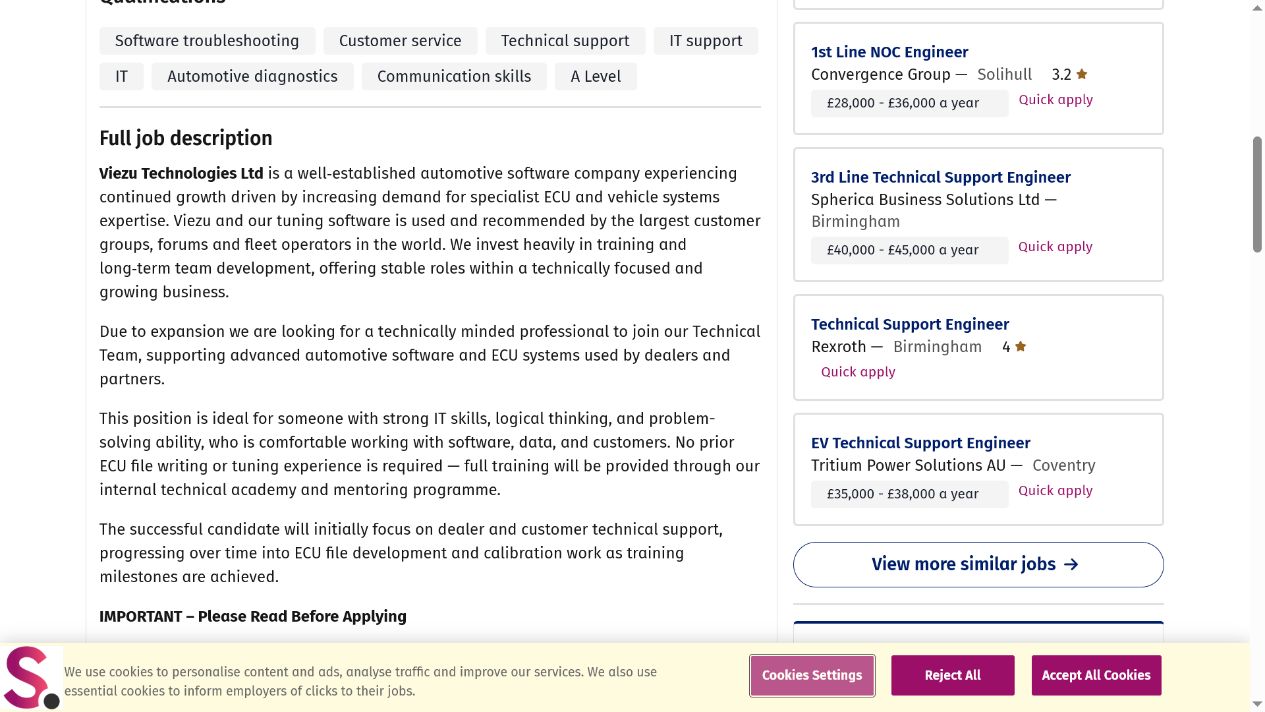
An expired Technical Support Engineer vacancy reproduced by SimplyHired went further. It stated that previous ECU file-writing or tuning experience was not required and described a structured progression from dealer and customer support into ECU file development and calibration after training milestones had been achieved. IT ability, analytical thinking, communication and customer support featured among the essential attributes; automotive diagnostics, motorsport or calibration exposure appeared as desirable rather than essential experience.
That is strong evidence for a narrow but important proposition: at least one advertised Viezu pathway allowed a person to enter the business without previous tuning experience and progress towards calibration work through internal training.
It is not evidence that an untrained new starter was immediately allowed to release high-output files without supervision. It does not reveal the quality of the course, the competence of the trainers, the approval thresholds or the level of senior review. The advert described months of development and staged progression, which is materially different from placing an inexperienced recruit at a desk and calling them an expert on day one.
Viezu’s own commercial pages also provide counter-evidence to any claim that its operation is simply a room of unqualified file editors. The company promotes specialist tuning software and an in-house technical team, describes its tuning-file service as supported by experienced staff and development facilities, and operates a technical academy.
Those are the company’s own descriptions rather than an independent audit, but they matter. A fair reading is not “Viezu’s writers know nothing about cars”. It is that Viezu publicly recruits for aptitude and trains some people internally, while the customer-facing phrase “our in-house calibration team” still leaves unanswered who handled a particular file, at what competence level and under whose approval.
Case study two
Quantum: graduate recruitment, mixed backgrounds and automated file matching
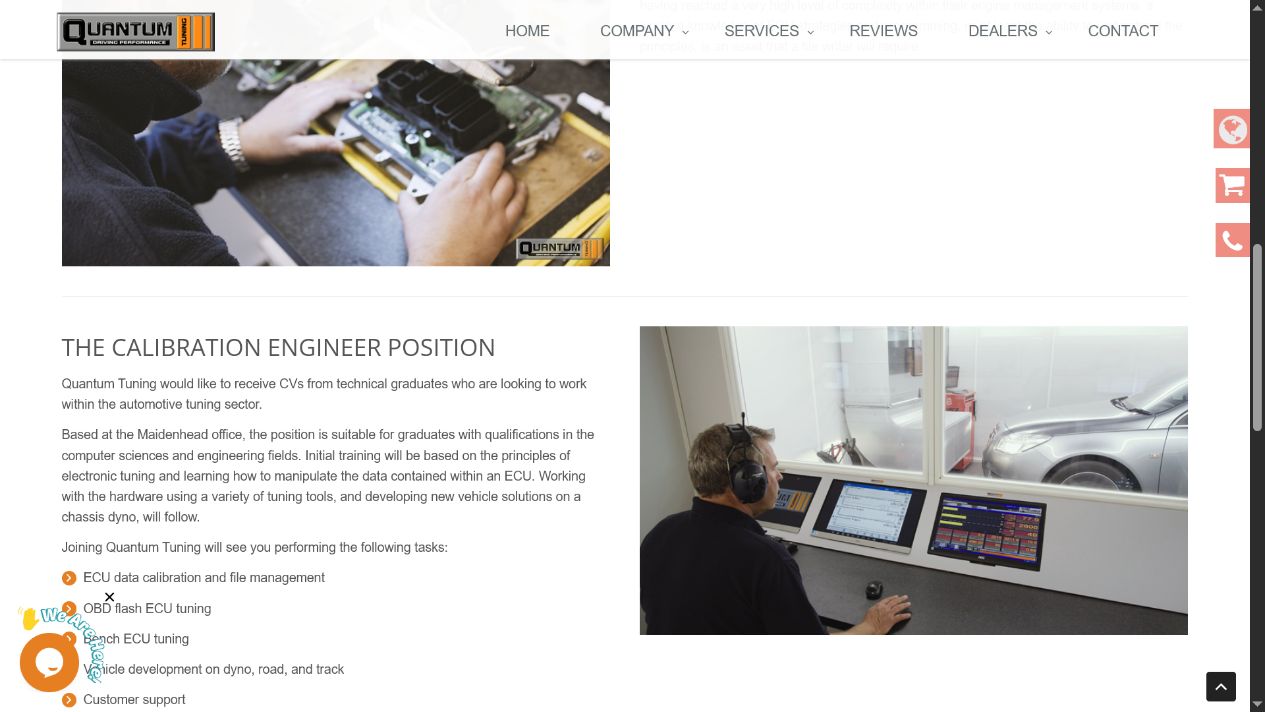
Quantum Tuning’s current graduate recruitment page says its calibration team creates and maintains ECU calibrations and describes the opportunity as suitable for technical graduates in computer sciences and engineering. Working knowledge of engine-control units is presented as an asset, while enthusiasm for cars and tuning, technical ability and a driving licence are also sought.
The page describes training in ECU data manipulation, followed by work that can include developing vehicle solutions on a chassis dynamometer and testing on dyno, road and track. That is not a vacancy for somebody with “nothing to do with cars”. It is an entry route for technically educated candidates who are expected to learn automotive calibration through training and practical development.
Quantum’s published staff profiles reinforce the mixed nature of the team. Some employees entered from web design, consumer-electronics repair, database work or university and developed through internal training. Other senior biographies describe substantial mechanical, engine-development, rolling-road and motorsport-related experience, including work associated with Ford, Prodrive and Superchips.
It would therefore be inaccurate to present Quantum as an organisation staffed only by generic computer graduates. The more revealing point is that the company appears to combine different backgrounds and experience levels inside one file-supply operation. The customer usually does not know which part of that spectrum handled the order.
Sometimes the transaction may not involve fresh file writing at all
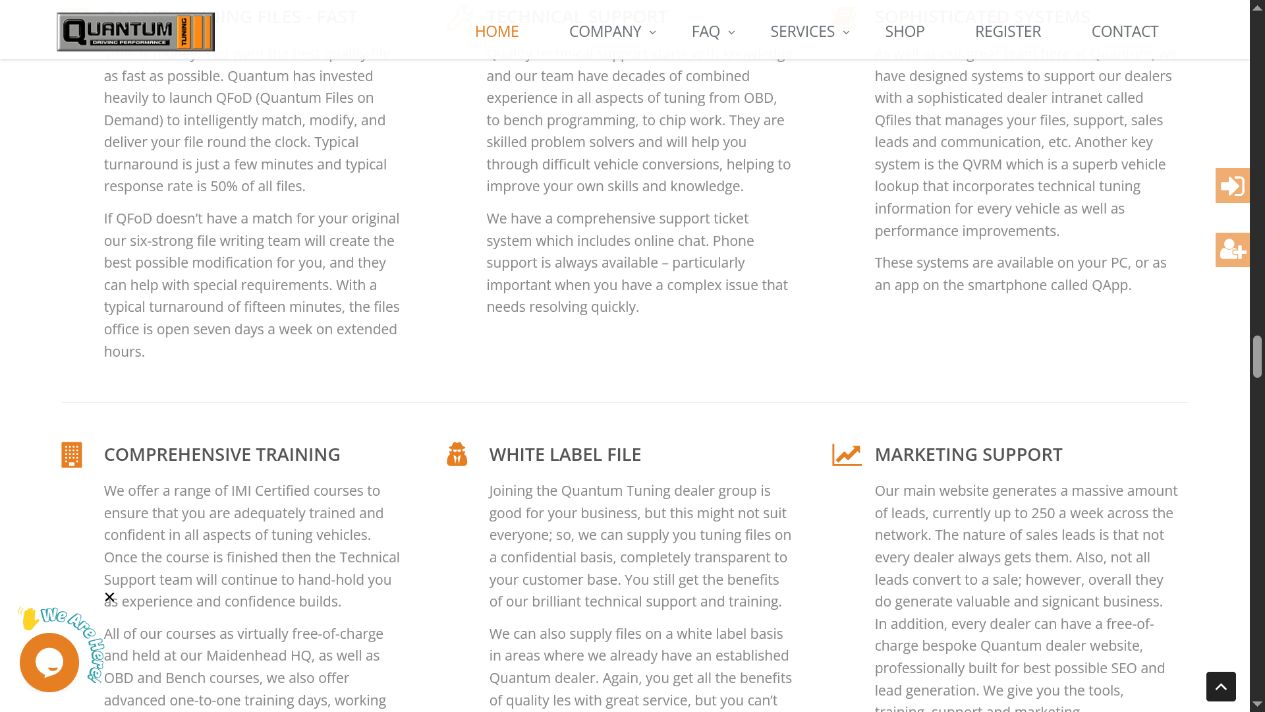
Quantum’s dealer platform introduces another distinction. Its QFoD marketing says that its system can provide an automated response for approximately half of submitted files, with recognised files matched and returned within minutes. Unmatched work is said to pass to a six-person file-writing team, with a promoted manual turnaround measured in minutes.
That does not mean the automated file is poor. If the identification is exact and the underlying solution was properly developed, automation may simply retrieve a proven calibration consistently and without unnecessary human error. It does mean that the familiar sales phrase “our engineers write every file” needs qualification. In an automated transaction, nobody may freshly write anything for that vehicle on that day.
There is also a striking tension inside Quantum’s own public wording. Its consumer website says every vehicle is “Custom Remapped”. The company’s linked 24/7 Files FAQ, however, says a generic file is a tried-and-tested calibration that may be applied to thousands, and reserves “custom” for a vehicle converted on a dynamometer to suit the customer’s requirements and hardware. The same file platform describes automatic matching to existing calibrations.
Those statements do not prove the automatically supplied tune is bad. They do create a fair question about terminology: if an uploaded original is automatically matched to an existing library calibration and the car is not on a dyno, how does that transaction satisfy the supplier’s own published definition of custom? The customer should be told which route was used rather than being expected to infer it from a universal slogan.
The technically useful questions become: Was the file an exact database match? Who created the original modified version? On what vehicle and fuel was it validated? How are software variants checked for compatibility? What changes trigger manual review? Does an engineer examine post-flash logs? How does the organisation learn about and revise a base file if field data reveals a problem?
Case study three
Avon: an entry-level database role is not the same thing as an R&D calibrator
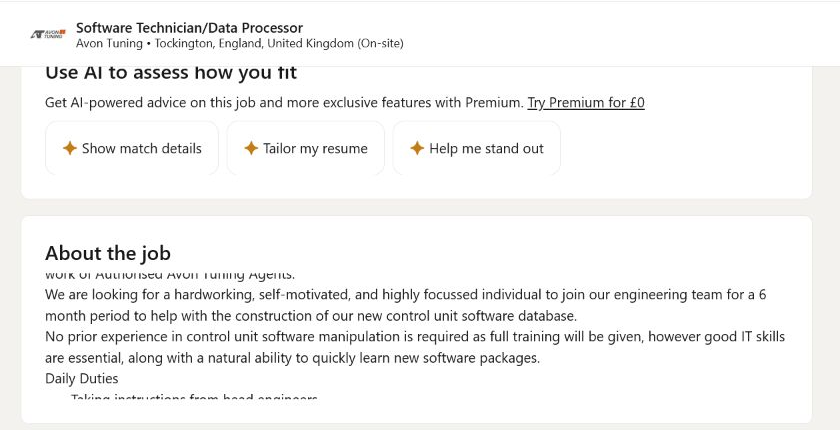
An expired Avon Tuning Software Technician/Data Processor vacancy described a six-month role helping to construct a new control-unit software database. It stated that no previous control-unit software-manipulation experience was required, while good IT skills and the ability to learn new software packages were essential.
The duties matter more than the provocative headline. They included taking instructions from head engineers, adding software variants, updating database projects, managing version control, and setting up computers and software for agents. An Avon employee’s LinkedIn recruitment post summarised the opening in similar terms: no experience was necessary, full training would be provided and computer literacy was essential.
This proves that an inexperienced entrant could work inside Avon’s engineering support pipeline and touch the control-unit software database. It does not prove that the entrant designed torque, boost, fuelling or ignition changes; validated a vehicle; or released a customer calibration without review. In fact, “taking instructions from head engineers” points in the opposite direction. The defensible criticism is that a customer seeing “our in-house software engineers” cannot tell how much of the delivered product was database processing, known-solution transfer, calibration development or senior approval.
Avon also publishes substantial counter-evidence to any suggestion that its whole technical team lacks automotive knowledge. Its current team page lists software engineers with light-vehicle, HGV auto-electrical and main-dealer backgrounds, a Vehicle Systems Engineer with a mechanical-engineering degree and systems-integration experience, and technical staff with motorsport, truck and agricultural engineering experience.
The company further says that its second dyno cell is used for research, development and validation of files before network release. Those are company-authored claims rather than an independent process audit, but they are directly relevant. They make “Avon has nobody who understands cars” an untenable conclusion from this vacancy.
Case study four
Celtic: the danger of confusing web developers, technicians and calibration authors
Celtic Tuning provides a useful warning about reading job adverts without examining the duties. Archived recruitment pages include vacancies for software and web-development skills, but the wording does not show those developers being recruited to calibrate engines.
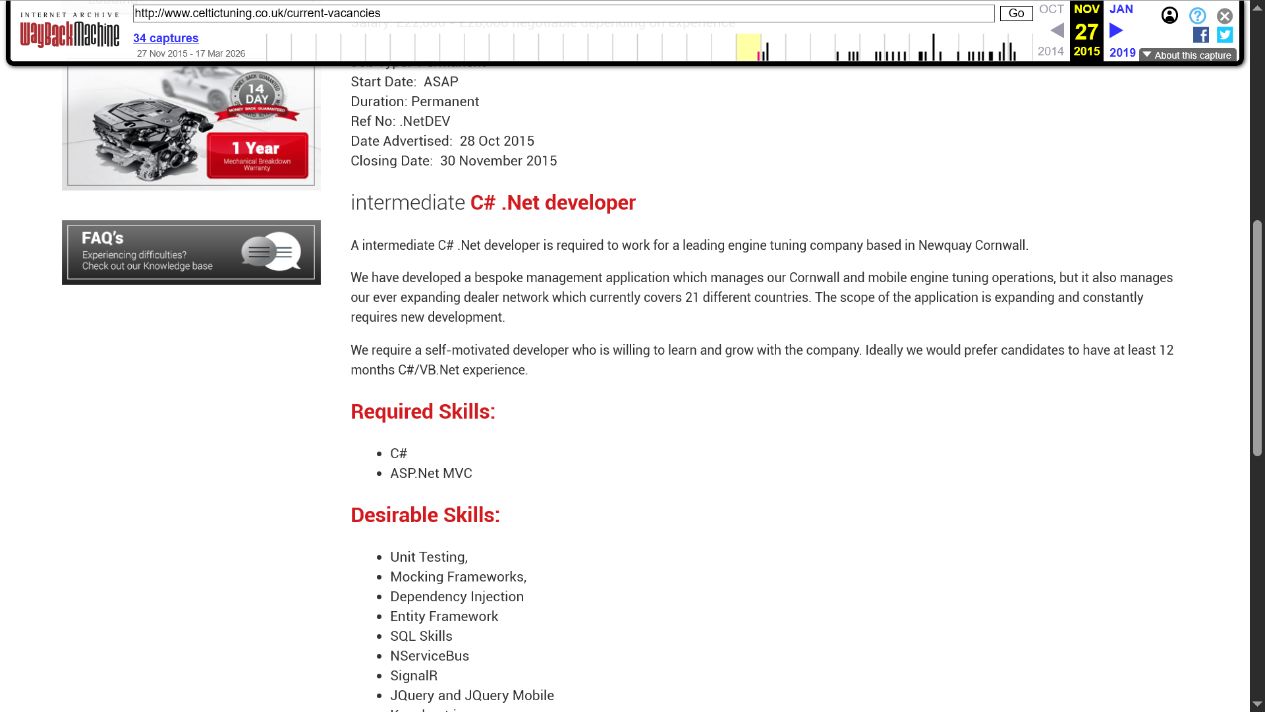
An archived 2015 vacancy and a similar 2016 version sought .NET development skills for a bespoke management and dealer-distribution system. An archived web-developer advert concerned website, front-end and back-end work. These positions supported the digital infrastructure of a tuning business; they were not presented as engine-calibration roles.
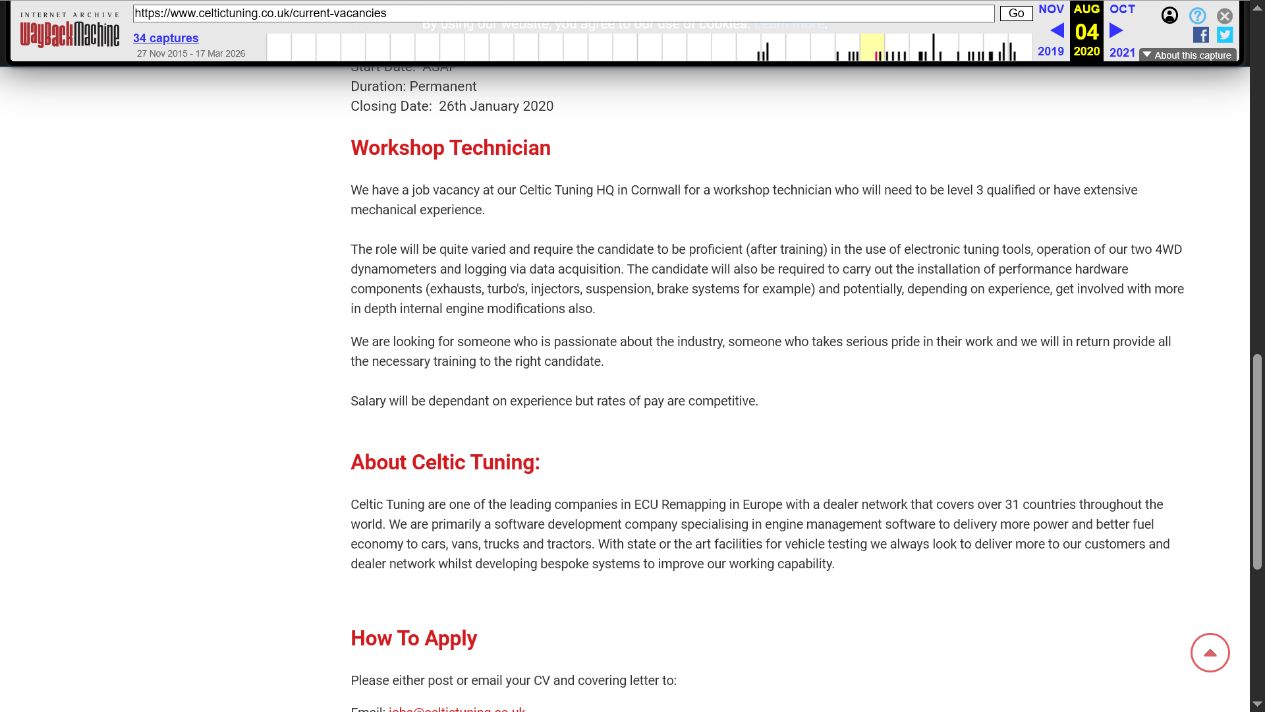
The automotive vacancies tell a different story. Celtic’s archived 2020 workshop-technician advert required a Level 3 qualification or extensive mechanical experience. The duties referenced two four-wheel-drive rolling roads, data logging, hardware installation and engine modifications. That is clear evidence of practical automotive work.
A later mobile-technician vacancy focused on visiting vehicles, using electronic tools, diagnostics and customer-facing installation. It did not establish that the mobile technician authored the calibration. Again, installation and authorship are separate.
Celtic’s current company profile claims hands-on ECU development, manufacturer training, BMW-trained technicians, in-house rolling-road work and data logging. Those claims provide meaningful counter-context. We did not find a public Celtic vacancy that proved a generic website developer was employed to write tuning maps, and it would be misleading to imply otherwise.
The real finding is one of visibility. Public vacancies reveal portal developers, workshop technicians and mobile installers, but they do not necessarily identify the person who creates and approves the calibration product delivered through the network. Customers can see the front of the organisation more easily than its authorship and sign-off structure.
The question marketing leaves open
Several of the UK’s best-known large tuning networks clearly do not all describe the same approach
There is a tendency to discuss every large file supplier as if it used one identical “file factory” method. The public evidence does not support that simplification. The networks advertise different combinations of trained entrants, experienced calibrators, automated retrieval, manual file writing, rolling-road development and central R&D. What they generally do not provide is a traceable production record for the individual file sold to an individual customer.
Viezu
Is every uploaded original being individually changed?
Recruitment material describes support staff progressing into file development and calibration, while the commercial service promotes fast remote delivery from an in-house team. That may involve a fresh adjustment, transfer of a known solution, retrieval from a library, or a mixture of all three. The public material does not tell us which occurred on one order.
If a file is changed remotely for one car, how is that change tested on that car before release?
Quantum
Automation is documented more openly
Quantum says recognised files can receive an automated response and unmatched files pass to a manual team. Its own 24/7 Files FAQ draws an unusually clear distinction: a generic file is a tried-and-tested calibration that may be applied to thousands of vehicles, while a custom conversion is carried out with the car on a dynamometer to suit the customer and hardware.
By that published definition, an automatically matched library calibration can be valuable and proven—but it remains generic rather than a fresh custom tune.
Celtic
Are these more extensively developed OTS products?
Celtic’s public material stresses rolling roads, logging, workshop technicians and in-house development. It is entirely possible for a supplier to spend considerable time developing a strong repeatable calibration, then distribute that product across compatible vehicles. That can produce an excellent OTS map. It does not make every later installation bespoke.
How much of the customer’s file is established product and how much is revised from evidence gathered on that vehicle?
Avon
A central R&D claim alongside an expanding software database
Avon describes network files developed and validated at headquarters, while its vacancy shows staff adding and maintaining software variants under head engineers. That looks compatible with a centrally developed library distributed through agents. It still does not expose the complete authorship and approval history of the file received in one transaction.
A database is a delivery asset. Its quality depends on how every releasable solution entered it.
Is Viezu creating a genuinely fresh file for every car—and, if so, how is each remote revision tested? Is Celtic spending longer developing strong OTS products and then reusing them? The honest answer from the public evidence is: we do not know.
That uncertainty is not proof of wrongdoing. It is the transparency problem. “Custom written”, “developed in-house” and “R&D tested” can all be true at company level while saying very little about what happened between the upload of one customer’s original file and the download of the modified version.
R&D recruitment audit · checked 14 July 2026
Could we find the people publicly recruited to develop and validate the maps?
We searched for vacancies described as R&D Technician, Calibration Engineer, calibration-development engineer, dyno-development technician, validation or test technician, and close equivalents. A missing public advert is not evidence that a company has no R&D personnel: businesses recruit privately, use different titles, promote internally and remove expired listings. It is still worth recording what a customer can and cannot verify in public.
Dedicated advert not located
Viezu Technologies
We did not locate a vacancy specifically titled R&D or calibration-development technician. The closest public route is the Technical Support Engineer advert already examined: it allows entry without previous tuning experience and describes progression into file development and calibration after training.
That absence cannot be turned into “Viezu has no R&D staff”. Its official R&D page describes in-house dyno and emissions development, its current team page assigns R&D responsibility to named technical leadership, and an archived 2012 team page described several people carrying out data logging, dynamometer testing, calibration and development.
Equivalent development vacancy found
Quantum Tuning
Quantum’s Calibration Engineer recruitment page is functionally an R&D pathway even though it does not use the title “R&D Technician”. It accepts computer-science and engineering graduates, then describes training followed by new-vehicle solution development on a chassis dyno and testing on dyno, road and track.
Its staff page also names a Development Engineer and personnel with powertrain-calibration, rolling-road and engine-dyno experience. This is direct counter-evidence to claiming that Quantum publishes no development roles or employs nobody with automotive calibration experience.
Dedicated advert not located
Celtic Tuning
We found no public Celtic vacancy specifically advertised as R&D Technician, Calibration Engineer or calibration-development technician. We did find the archived Workshop Technician role requiring Level 3 qualification or extensive mechanical experience and involving dyno operation and data logging. That overlaps testing and development without proving calibration authorship.
Celtic’s current company page says engineers use control-strategy documentation, write calibrations in-house and refine them from logged boost, fuel-pressure, EGT, lambda, ignition and knock data. Its dyno page describes a development centre with two linked 4WD cells. Those remain company-authored claims, but they are meaningful contrary evidence.
Dedicated advert not located
Avon Tuning
We found Avon’s software-database vacancy, but no public advert specifically recruiting an R&D technician, calibration engineer or validation technician. It would be wrong to rebrand the data-processing position as that role merely because it sat inside the engineering team.
Avon nevertheless publishes named software and vehicle-systems engineers with automotive and mechanical backgrounds, calls its headquarters team an R&D operation and says its dyno cell is used to develop and validate network files. Therefore the supported finding is “no dedicated public R&D vacancy located”, not “no R&D people exist”.
Compare that transparency with an OEM-style calibration vacancy
There is no single qualification that turns somebody into a good tuner. Nevertheless, official powertrain-calibration vacancies from vehicle manufacturers and engineering organisations illustrate the breadth of competence normally associated with formal calibration engineering.
A Ford powertrain-calibration engineering vacancy combines engineering education or experience with knowledge of engine-control systems, analysis of complex test data, vehicle and dynamometer development, emissions-related requirements and collaboration across engineering functions. Rimac’s powertrain-calibration role similarly presents calibration as a combination of control-system knowledge, data analysis, testing and whole-vehicle development.
These adverts are not proof that every OEM engineer is excellent, nor do they mean that an independent tuner needs an identical academic career. Some of the best independent calibrators have built their expertise through decades of practical development rather than a university route. The comparison demonstrates that professional calibration is broader than finding several maps in an ECU binary and increasing their values.
What a short file-service description may emphasise
- Fast turnaround
- Large file database
- Dealer support
- Software manipulation
- Tool and ECU familiarity
- High order volume
What a broader calibration role may emphasise
- Control strategy and system interactions
- Combustion, air-path and torque behaviour
- Dynamometer and vehicle validation
- Data quality and statistical interpretation
- Thermal, durability and emissions constraints
- Documented release and engineering accountability
An independent tuning company does not need an OEM-sized department to do responsible work. It does need someone capable of understanding the relevant systems, recognising the limits of the available evidence and refusing to release a calibration when the vehicle or data does not support it.
A computing background is not the problem
It is tempting to ridicule recruitment adverts that mention computer science, databases, electronics or PC literacy rather than years in a mechanical workshop. That criticism misses how modern powertrains work.
An ECU is a real-time control system. Calibration work involves structured data, software versions, addresses, scaling, interpolation, control loops, diagnostic states, signal plausibility and interactions between multiple controllers. A person with a strong computing, electronic or data-analysis background may learn these concepts faster than somebody who understands engines mechanically but struggles to reason about software and control behaviour.
Conversely, software ability does not automatically provide an ear for combustion problems, an understanding of turbocharger operation, the ability to recognise a weak fuel system or the judgement to stop a test when the numbers look attractive but the engine is unhappy. Modern calibration needs both sides of the problem.
The relevant criticism is therefore not “this employee once worked in web design”. It is: what automotive and controls training followed, what practical experience was accumulated, what work can the person release independently, and what evidence is required before the company sells the result?
A non-traditional background can produce an excellent calibrator. A job title cannot replace training, testing, supervision and accountable sign-off.
Why the authorship and validation chain matters technically
A modern remap is not simply a request for more boost and fuel. The ECU may contain overlapping driver-demand, torque, air-mass, load, turbocharger, ignition, lambda, fuel-pressure, temperature, diagnostic and protection strategies. The transmission, stability system and other controllers may also rely on the torque values reported by the engine ECU.
A file can produce an impressive peak figure while behaving poorly elsewhere. It may overshoot boost during transient operation, request torque the gearbox is not prepared to manage, conceal an air-path problem, exhaust the high-pressure fuel system at high engine speed or rely too heavily on knock correction. It may feel dramatic because the pedal mapping is aggressive rather than because the engine makes proportionally more usable power.
Equally, a calibration can look conservative on one rolling-road graph yet be the better product because it controls torque cleanly, maintains repeatability as temperatures rise and preserves appropriate component protection. Peak power is one result, not the complete engineering assessment.
The minimum useful validation loop
Step 1
Establish the vehicle’s condition
Confirm the hardware specification, fault state, maintenance history, fuel and obvious mechanical limitations. A remap should not be used to disguise an existing defect.
Step 2
Record a meaningful baseline
Capture comparable performance and operating data before modification. The baseline shows whether the vehicle is already underperforming and gives the tuner something more useful than an internet claim to compare against.
Step 3
Apply a reasoned starting calibration
A proven base file can be an efficient starting point. Its targets still need to suit the ECU version, hardware, fuel and intended use of the car in front of the tuner.
Step 4
Log the relevant channels
Requested and achieved load, boost, torque, lambda, fuel pressure, ignition, knock response, temperatures, intervention and diagnostic status may all matter. The exact channels depend on the engine and control system.
Step 5
Interpret rather than merely collect
A clean-looking graph does not explain why the ECU corrected timing or why fuel pressure fell. Data requires someone who understands the control strategy and can distinguish a calibration limitation from a mechanical fault or measurement problem.
Step 6
Revise and repeat
Custom calibration is a feedback process. If the result exposes unnecessary intervention, unstable control or unused safe capacity, the tuner changes the relevant strategy and tests again under comparable conditions.
Step 7
Check more than one operating point
A full-load dyno pull cannot represent cold start, part-throttle response, heat soak, transient boost, gear changes or extended real-world load. Validation should reflect the intended use and the risks of the application.
Step 8
Approve, document and retain evidence
The final release should have an identifiable basis: vehicle details, file version, relevant data, changes made and the person or process responsible for approval.
An OTS calibration can pass a rigorous version of this process during product development and then be deployed repeatedly to matching vehicles. That is how a good standardised product should work. The unavoidable limitation is that the original validation cannot know the condition of every future engine, the exact fuel in its tank, every hardware variation or every operating environment.
A genuinely custom service closes part of that gap by looking at the actual vehicle and revising the calibration when the evidence justifies it. It does not guarantee that the tuner is skilled, and it does not mean that every car should be pushed harder. Sometimes the correct custom decision is to reduce the requested output, repair a fault or retain a larger margin.
Why speed, scale and slick software can be mistaken for engineering proof
Dealer networks compete on convenience. Their portals can identify files, manage credits, track jobs and return solutions quickly. Mobile apps may offer map switching, fault-code functions, logging or at-home flashing. Those features can be genuinely useful.
They are not substitutes for calibration evidence. An attractive interface demonstrates product design. A large database demonstrates scale. Thousands of dealers demonstrate distribution. A fifteen-minute turnaround demonstrates operational speed. None of those facts, in isolation, demonstrates that the calibration is optimal for a particular vehicle.
Scale can improve a product because a provider sees many software versions and receives a large amount of field feedback. Scale can also encourage standardisation, aggressive turnaround promises and reliance on a library that the local dealer cannot fully interrogate. The result depends on how information is collected, reviewed and fed back into development.
This is why “we have supplied tens of thousands of files” is not a complete answer to a technical question. Volume can be reassuring evidence of commercial maturity, but it does not disclose the failure rate, revision rate, testing depth, fleet mix or the competence level involved in each order.
Questions to ask before buying a dealer-network or OTS remap
A responsible provider should not be offended by sensible questions. The buyer is not asking for trade secrets or a complete map definition. They are asking who takes responsibility for the software being installed in an expensive engine.
-
Is this an existing library file, an automatically matched file or a newly revised calibration?
All three can be legitimate. The answer tells you what work is actually included in the price.
-
If it is a library file, who originally developed it?
Ask whether the base was developed internally, purchased from another supplier or adapted from a third party.
-
What vehicle and hardware specification was used for development?
A file validated on a mechanically standard car should not automatically be presented as bespoke for different turbochargers, fuel systems or supporting hardware.
-
What fuel was used?
Octane, ethanol content and fuel quality affect achievable ignition, boost and thermal margin. “Premium fuel recommended” is less useful than a clear minimum requirement.
-
Does the person installing the file also understand the calibration?
If not, ask how technical questions and abnormal logs reach the actual file-development team.
-
What experience does the author have with this ECU and engine family?
A generic claim about decades of company experience may combine the careers of several people. Ask about relevant, current competence.
-
Can trainees or junior staff release files independently?
There is no shame in supervised training. There should be a clear boundary between learning, preparing work and approving a customer release.
-
Who signs off the calibration?
The answer may be a named senior engineer, a documented peer-review process or a validated product-release procedure. “The portal accepted it” is not engineering sign-off.
-
Will my car be checked before it is tuned?
Fault codes, fuel trims, boost leaks, ignition condition, fuel delivery and existing modifications can change whether the expected calibration is appropriate.
-
Will you record a baseline?
Without a baseline, an impressive after figure can conceal an unhealthy starting point or an incomparable test condition.
-
Which parameters will be logged after flashing?
Ask for more than “we checked the boost”. The appropriate data depends on the platform, but the provider should be able to explain what indicates safe, controlled operation.
-
Are revisions included when the data is not satisfactory?
A custom service needs a feedback loop. If the supplied file is treated as final regardless of the evidence, the service is functionally closer to a fixed OTS product.
-
What happens if the car makes less than the advertised figure?
A credible answer considers vehicle condition, fuel, test method and environmental variation before promising a number.
-
What happens if the file produces intervention or unstable control?
The provider should investigate rather than dismiss repeated correction, throttle closure, boost deviation or fuel-pressure loss simply because no warning light is present.
-
Can I receive the before-and-after evidence?
Graphs and relevant log summaries allow the customer to see what was tested and give another specialist a useful record if the vehicle changes later.
The Llandow Tuning position: judge the tune at the car, not at the marketing department
Our position is straightforward. A respected OTS file can be an excellent starting point. Large providers have access to many vehicles, software versions and years of accumulated development. It would be arrogant to ignore that body of work merely because it came from another tuning company.
Independent calibrators study factory strategies, compare established approaches and learn from how successful products behave. That is normal technical development. The value of a proper custom service is not the theatrical claim that every byte was invented from nothing. It is the ability to examine the actual vehicle, understand the starting calibration, measure the result, identify where it can be improved and revise it responsibly.
If an established OTS calibration works cleanly, the custom tuner should be able to explain what is being changed and why. If no additional output is appropriate because of fuel, hardware, temperature or mechanical condition, honesty is more valuable than forcing a larger graph. If a vehicle-specific improvement is available, the tuner should demonstrate it with comparable data rather than relying on brand reputation.
A logo cannot read your fuel pressure. A dealer count cannot inspect your ignition correction. A fast portal cannot decide whether your individual engine needs more, less or different calibration.
The same scrutiny must apply to us. “Custom tuned” is not a protected engineering qualification. Customers should judge Llandow Tuning by the questions we ask, the condition checks we make, the evidence we collect, the revisions we perform and our willingness to explain the outcome.
So, who wrote your OTS tune?
The honest answer may be a senior calibrator, a supervised trainee, a file-support technician, an automated matching system retrieving an older development file, or several of those working in sequence. The local dealer who installed it may never have met the original author.
The job adverts we examined do not prove that Viezu, Quantum, Celtic or Avon employ people who “have no idea about cars”. Viezu’s recruitment material shows that previous tuning experience is not always required at entry, but it also describes training and progression. Quantum recruits technical graduates into an explicitly automotive calibration-development pathway and publishes experienced engineering backgrounds, while its dealer platform openly promotes automated fulfilment. Celtic’s programming vacancies relate to digital infrastructure, while its workshop recruitment and current pages provide evidence of mechanical and dyno capability. Avon advertised an entry-level data-processing role for which prior control-unit software-manipulation experience was not required; its published material separately identifies automotive-qualified software and vehicle-systems staff and a central R&D facility.
Our R&D vacancy search reached a similarly careful result. We found a clear Quantum calibration-development advert. We did not locate dedicated R&D or calibration-development vacancies for Viezu, Celtic or Avon, but that is not evidence that those companies have no development staff; their own team and facility pages provide contrary evidence. The meaningful gap is the absence of a customer-visible chain linking those development resources to the authorship, testing and approval of one supplied file.
That balanced conclusion is more useful than an online insult. The weakness in much of the OTS market is not necessarily that nobody knows what they are doing. It is that customers are asked to infer competence from phrases such as “in-house”, “custom written”, “developed by experts” and “thousands of vehicles tuned” without being shown the authorship, validation and approval chain behind their own file.
A good OTS map can be a strong, repeatable product. A poor custom tune can be worse than a good OTS map. The difference worth paying for is not the label. It is competent vehicle-specific judgement, transparent testing and an accountable person prepared to revise—or reject—the calibration when the evidence demands it. We cannot state exactly which internal production model every large network applies to every order. We can state how Llandow Tuning approaches the car in front of us and show the feedback loop used to reach its result.