
Testing GDI Petrol Injectors

Testing GDI Petrol Injectors

Testing GDI Petrol Injectors

Modern GDI petrol injectors work in a much harsher environment than traditional port injectors.

Instead of spraying fuel into the inlet port, a GDI injector sprays directly into the combustion chamber. That means the injector has to deliver fuel with the correct pattern, timing and atomisation under much more demanding conditions.

ASNU's GDI testing material highlights that correct electronic operation, fuel distribution and atomisation are critical to engine running, performance, fuel economy and emissions.

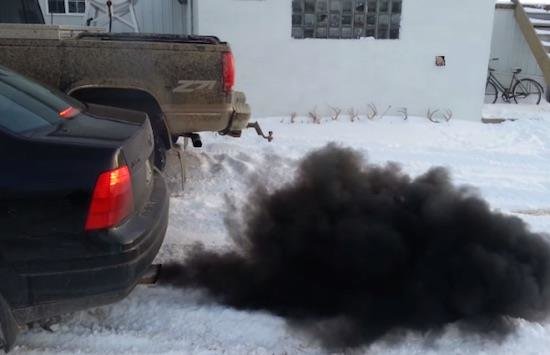
If a GDI injector is not performing properly, the engine may still run, but it may not run well. You can end up with poor cold starts, rough idle, hesitation, misfires, increased fuel consumption, uneven cylinder fuelling and fault codes that do not always point clearly at the injector itself.

ASNU notes that even slight irregularities in spray pattern can lead to engine warning light issues without a specific cause being identified.

Why GDI injector testing matters

A GDI injector is not just a simple on-off valve.

It has to open and close correctly, flow the right amount of fuel, seal properly when shut, and produce the right spray image. If the injector dribbles, has poor atomisation, or flows differently to the others, one cylinder can end up behaving very differently from the rest.

Llandow Tuning's injector testing page explains that tuned engines leave less margin for error, and that without proper testing you cannot be sure all injectors are delivering the correct amount of fuel with the correct spray pattern.

That becomes even more important on performance engines and direct-injection turbo petrol engines where fuelling quality has a major effect on combustion quality, knock resistance and exhaust temperatures.

What we check when testing GDI injectors

At Llandow Tuning, our injector testing process is built around proper measurement rather than guesswork.

Our injector testing service page sets out the core steps as:

  • external inspection and cleaning
  • resistance and inductance checks
  • leak testing
  • spray pattern assessment
  • dynamic flow testing

That matters because a GDI injector can fail in more than one way. Some injectors may electrically test fine but leak when closed. Others may seal correctly but have a weak or distorted spray pattern. Others may still spray, but not evenly enough compared with the rest of the set.

What cars use GDI petrol injectors?

Gasoline Direct Injection is now common across a huge number of petrol vehicles, especially turbocharged petrol engines from the last 15 to 20 years.

Examples include many petrol models from:

  • Volkswagen, Audi, SEAT and Skoda using FSI, TSI and TFSI engines
  • BMW petrol engines using direct injection across many 4-cylinder, 6-cylinder and V8 turbo platforms
  • Ford petrol models using EcoBoost engines
  • Mercedes-Benz petrol direct injection engines
  • Vauxhall / Opel direct injection turbo petrol engines
  • Peugeot / Citroen / DS / MINI petrol direct injection turbo engines in many Prince-family and later applications
  • Hyundai / Kia petrol GDi and T-GDi models

In simple terms, if you have a modern petrol turbo engine, there is a good chance it uses GDI injectors.

Our ASNU injector testing equipment

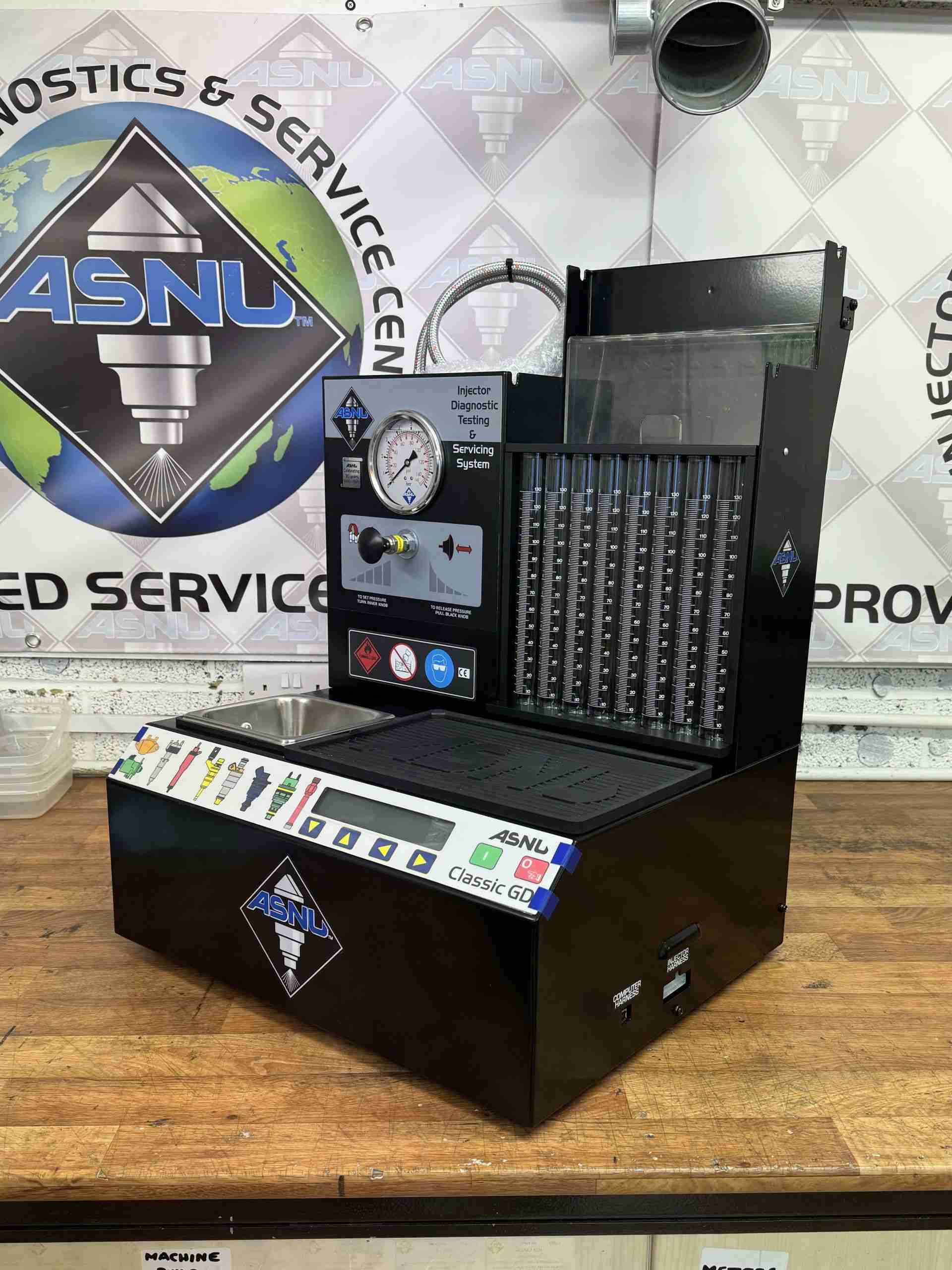
Llandow Tuning publicly states that it has an ASNU injector testing and service machine capable of controlling, flow-testing and ultrasonic cleaning most injector types, including top-fed, side-fed, mechanical and GDI injectors. The site also says the machine has been expanded in-house with additional control gear to test even more complex injectors.

On the tools page, Llandow Tuning describes its ASNU bench as allowing:

  • full flow testing
  • spray pattern analysis
  • ultrasonic cleaning

Llandow Tuning also says it has been using ASNU systems since 2010.

On the ASNU side, the official product information explains that:

  • the ASNU GDI Adapter Box is designed to drive GDI injectors with an approved supply of current and voltage to simulate operation on the engine
  • the ASNU Classic GDI system is designed to compare injector against injector safely and to examine spray pattern, fuel distribution and atomisation in detail
  • ASNU's system range covers K-JET, port, side-feed, top-feed, monopoint, GDI, solenoid and piezo injectors

So in practical terms, our ASNU-based setup gives us the ability to test far more than just ordinary port injectors.

Why proper injector testing beats guessing

It is very easy to blame coils, plugs, carbon build-up or tuning when a GDI petrol engine has a fuelling issue.

Sometimes those things are the cause. Sometimes they are not.

Injector testing gives you real evidence. It lets you see whether an injector is leaking, under-flowing, over-flowing, or spraying badly. On direct injection engines, that can make the difference between replacing parts blindly and actually solving the problem.

GDI injector testing in Wales

If you have a petrol direct injection vehicle with a suspected injector issue, or you are tuning a GDI engine and want to reduce the guesswork, proper testing is a sensible step.

At Llandow Tuning, our ASNU injector testing equipment allows us to assess injector condition properly rather than assuming all cylinders are being fuelled equally. And on modern GDI engines, that assumption can be an expensive one to get wrong.

Further reading

Klauss

KLAUS NIELSEN

22.5K Followers

At the bleeding edge of tuning and ICE development
Motorsports & Fast Road Tuning Specialist
Software Skills: Reverse Engineering - Assembler(IDA Pro - OllyDbg - WinDbg etc)
C/C++ - Pascal - Java - C#/VB.Net - Python - Perl
Experience on PowerPC, x86/64, Motorola, Infineon TriCore etc