Sometimes, people ignore advice and later act as if they never heard it when proven wrong. If you have a modified car especially if you have a standalone ECU, it’s crucial to install an O2/AFR sensor to ensure safety on the road. Our advice is straightforward and honest, typically rejected only when the cost is too high for the customer to implement.
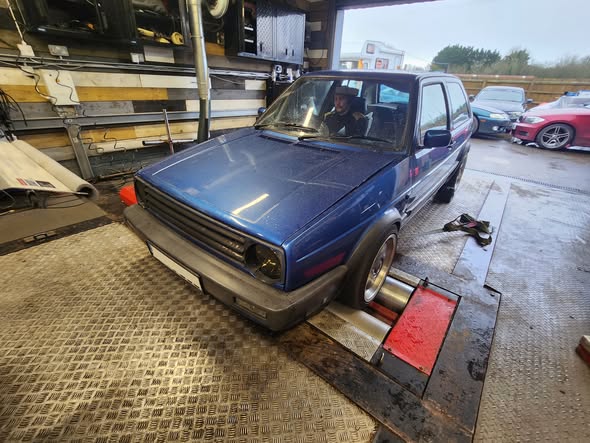
A little while ago, we had a VW Golf MK 2 brought in by a customer who had bought it on eBay (not that he said that, but I found it when looking up the vehicle online). The car had previously been used as a track/race car.
The car:
• VW Golf MK 2
• CANEMS ECU
• Swirl Pot Fuel Setup in the boot
• Track spec build
• ITB Throttle Bodies
The customer was converting the car back into a road vehicle and had reinstalled the rear seats. Would I personally turn a track car back into a road car?
Probably not, but our opinion on customers’ requests doesn’t really matter.
The boot was filled with fuel swirl pot-related parts, and the customer wanted the swirl pot removed and replaced with a single fuel pump. Upon arrival, the car wouldn’t idle due to very low fuel pressure at the fuel rail.
There was a fuel pressure gauge on the engine fuel rail, but it didn’t read correctly compared to our fuel pressure test gauges.
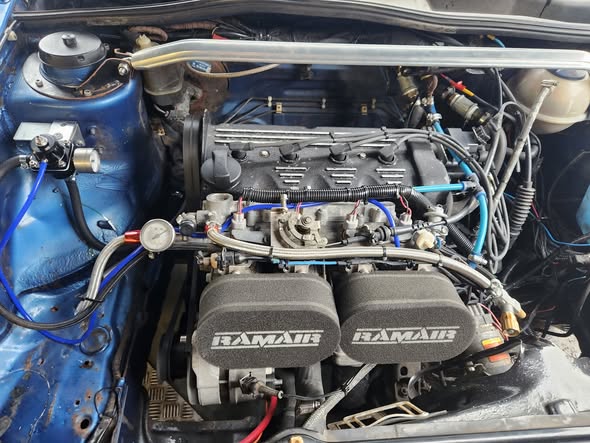
The simplest solution was to fit a fuel pressure regulator with a gauge in the engine bay.
First big issue: As soon as there was a little fuel pressure the return line didn’t stop leaking so we had to run a new hose to the tank too.
Problem solved. You can see this in one of the pictures we took of the bay after fitting it.
We balanced up the ITB Throttle Bodies which often go out of sync like a cab.
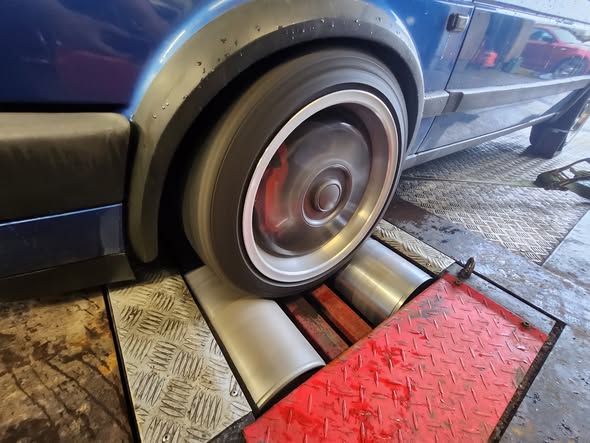
The vehicle was then tested in the dyno cell using a Bosch gas analyser and an O2 sensor in the exhaust. We set the fuel pressure to around 2 bar, where the AFR looked correct.
To ensure everything was in order, we performed a quick check on the dyno at various RPM points to verify the AFR, and found no noticeable issues. After tweaking the idle settings slightly, adding some idle ignition scatter, the vehicle was good to go.
The calibration on the engine worked. I wouldn’t call it the best. The idle setting we certainly undeveloped. No idea why they didn’t do what we did. But in terms of the fueling all seemed fine. Ignition advance etc looked a bit out of a book. The kind of thing you see from people that do the tuning on the road. Nothing wrong with it, but its hard to do ignition timing when driving the car looking for knock.
I think it would have been better with a wideband O2 sensor installed then it could have used some feedback and gone closed loop. The guy didn’t want it and I took from that he didn’t really want to spend the money developing a map which clearly had already been working.
Got we have got more power from it? Yes 100%.
All that sounds easy, but it wasn’t quite that straightforward. The vehicle had a CANEMS ECU, a reputable brand, but not the most common.
However, their software didn’t work with the ECU. After several days of back-and-forth emails, they realized it was a very early unit. In their own words:
“Oh wow! This is a very old unit. I wasn't even sure there were any out there.”
I had to install Windows XP on a machine to run the old .NET 1.1 application. Despite its age, the software worked flawlessly.
I made a few recommendations to the customer at this point:
1) Fit an AFR gauge and connect it to the ECU (the ecu supported it) He’d be able to see the AFR then and also we could get the ECU to do some short and long term fuel terms to keep the fuel economy good. Not to mention it’s a good failsafe which I am sure he later regretted.
2) Consider changing the ECU to something more modern
The car drove off, was idling fine, everything we’d been asked to do was done.
--------------------------
In the following weeks, the customer reported that he thought the car was running rich. This is a common concern with cars lacking a catalytic converter, as people often associate the smell with improper running conditions. In many cases, they aren't actually running rich but lean.
When the car came back in, we checked the AFR and found it was indeed running rich. The fuel pressure had changed. Instead of asking the customer, "Hey, why did you mess with the fuel pressure?" we simply reset it to where it had been previously. We could have been more direct, but it’s his car, and he can adjust it as he sees fit.
I strongly suggested again that he should fit an AFR gauge. Without it, he has no way of accurately monitoring the AFR, nor does the ECU. With an AFR gauge, he wouldn’t constantly think something was wrong and wouldn’t be tempted to make unnecessary adjustments. He wouldn’t be the first customer over the years to mess with their car based on a guy feeling.
--------------------------
Months later, the customer contacted me again, saying he thought the car was running rich. I advised him to fit the O2 sensor and, if it was running that poorly, to stop driving it and bring it in for inspection.
When we checked the car, it had lower compression in one cylinder, and once again, the fuel pressure had changed. If an AFR gauge had been fitted as I suggested, the customer could have seen the issue before any damage occurred.
Now, the car has gone rich again and washed out the bores. As harsh as it is to say, if you don't listen to our advice, there's not much we can do to help. Our advice is free; it's up to you to take it.
We always try to help our customers, which is why so many return. Despite only charging the customer for a dyno run and the fuel pot-related issues, we didn’t bill him for his subsequent visits, even though the problems were due to his own adjustments.
The moral of the story is that modified cars are just that—modified. You need to mitigate risks with systems and sensors that keep you informed. When we do stage 3 cars, sensors and data collection are crucial.
How many V8 engines have just one O2 sensor? It doesn’t tell you if there’s an issue with one bank. You’re taking a risk.
The truth is, modifying cars doesn’t make good financial sense. If you’re on a limited budget, stick with factory-built systems.
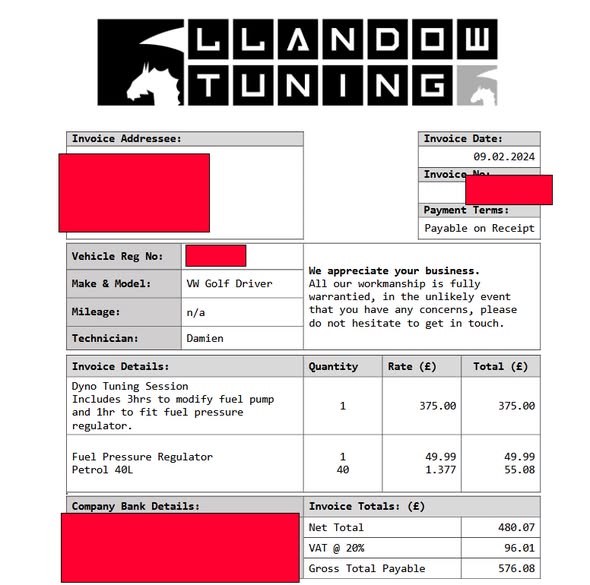
Here's what we billed for all this:
• Spending a day modifying the fuel tank, swirl pots, and running a new return line. Not to mention working out the wiring and timer relays which had been fitted.
• Spending a morning in the dyno cell to check the fuelling
• Balancing the ITB throttle bodies
• Setting up ignition scatter to get a decent idle
We didn't bill for clips, pipes, etc etc not to mention we probably only billed for about half the labour we spent on it.
Total: £375 Labour.