Tuning Wiki

This is a historical revision. Read the current page or return to its history.

Page organisation in this revision
Page type
Technical article
Subject
Tools
Parent
Section level
Applies to
No ECU-specific applicability
Tool groups
Diagnostic tools, Flashing and tuning tools
Manufacturers
Mercedes-Benz

Changes from revision 1 to revision 1

Removed text is struck through; added text is highlighted.

A diagnosis system, not a single cable

Mercedes-Benz factory diagnosis is a set of parts that have to match the vehicle and the job: a diagnosis computer, one or more software packages, a vehicle communication interface, the correct vehicle cable, and often an online account with the rights for that operation. Reading a fault code, coding a control unit and programming a control unit are different operations. A tester that can display a fault does not automatically have the data or the authorisation to replace the controller.

The current dealer kit is XENTRY Diagnosis Kit 5. Mercedes-Benz describes it as an XENTRY Diagnosis Pad 5 and an XENTRY Diagnosis VCI, supplied with a power adapter, a 16-pin OBD cable and a USB cable. Kit 4, the Pad 2 and VCI combination, stopped being available to order in January 2026. Older vehicles and older workshop installations use earlier computers and interfaces, documented on the multiplexer, DAS, HHT and XENTRY pages.
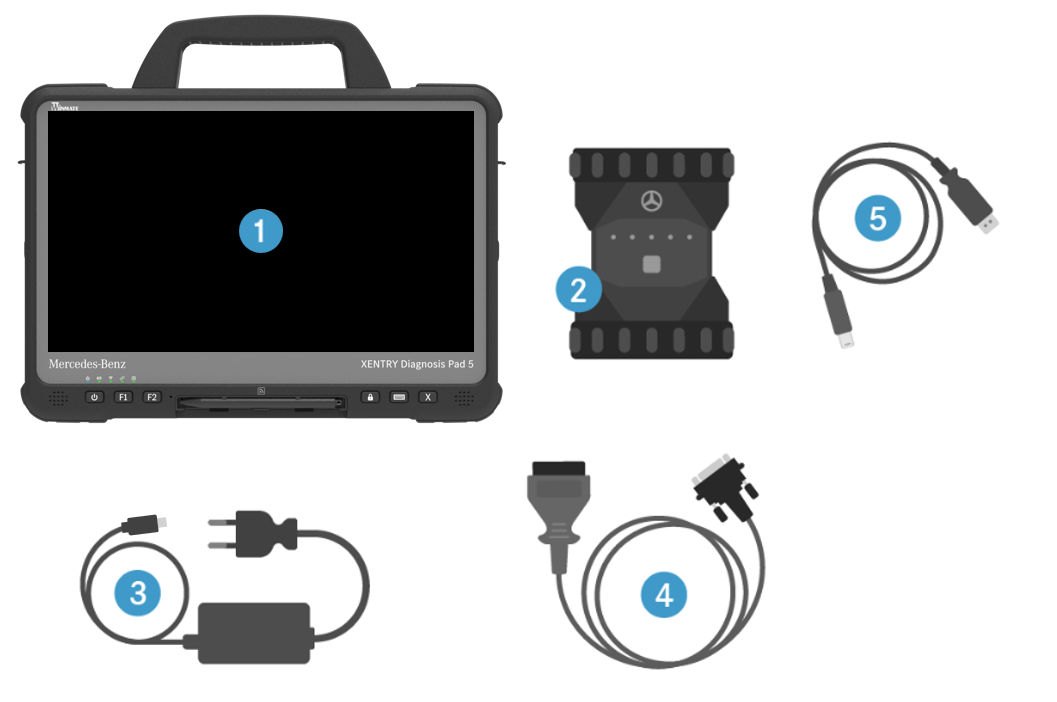
XENTRY Diagnosis Kit 5 as illustrated in the January 2026 operation manual: 1 Pad 5, 2 Diagnosis VCI, 3 power adapter, 4 16-pin OBD cable, 5 USB cable. Excerpt from Mercedes-Benz AG, GCSP/ROX, XENTRY Diagnosis Kit 5 operation manual, valid from 01/2026, Figure 1; © Mercedes-Benz AG. Quoted as a contextual visual extract under the UK quotation exception, Copyright, Designs and Patents Act 1988, section 30(1ZA). Complete manual.

Hardware generations

The computer and the vehicle interface are different parts, even when a seller uses one nickname for both. Compact 3 and Compact 4 are diagnosis-computer names. Part D3 and SDconnect are interfaces. C3, C4, C5 and C6 are workshop labels and are not reliable on their own; the multiplexer page records where Mercedes uses the factory names.

What it isFactory examplesWhat to check Handheld testerHHT, with HHT-WIN later reproducing handheld functions on a suitable computerEarly systems may use a 38-pin diagnostic socket rather than the later 16-pin OBD connector. Diagnosis computerStar Diagnosis Basic, Compact 3 w and Compact 4; XENTRY Tab; XENTRY Diagnosis Pad 2 and Pad 5The computer generation does not by itself prove which multiplexer or which vehicle years are covered. Vehicle interfacePart D3; SDconnect, including an SDconnect DoIP variant; XENTRY Connect; XENTRY Diagnosis VCIK-line, CAN and DoIP are properties of the interface, cable and software together. DoIP on the vehicle is not the same thing as the workshop Wi-Fi link. Measurement accessoryXENTRY Scope, optional with the later kits. A 2007 workshop article also describes HMS990 as the measurement part of the earlier Star Diagnosis package.An oscilloscope does not replace the diagnostic application.

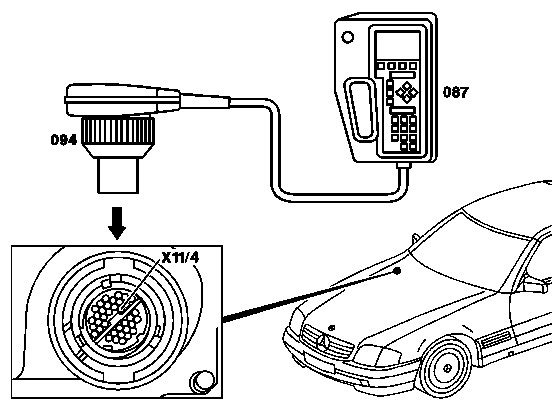
Hand-Held Tester, multiplex cable and the round diagnostic socket X11/4 in a Daimler engine 119 ME fault-memory sheet. Callout 087 is the tester and 084 is the cable connector. © Daimler AG, as reproduced in the hosted workshop sheet. Quoted as a contextual visual extract under the UK quotation exception, Copyright, Designs and Patents Act 1988, section 30(1ZA). Complete sheet, page 3. This is one application, not a pinout for every chassis.

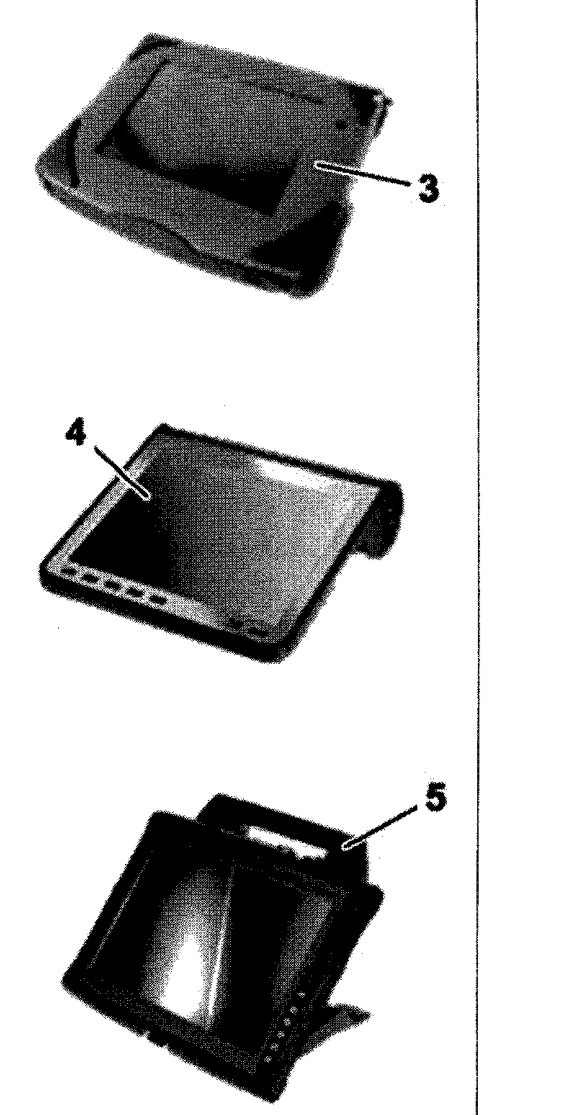
Star Diagnosis computers in the January 2013 multiplexer bulletin: 3 Basic, 4 Compact 3 w, 5 Compact 4. Excerpt from Mercedes-Benz USA, LLC, star bulletin S-B-58.40/162, 3 January 2013, Figure 2; © 2012 Mercedes-Benz USA, LLC. Quoted as a contextual visual extract under the UK quotation exception, Copyright, Designs and Patents Act 1988, section 30(1ZA). Complete bulletin.

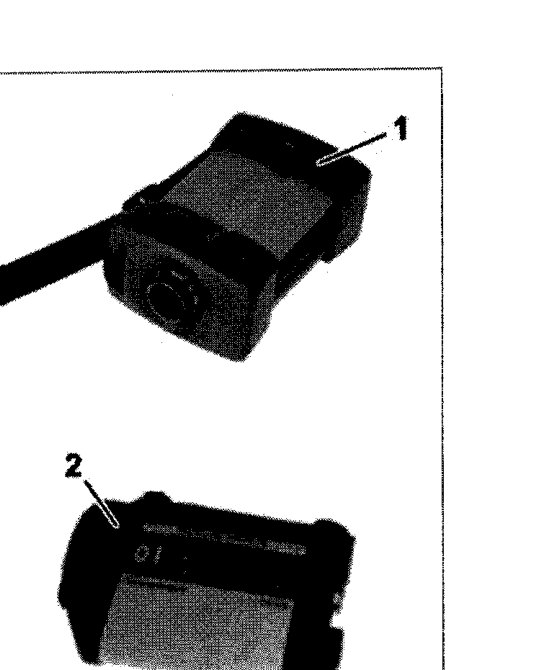
Part D3 (1) and SDconnect (2). Excerpt from Mercedes-Benz USA, LLC, star bulletin S-B-58.40/162, 3 January 2013, Figure 1; © 2012 Mercedes-Benz USA, LLC. Quoted as a contextual visual extract under the UK quotation exception, Copyright, Designs and Patents Act 1988, section 30(1ZA). Complete bulletin. The same bulletin distinguishes a later SDconnect DoIP unit by its model-plate marking.

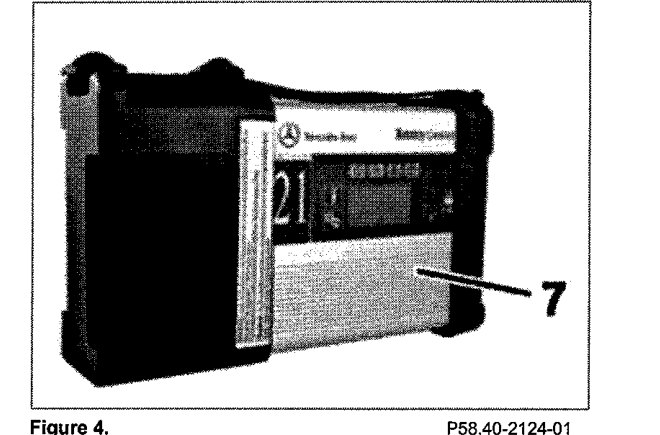
XENTRY Connect, item 7 in the 2013 bulletin. In XENTRY Kit 2 this vehicle-side unit ran the diagnostic desktop and was operated remotely. Excerpt from Mercedes-Benz USA, LLC, star bulletin S-B-58.40/162, 3 January 2013, Figure 4; © 2012 Mercedes-Benz USA, LLC. Quoted as a contextual visual extract under the UK quotation exception, Copyright, Designs and Patents Act 1988, section 30(1ZA). Complete bulletin.

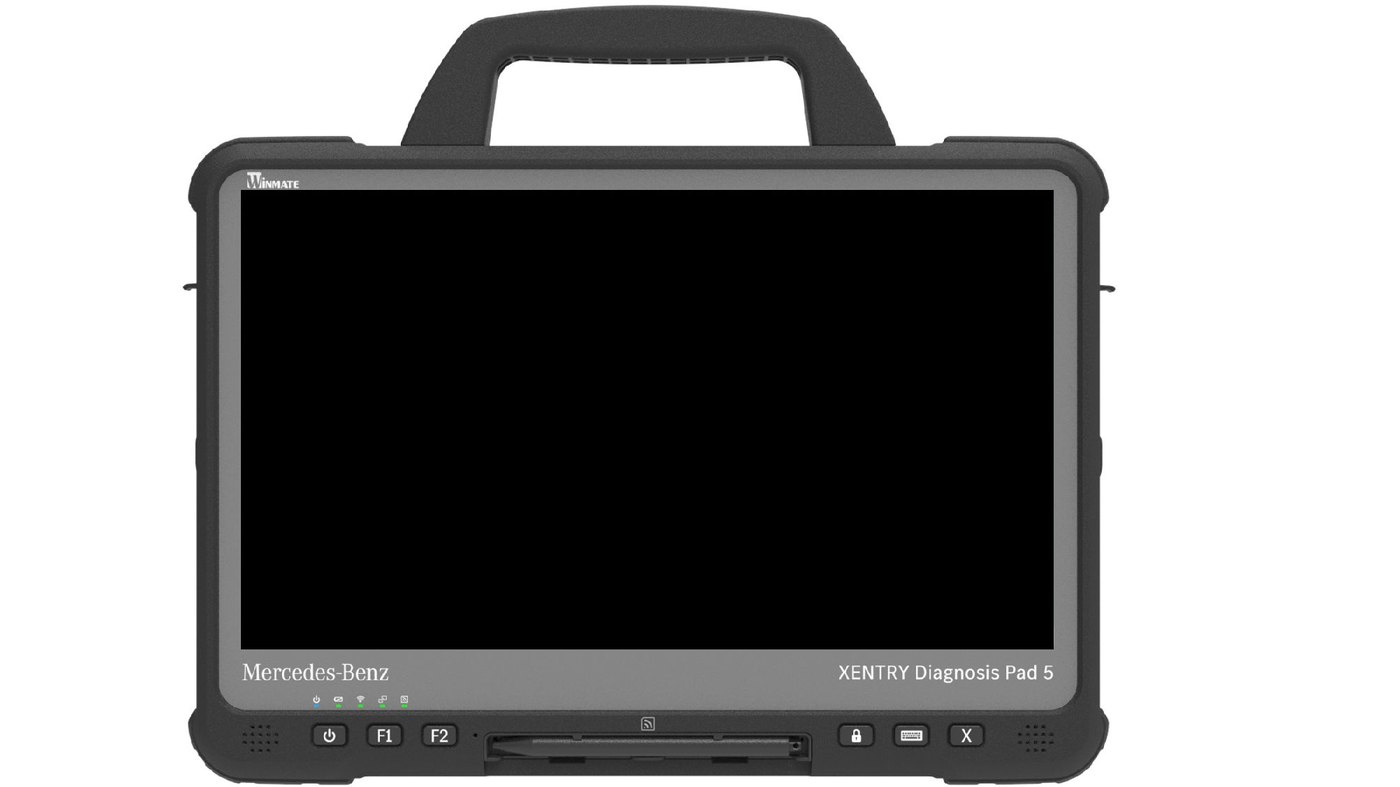
XENTRY Diagnosis Pad 5. The bezel in this manual photograph also carries the Winmate name; the diagnosis system is the Mercedes-Benz kit, not a generic tablet image. Excerpt from Mercedes-Benz AG, XENTRY Diagnosis Kit 5 operation manual, valid from 01/2026; © Mercedes-Benz AG. Quoted as a contextual visual extract under the UK quotation exception, Copyright, Designs and Patents Act 1988, section 30(1ZA). Complete manual. The manual lists a 1 TB SSD, 16 GB DDR4, an Intel Core i5 and Windows 11 IoT for this pad.

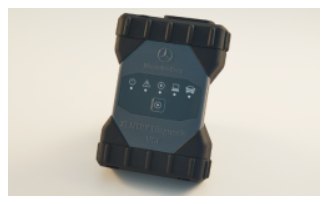
XENTRY Diagnosis VCI. Mercedes-Benz Canada’s March 2017 note says this interface has no separate PC core, battery, fan or display, and is used from the Diagnosis Pad over WLAN or USB. Excerpt © Mercedes-Benz Canada. Quoted as a contextual visual extract under the UK quotation exception, Copyright, Designs and Patents Act 1988, section 30(1ZA). Complete note.

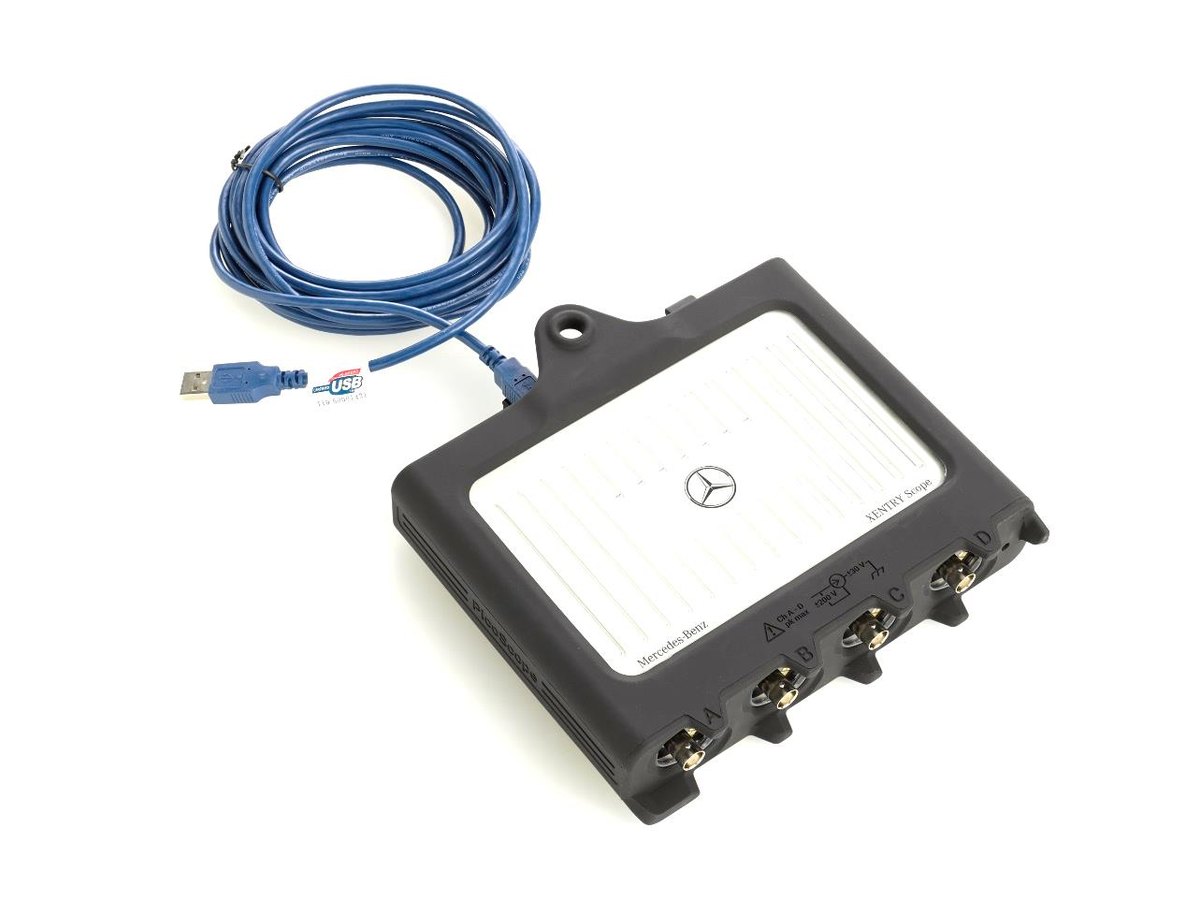
XENTRY Scope in the August 2020 Kit 4 brochure. The top is marked Mercedes-Benz and XENTRY Scope; the side of this unit is marked PicoScope. Excerpt from Mercedes-Benz AG, XENTRY Diagnosis Kit 4 product brochure; © Mercedes-Benz AG. Quoted as a contextual visual extract under the UK quotation exception, Copyright, Designs and Patents Act 1988, section 30(1ZA). Complete brochure. The Kit 5 manual still lists XENTRY Scope as an optional accessory; that later illustration is not clear enough to identify the manufacturer of the housing.

Dealer software and the independent-workshop packages

XENTRY Diagnosis is the current guided diagnostic application. For supported older series it opens DAS. Still earlier functions can require HHT-WIN or the original handheld tester. There is no single model-year on which every market and every control unit changed over.
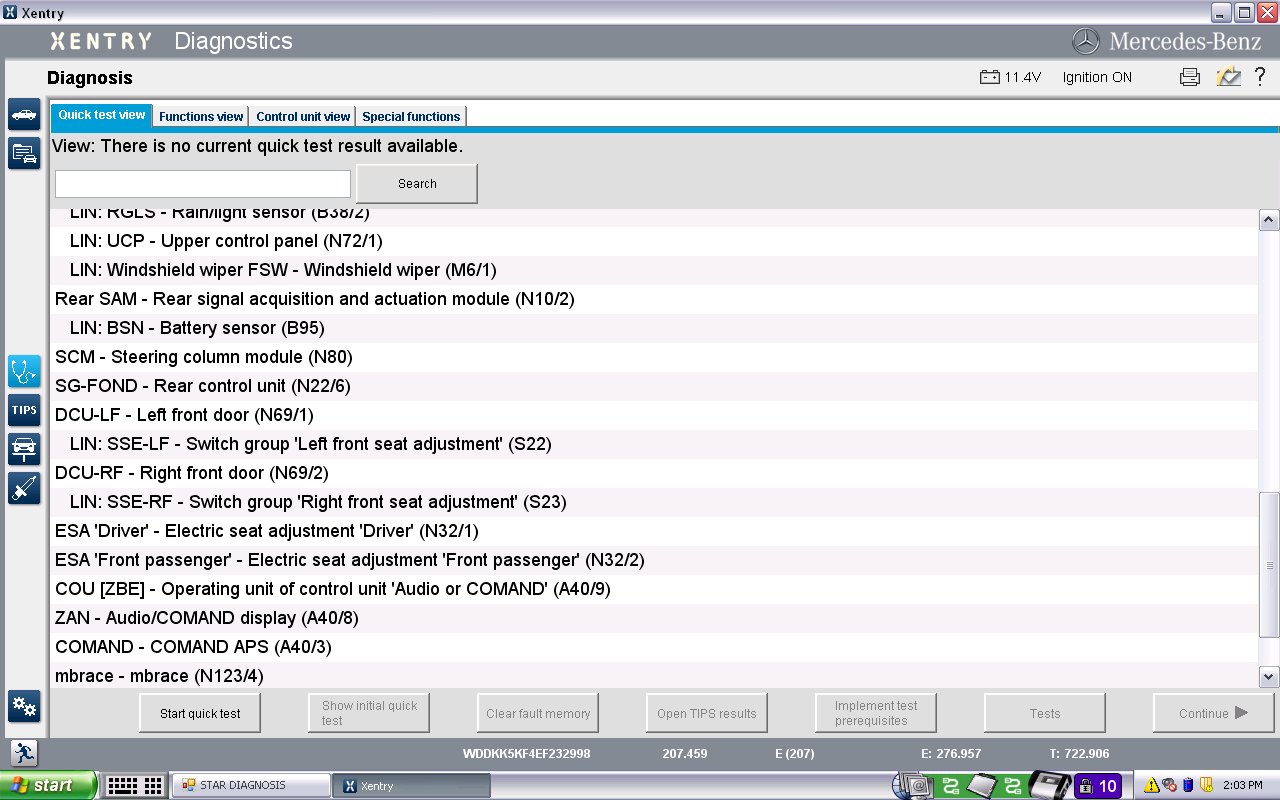
XENTRY Diagnostics in a 2014 service document, showing the control-unit list and the quick-test, functions, control-unit and special-functions views. The status line belongs to the vehicle in that document. Excerpt from Daimler AG service information LI65.00-P-059054, hosted by NHTSA; © Daimler AG. Quoted as a contextual visual extract under the UK quotation exception, Copyright, Designs and Patents Act 1988, section 30(1ZA). Complete document, page 3.

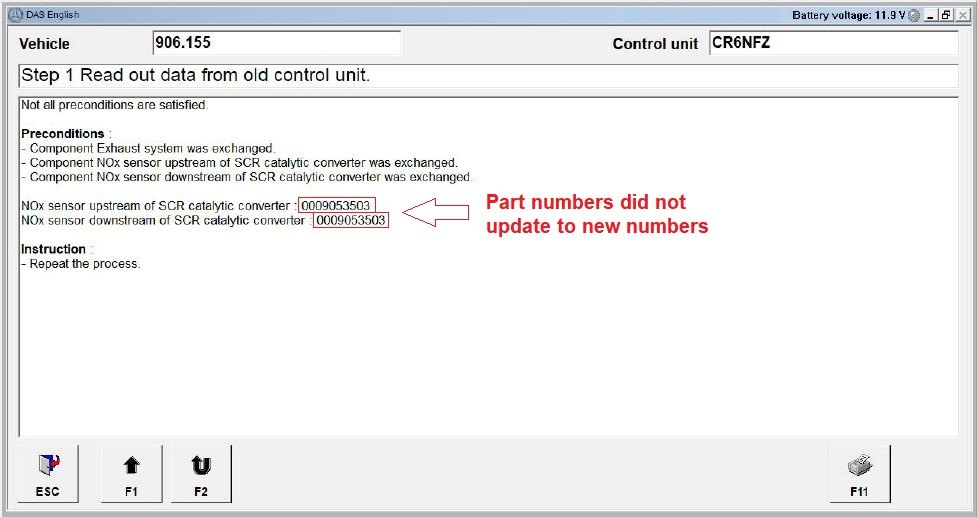
A DAS window during one Sprinter NOx-sensor procedure. The red note is part of the service document, and the screen is not the DAS main menu. Excerpt from Mercedes-Benz AG XENTRY Tips document LI49.20-N-074942, hosted by NHTSA; © Mercedes-Benz AG. Quoted as a contextual visual extract under the UK quotation exception, Copyright, Designs and Patents Act 1988, section 30(1ZA). Complete document.

Mercedes-Benz UK currently compares three ways of obtaining diagnosis:

XENTRY Diagnosis Kit 5 is the full dealer-style kit. Mercedes states coverage of all model series. XENTRY Diagnosis Lite is the independent-workshop package for a standard Windows PC, supplied with an XENTRY Diagnosis VCI. The UK FAQ limits it to control units of model series from model year 2004, including DAS for those series, and explicitly excludes HHT-WIN. The product page also excludes smart model number 1. Ordering is described for the EU, Iceland, Liechtenstein, Norway, Switzerland and the United Kingdom. XENTRY Pass Thru EU is the narrower Euro 5/6 passenger-car and van offering for a standard PC and a suitable Pass Thru interface. See the Pass Thru page. It is not the same product as Diagnosis Lite.

The Kit 5 manual and the Kit 4 product page also name software that sits beside the diagnostic application: ConfigAssist for setup and StartKey handling, XENTRY Update Service for online software updates, and XENTRY Diagnosis AQT for an automatic quick test in service reception. XENTRY Flash is a separate authorisation in the Pass Thru FAQ; a diagnosis login does not by itself include every programming right. Coding and SCN are explained on the SCN coding page.
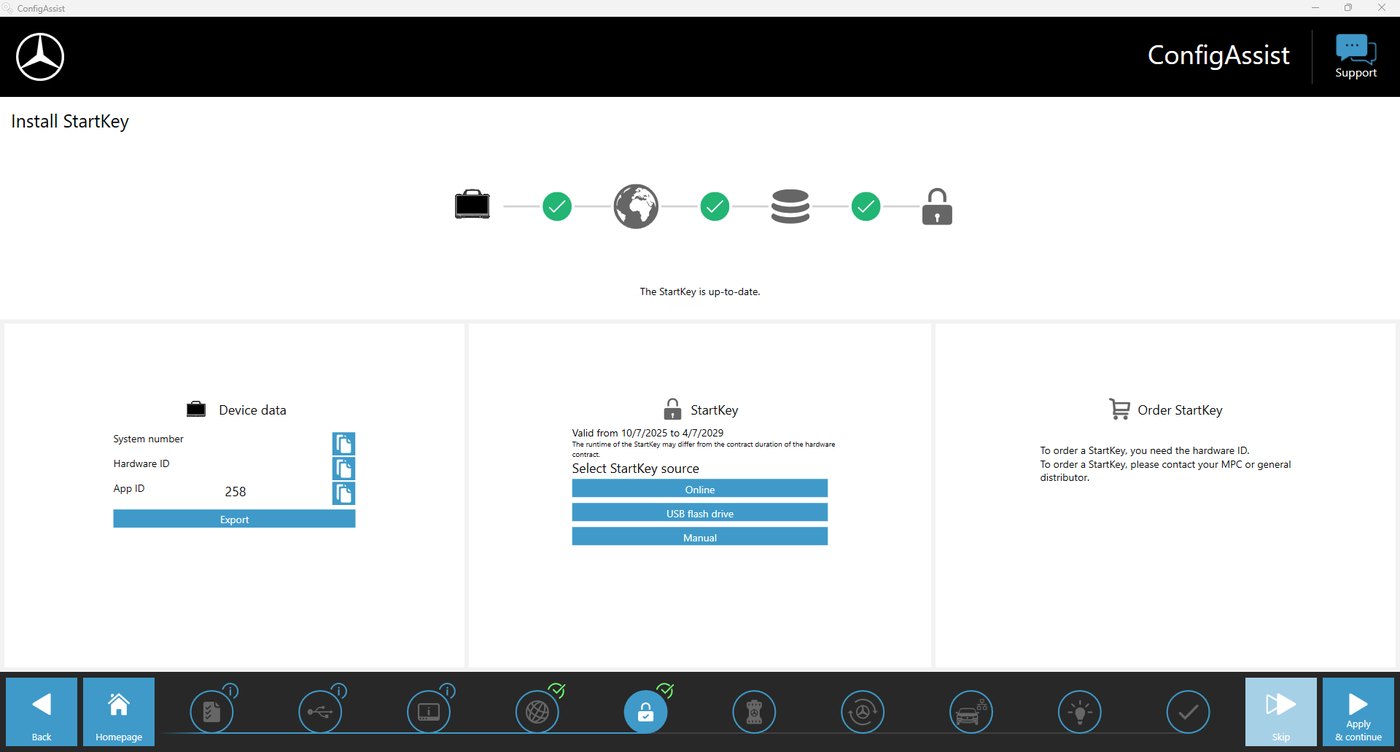
ConfigAssist on a Kit 5 pad, at the StartKey step. The hardware identifiers and validity dates are the manual’s example. Excerpt from Mercedes-Benz AG, XENTRY Diagnosis Kit 5 operation manual, valid from 01/2026; © Mercedes-Benz AG. Quoted as a contextual visual extract under the UK quotation exception, Copyright, Designs and Patents Act 1988, section 30(1ZA). Complete manual.

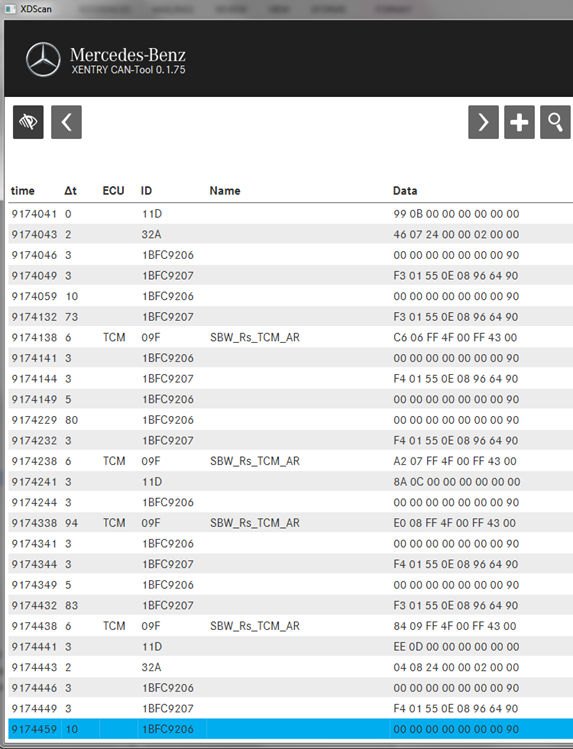
XENTRY CAN-Tool 0.1.75 as shown in the Kit 5 manual. It is a bus-trace view, separate from the guided XENTRY Diagnosis screens. The rows are the manual’s example. Excerpt from Mercedes-Benz AG, XENTRY Diagnosis Kit 5 operation manual, valid from 01/2026; © Mercedes-Benz AG. Quoted as a contextual visual extract under the UK quotation exception, Copyright, Designs and Patents Act 1988, section 30(1ZA). Complete manual.

Workshop information is not the scan tool

Repair instructions, wiring diagrams, labour times and parts catalogues are separate publications. WIS, XENTRY TIPS, parts information and operation times can be opened alongside diagnosis, and a diagnosis screen can link to them, but a wiring diagram does not communicate with the car. Mercedes sells the repair-and-maintenance information products separately from diagnosis equipment.

Engineering software is not the dealer tester

Vediamo is a Mercedes-Benz engineering application built on the CAESAR communication platform and DIOGENES diagnostic data. DTS Monaco is Softing’s ODX engineering tester. Mercedes development job advertisements list DTS Monaco among the tools those teams use. Neither program is XENTRY Diagnosis, and a workshop copy of either one does not establish that an online commissioning or SCN procedure can be skipped.

Preinstalled laptops sold as “MB Star” with a bundle of DAS, XENTRY, WIS, EPC, Vediamo and DTS Monaco are aftermarket installations. The photographs above are of the factory hardware and of screens in Mercedes or Softing documents. A seller’s software list does not establish that the installation is licensed, current, or able to complete a particular programming job.

Sources

Curated reference notes. Applicability follows the cited sources; hardware testing by this wiki is not implied.

Mercedes-Benz XENTRY Diagnosis Kit 5 operation manual. Mercedes-Benz AG, GCSP/ROX; Pad 5, VCI, cables, ConfigAssist, CAN-Tool and optional Scope. Source revision valid from 01/2026; accessed 2026-11-11. Mercedes-Benz UK: XENTRY Diagnosis Kit 4. Mercedes-Benz AG; Kit 4 contents and the January 2026 end of ordering. Source revision product page, accessed 11 November 2026; accessed 2026-11-11. Mercedes-Benz UK: XENTRY Diagnosis Kit 5. Mercedes-Benz AG; Pad 5, VCI and stated scope of delivery. Source revision product page, accessed 11 November 2026; accessed 2026-11-11. Mercedes-Benz UK: XENTRY Diagnosis Lite FAQ. Mercedes-Benz AG; independent-workshop scope, VCI, model-year 2004 limit and HHT-WIN exclusion. Source revision FAQ, accessed 11 November 2026; accessed 2026-11-11. Mercedes-Benz star bulletin S-B-58.40/162: Multiplexer. Mercedes-Benz USA, LLC, hosted by NHTSA; Basic, Compact 3 w, Compact 4, Part D3, SDconnect, XENTRY Tab and XENTRY Connect. Source revision 3 January 2013; accessed 2026-11-11. Mercedes-Benz Canada: XENTRY Diagnosis VCI. Mercedes-Benz Canada; Kit 3 interface description. Source revision March 2017; accessed 2026-11-11. Mercedes-Benz Canada: technical information. Mercedes-Benz Canada; Kit 3 support ending 30 June 2025, and the EPC, WIS and TIPS descriptions. Source revision page, accessed 11 November 2026; accessed 2026-11-11. Mercedes-Benz XENTRY Diagnosis Kit 4 product brochure. Mercedes-Benz AG; Pad 2 and XENTRY Scope photograph. Source revision August 2020; accessed 2026-11-11. Star Diagnosis: Your Guiding Light. Automotive Tech Info, September 2007; period description of DAS, WIS and HMS990 as the three parts of Star Diagnosis. Source revision September 2007; accessed 2026-11-11.

Rendered revisions

Open each version to inspect formatting, tables and photographs.

Revision 1: Mercedes-Benz factory diagnostic equipment

A diagnosis system, not a single cable

Mercedes-Benz factory diagnosis is a set of parts that have to match the vehicle and the job: a diagnosis computer, one or more software packages, a vehicle communication interface, the correct vehicle cable, and often an online account with the rights for that operation. Reading a fault code, coding a control unit and programming a control unit are different operations. A tester that can display a fault does not automatically have the data or the authorisation to replace the controller.

The current dealer kit is XENTRY Diagnosis Kit 5. Mercedes-Benz describes it as an XENTRY Diagnosis Pad 5 and an XENTRY Diagnosis VCI, supplied with a power adapter, a 16-pin OBD cable and a USB cable. Kit 4, the Pad 2 and VCI combination, stopped being available to order in January 2026. Older vehicles and older workshop installations use earlier computers and interfaces, documented on the multiplexer, DAS, HHT and XENTRY pages.

XENTRY Diagnosis Kit 5 contents: Pad 5, Diagnosis VCI, power adapter, 16-pin OBD cable and USB cable
XENTRY Diagnosis Kit 5 as illustrated in the January 2026 operation manual: 1 Pad 5, 2 Diagnosis VCI, 3 power adapter, 4 16-pin OBD cable, 5 USB cable. Excerpt from Mercedes-Benz AG, GCSP/ROX, XENTRY Diagnosis Kit 5 operation manual, valid from 01/2026, Figure 1; © Mercedes-Benz AG. Quoted as a contextual visual extract under the UK quotation exception, Copyright, Designs and Patents Act 1988, section 30(1ZA). Complete manual.

Hardware generations

The computer and the vehicle interface are different parts, even when a seller uses one nickname for both. Compact 3 and Compact 4 are diagnosis-computer names. Part D3 and SDconnect are interfaces. C3, C4, C5 and C6 are workshop labels and are not reliable on their own; the multiplexer page records where Mercedes uses the factory names.

What it isFactory examplesWhat to check
Handheld testerHHT, with HHT-WIN later reproducing handheld functions on a suitable computerEarly systems may use a 38-pin diagnostic socket rather than the later 16-pin OBD connector.
Diagnosis computerStar Diagnosis Basic, Compact 3 w and Compact 4; XENTRY Tab; XENTRY Diagnosis Pad 2 and Pad 5The computer generation does not by itself prove which multiplexer or which vehicle years are covered.
Vehicle interfacePart D3; SDconnect, including an SDconnect DoIP variant; XENTRY Connect; XENTRY Diagnosis VCIK-line, CAN and DoIP are properties of the interface, cable and software together. DoIP on the vehicle is not the same thing as the workshop Wi-Fi link.
Measurement accessoryXENTRY Scope, optional with the later kits. A 2007 workshop article also describes HMS990 as the measurement part of the earlier Star Diagnosis package.An oscilloscope does not replace the diagnostic application.
Line drawing of a Mercedes Hand-Held Tester, multiplex cable and round 38-pin diagnostic socket
Hand-Held Tester, multiplex cable and the round diagnostic socket X11/4 in a Daimler engine 119 ME fault-memory sheet. Callout 087 is the tester and 084 is the cable connector. © Daimler AG, as reproduced in the hosted workshop sheet. Quoted as a contextual visual extract under the UK quotation exception, Copyright, Designs and Patents Act 1988, section 30(1ZA). Complete sheet, page 3. This is one application, not a pinout for every chassis.
Mercedes Star Diagnosis Basic, Compact 3 w and Compact 4 diagnosis computers
Star Diagnosis computers in the January 2013 multiplexer bulletin: 3 Basic, 4 Compact 3 w, 5 Compact 4. Excerpt from Mercedes-Benz USA, LLC, star bulletin S-B-58.40/162, 3 January 2013, Figure 2; © 2012 Mercedes-Benz USA, LLC. Quoted as a contextual visual extract under the UK quotation exception, Copyright, Designs and Patents Act 1988, section 30(1ZA). Complete bulletin.
Mercedes Part D3 and SDconnect diagnostic multiplexers
Part D3 (1) and SDconnect (2). Excerpt from Mercedes-Benz USA, LLC, star bulletin S-B-58.40/162, 3 January 2013, Figure 1; © 2012 Mercedes-Benz USA, LLC. Quoted as a contextual visual extract under the UK quotation exception, Copyright, Designs and Patents Act 1988, section 30(1ZA). Complete bulletin. The same bulletin distinguishes a later SDconnect DoIP unit by its model-plate marking.
Mercedes-Benz XENTRY Connect vehicle-side diagnostic computer
XENTRY Connect, item 7 in the 2013 bulletin. In XENTRY Kit 2 this vehicle-side unit ran the diagnostic desktop and was operated remotely. Excerpt from Mercedes-Benz USA, LLC, star bulletin S-B-58.40/162, 3 January 2013, Figure 4; © 2012 Mercedes-Benz USA, LLC. Quoted as a contextual visual extract under the UK quotation exception, Copyright, Designs and Patents Act 1988, section 30(1ZA). Complete bulletin.
Mercedes-Benz XENTRY Diagnosis Pad 5 rugged tablet
XENTRY Diagnosis Pad 5. The bezel in this manual photograph also carries the Winmate name; the diagnosis system is the Mercedes-Benz kit, not a generic tablet image. Excerpt from Mercedes-Benz AG, XENTRY Diagnosis Kit 5 operation manual, valid from 01/2026; © Mercedes-Benz AG. Quoted as a contextual visual extract under the UK quotation exception, Copyright, Designs and Patents Act 1988, section 30(1ZA). Complete manual. The manual lists a 1 TB SSD, 16 GB DDR4, an Intel Core i5 and Windows 11 IoT for this pad.
Mercedes-Benz XENTRY Diagnosis VCI multiplexer
XENTRY Diagnosis VCI. Mercedes-Benz Canada’s March 2017 note says this interface has no separate PC core, battery, fan or display, and is used from the Diagnosis Pad over WLAN or USB. Excerpt © Mercedes-Benz Canada. Quoted as a contextual visual extract under the UK quotation exception, Copyright, Designs and Patents Act 1988, section 30(1ZA). Complete note.
XENTRY Scope measurement interface with four BNC inputs and a USB lead
XENTRY Scope in the August 2020 Kit 4 brochure. The top is marked Mercedes-Benz and XENTRY Scope; the side of this unit is marked PicoScope. Excerpt from Mercedes-Benz AG, XENTRY Diagnosis Kit 4 product brochure; © Mercedes-Benz AG. Quoted as a contextual visual extract under the UK quotation exception, Copyright, Designs and Patents Act 1988, section 30(1ZA). Complete brochure. The Kit 5 manual still lists XENTRY Scope as an optional accessory; that later illustration is not clear enough to identify the manufacturer of the housing.

Dealer software and the independent-workshop packages

XENTRY Diagnosis is the current guided diagnostic application. For supported older series it opens DAS. Still earlier functions can require HHT-WIN or the original handheld tester. There is no single model-year on which every market and every control unit changed over.

XENTRY Diagnostics control-unit list from a 2014 Mercedes-Benz service document
XENTRY Diagnostics in a 2014 service document, showing the control-unit list and the quick-test, functions, control-unit and special-functions views. The status line belongs to the vehicle in that document. Excerpt from Daimler AG service information LI65.00-P-059054, hosted by NHTSA; © Daimler AG. Quoted as a contextual visual extract under the UK quotation exception, Copyright, Designs and Patents Act 1988, section 30(1ZA). Complete document, page 3.
DAS window during a Sprinter control-unit data read, with the service document's own annotation
A DAS window during one Sprinter NOx-sensor procedure. The red note is part of the service document, and the screen is not the DAS main menu. Excerpt from Mercedes-Benz AG XENTRY Tips document LI49.20-N-074942, hosted by NHTSA; © Mercedes-Benz AG. Quoted as a contextual visual extract under the UK quotation exception, Copyright, Designs and Patents Act 1988, section 30(1ZA). Complete document.

Mercedes-Benz UK currently compares three ways of obtaining diagnosis:

  • XENTRY Diagnosis Kit 5 is the full dealer-style kit. Mercedes states coverage of all model series.
  • XENTRY Diagnosis Lite is the independent-workshop package for a standard Windows PC, supplied with an XENTRY Diagnosis VCI. The UK FAQ limits it to control units of model series from model year 2004, including DAS for those series, and explicitly excludes HHT-WIN. The product page also excludes smart model number 1. Ordering is described for the EU, Iceland, Liechtenstein, Norway, Switzerland and the United Kingdom.
  • XENTRY Pass Thru EU is the narrower Euro 5/6 passenger-car and van offering for a standard PC and a suitable Pass Thru interface. See the Pass Thru page. It is not the same product as Diagnosis Lite.

The Kit 5 manual and the Kit 4 product page also name software that sits beside the diagnostic application: ConfigAssist for setup and StartKey handling, XENTRY Update Service for online software updates, and XENTRY Diagnosis AQT for an automatic quick test in service reception. XENTRY Flash is a separate authorisation in the Pass Thru FAQ; a diagnosis login does not by itself include every programming right. Coding and SCN are explained on the SCN coding page.

ConfigAssist Install StartKey screen with online, USB and manual source buttons
ConfigAssist on a Kit 5 pad, at the StartKey step. The hardware identifiers and validity dates are the manual’s example. Excerpt from Mercedes-Benz AG, XENTRY Diagnosis Kit 5 operation manual, valid from 01/2026; © Mercedes-Benz AG. Quoted as a contextual visual extract under the UK quotation exception, Copyright, Designs and Patents Act 1988, section 30(1ZA). Complete manual.
XENTRY CAN-Tool 0.1.75 trace listing CAN identifiers and data bytes
XENTRY CAN-Tool 0.1.75 as shown in the Kit 5 manual. It is a bus-trace view, separate from the guided XENTRY Diagnosis screens. The rows are the manual’s example. Excerpt from Mercedes-Benz AG, XENTRY Diagnosis Kit 5 operation manual, valid from 01/2026; © Mercedes-Benz AG. Quoted as a contextual visual extract under the UK quotation exception, Copyright, Designs and Patents Act 1988, section 30(1ZA). Complete manual.

Workshop information is not the scan tool

Repair instructions, wiring diagrams, labour times and parts catalogues are separate publications. WIS, XENTRY TIPS, parts information and operation times can be opened alongside diagnosis, and a diagnosis screen can link to them, but a wiring diagram does not communicate with the car. Mercedes sells the repair-and-maintenance information products separately from diagnosis equipment.

Engineering software is not the dealer tester

Vediamo is a Mercedes-Benz engineering application built on the CAESAR communication platform and DIOGENES diagnostic data. DTS Monaco is Softing’s ODX engineering tester. Mercedes development job advertisements list DTS Monaco among the tools those teams use. Neither program is XENTRY Diagnosis, and a workshop copy of either one does not establish that an online commissioning or SCN procedure can be skipped.

Preinstalled laptops sold as “MB Star” with a bundle of DAS, XENTRY, WIS, EPC, Vediamo and DTS Monaco are aftermarket installations. The photographs above are of the factory hardware and of screens in Mercedes or Softing documents. A seller’s software list does not establish that the installation is licensed, current, or able to complete a particular programming job.

Sources

Curated reference notes. Applicability follows the cited sources; hardware testing by this wiki is not implied.