Removed text is struck through; added text is highlighted.
What is Bosch ME7?
Bosch ME7 is a family of electronic engine management systems for petrol engines. It combines electronic throttle control with fuel injection and ignition control. ME7 was used on naturally aspirated and turbocharged engines; many applications use multipoint port injection.
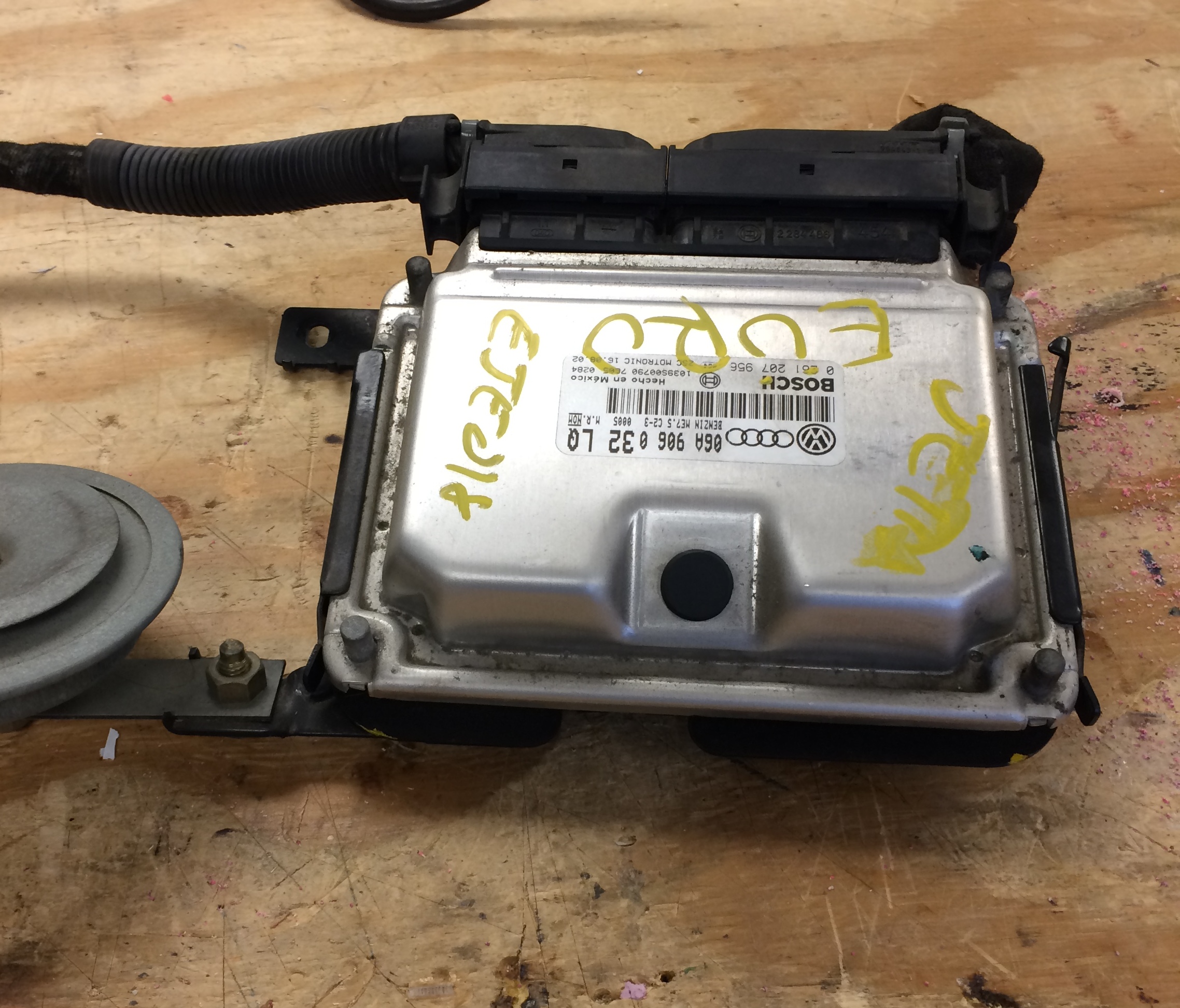
Example Bosch ME7.5 ECU, VW/Audi part number 06A 906 032 LQ and Bosch number 0 261 207 956. Photograph by Mkamara9540, cropped by Wikisympathisant; Wikimedia Commons; CC BY-SA 4.0. Source file unchanged by Tuning Wiki.Example Bosch ME7.5 ECU, VW/Audi part number 06A 906 032 LQ and Bosch number 0 261 207 956. Photograph by Mkamara9540, Wikimedia Commons; CC BY-SA 4.0. Original photograph, unmodified.
ME7 uses a torque-oriented control strategy: it estimates engine torque and coordinates requests for it, while also calculating the fuel needed for the air entering the engine. The details vary with the engine and software. See Audi SSP 198 and Bosch's ME-Motronic guide.
How torque control works
The accelerator pedal is interpreted as a request for torque, rather than a direct mechanical command to open the throttle. The ECU also considers requests and limits from functions such as idle control, cruise control, the gearbox and traction or stability control, as fitted.
Using its engine model and calibrated maps, the ECU estimates torque and the cylinder air charge needed to meet the permitted request. It controls the electronic throttle and, on turbocharged applications, can also control boost. Faster torque changes can be made through ignition timing or, when required, injection or cylinder cut. The calculated torque is an estimate, not a direct measurement from a torque sensor.
Fuel injection and ignition
ME7 also calculates a fuel quantity. It estimates the air charge from the available sensors and engine model, selects a target air-to-fuel ratio (lambda), then calculates the required fuel mass and injector opening time using injector calibration and operating corrections. When conditions allow, oxygen-sensor feedback adjusts fuelling to help reach the target. The commanded injector time does not directly measure how much fuel was actually delivered.
The ECU also controls ignition timing and, where fitted, uses knock-sensor feedback to adjust it. Other functions can include variable valve timing, emissions controls and fault diagnostics, depending on the application.
Example vehicles and engines
These are representative documented examples, not a complete fitment list. Model year, market, engine code and equipment can change the ECU fitted.
Audi S3 and TT 1.8T — APY and AJQ four-cylinder examples use ME7.5; see the Bosch application catalogue.Audi S4 and RS4 2.7 biturbo V6 — AGB and ASJ examples use ME7.1; Audi S6 4.2 V8 AQJ is another ME7.1 example in the same catalogue.Volkswagen Golf Mk4 (1J) 1.8T — AUM (150 PS) and AUQ (180 PS) manual-transmission examples are listed with ME7.5 in Alientech's application list.SEAT León Mk1 and Toledo Mk2 (1M) 1.8T — AUQ examples are listed with ME7.5 in TRW's vehicle application list.Škoda Octavia Mk1 (1U) 1.8T — the AUQ engine is listed with ME7.5 in the same TRW list.BMW X5 E53 4.4i — the M62TU 4.4-litre V8 uses ME7.2, as shown in BMW's X5 training material.Volvo S70 2.4 turbo — the 2000 B5244T five-cylinder example is shown with ME7 in the Volvo service information.Peugeot 307 1.6 16V — the TU5JP4 / NFU four-cylinder is documented with ME7.4.4 in Peugeot's engine information; the same document also lists M7.4.4, so check the individual vehicle.Fiat Bravo II 1.4 16V T-Jet — the 198 A4.000 engine is listed with ME7.9.10 in Alientech's application list.
What this means when tuning
Torque requests, air charge, boost, lambda, injector calibration and ignition interact. A change in one area can be limited or affect another, so compare requested and observed values and work from definitions for the exact ECU hardware and software. Internal torque and load values may be scaled differently between versions.
Main ME7 torque and load maps
These descriptions use the documented Audi 1.8T ME7.1 strategy as an example. Similar names are common in related ME7.5 software, but functions, axes, units and limits can vary by ECU and calibration. Here, load means relative cylinder air charge, not boost pressure.
KFPED — driver request. Uses accelerator-pedal position and engine speed to produce a relative driver torque request. This shapes how the pedal feels; it does not directly command throttle angle or injector quantity.KFMIRL — torque to load. Uses the requested torque, adjusted to the map's reference conditions, and engine speed to calculate the cylinder air charge needed for the air path. The resulting request is subject to applicable limits.KFMIOP — load to modelled torque. Relates cylinder charge and engine speed to an optimum indicated engine torque under reference conditions. The ECU uses this relationship when estimating available and operating torque; ignition and mixture efficiencies can modify the estimate. It is a model, not a torque-sensor reading. KFMIOP and KFMIRL describe complementary directions of the same relationship; they are not necessarily exact mathematical inverses.LDRXN — maximum load for boost control. In the documented turbocharged application, this engine-speed-dependent curve contributes to the maximum permitted relative cylinder charge. It is a load limit, not a direct boost-pressure target or wastegate duty map. Temperature, knock and other protection limits can reduce the allowable charge further.
How they work together: Pressing the pedal gives a relative request through KFPED. The ECU scales and coordinates that request using its estimate of available torque, then KFMIRL translates the resulting torque request into a desired air charge. The charge is limited by the applicable maximum, including the limit derived from LDRXN, and the throttle and boost controls work towards the permitted target. KFMIOP also helps the ECU estimate torque from cylinder charge and calculate available torque, so it participates in the wider coordination rather than acting as a single final step.
Other familiar calibrations: MLHFM converts a mass-air-flow sensor signal into airflow on applications using that sensor; LAMFA is one of the requested lambda maps; and KFZW provides a base ignition angle. Other maps and corrections also affect the final mixture and ignition timing. See ME7 torque, load and boost control for related guidance.
Family scope
The S4Wiki tuning reference discusses ME7.1 and ME7.5 and includes S4 M-box/L-box examples. Keep those examples attached to their software context.
ME7.1 and ME7.1.1 board examples
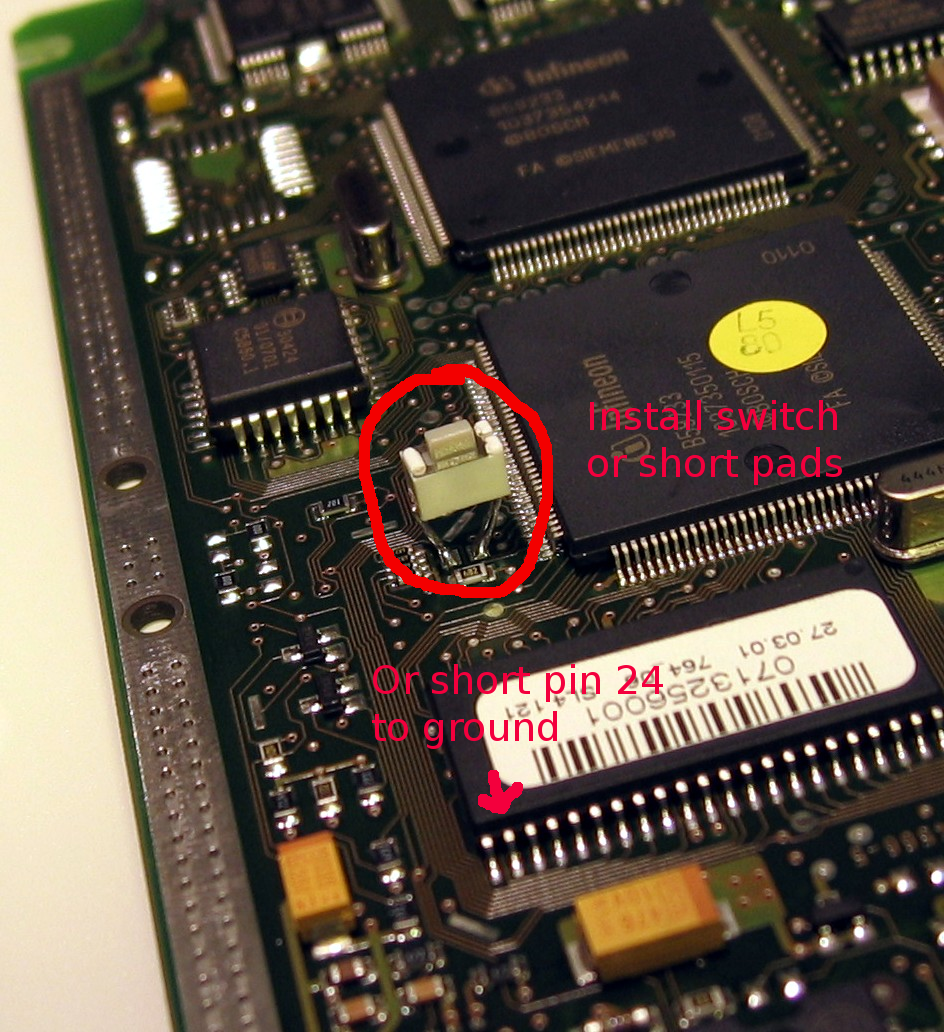
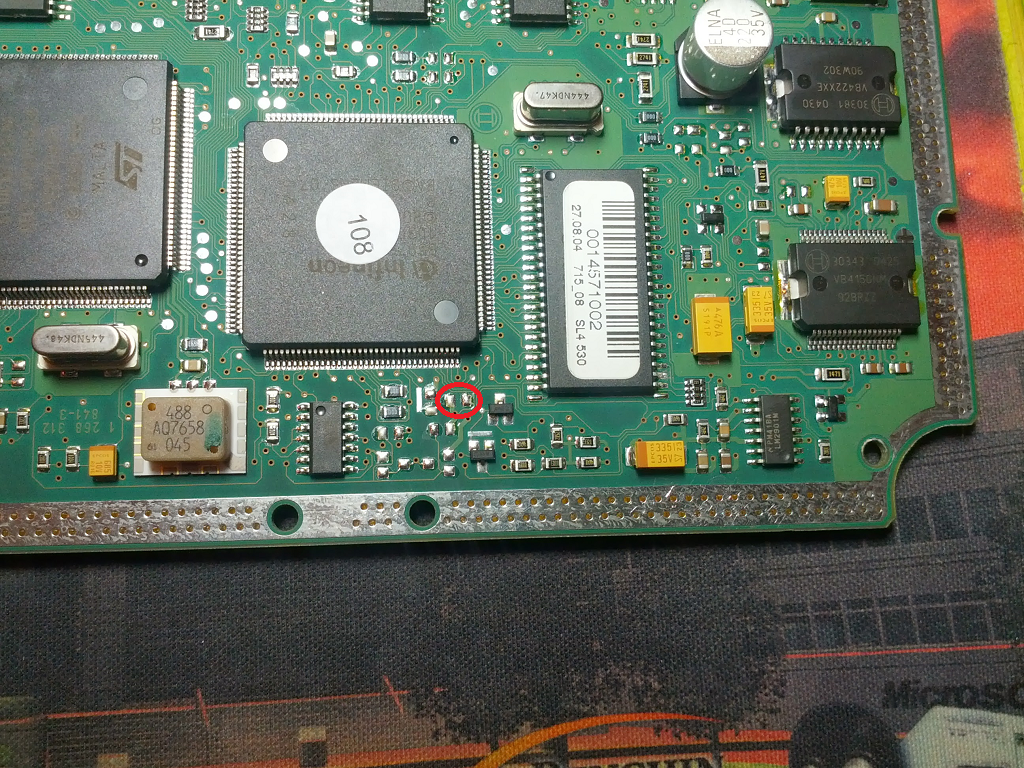
These show individual opened ECUs; the annotations relate to the pictured boards.
ME7.1 circuit-board example, showing a fitted switch and the original boot-mode annotations. Image uploaded by Nyet to S4Wiki; CC BY 4.0. Source image unmodified.
Related ME7.1.1 circuit-board example, with the source's red annotation. Image uploaded by Nyet to S4Wiki; CC BY 4.0. Source image unmodified.
Owner-catalogue model labelsThe active Bosch / ME7 catalogue browse showed 56 model labels on 10 November 2026, including the broad ME7 record; this list contains its 55 more specific labels. These hubs preserve catalogue identity and do not assert application fitment or interchangeability. Bosch M7 is a separately catalogued related branch; its placement here does not make its records ME7 variants.ME7.0ME7.0.1ME7.01ME7.1ME7.1.1ME7.1.1 CANME7.1.5ME7.11ME7.2ME7.2.7ME7.3ME7.3.1ME7.3.2ME7.3.2 - ME7.1.1ME7.3H4ME7.4ME7.4.4ME7.4.5ME7.4.6ME7.4.7ME7.4.9ME7.4.9NGME7.5ME7.5.1ME7.5.10ME7.5.20ME7.5.30ME7.5.4ME7.5.5ME7.6.1ME7.6.2ME7.6.3ME7.6.4ME7.6H4ME7.7.0ME7.7.1ME7.8ME7.8.1ME7.8.2ME7.8.4ME7.8.8ME7.9.10ME7.9.20ME7.9.3ME7.9.4ME7.9.41ME7.9.4NGME7.9.5ME7.9.51ME7.9.52ME7.9.6ME7.9.7ME7.9.71ME7.9.9ME7.X 4Mbit
Where to start
Read ME7 getting started and Motronic abbreviations. Choose a variant below for its scope notes and the inherited family guidance.
Sources
Curated reference notes. Applicability follows the cited sources; hardware testing by this wiki is not implied.
Bosch ME7.1 function and data sheet, Audi 1.8T 132 kW — original Funktionsrahmen covering driver request, torque, cylinder charge and boost control.Selected ME7.1 Funktionsrahmen modules translated by TTQS — English explanations of KFPED, KFMIRL, KFMIOP and LDRXN.Audi self-study programme 198: Motronic ME7.1 — torque-oriented control and its air and crankshaft-synchronous paths.Bosch: ME-Motronic technical instruction — torque, mixture formation and injection.Bosch electronic fuel injection vehicle component applications — Audi engine codes and ECU systems.TRW easycheck vehicle application list 8.0.0 — SEAT León and Toledo, and Škoda Octavia 1.8T / ME7.5 examples.BMW X5 E53 technical training — M62TU / ME7.2.Volvo S70 B5244T service information — ME7 component locations.Peugeot 307 TU5JP4 engine information — Bosch injection system.Alientech K-Suite 2.41 application list — Fiat Bravo 1.4 T-Jet / ME7.9.10.S4Wiki: Tuning. S4Wiki contributors; source site states Creative Commons Attribution. Source revision oldid 5324; accessed 2026-11-10.
Page organisation changed
Field
Revision 6
Revision 9
Page type
ECU hub
ECU hub
Subject
ECUs
ECUs
Parent
Bosch
Bosch Motronic
Applies to
No ECU-specific applicability
No ECU-specific applicability
Tool groups
None
None
Vehicle makes
None
None
Rendered revisions
Open each version to inspect formatting, tables and photographs.
Revision 6: Bosch ME7
What is Bosch ME7?
Bosch ME7 is a family of electronic engine management systems for petrol engines. It combines electronic throttle control with fuel injection and ignition control. ME7 was used on naturally aspirated and turbocharged engines; many applications use multipoint port injection.
Example Bosch ME7.5 ECU, VW/Audi part number 06A 906 032 LQ and Bosch number 0 261 207 956. Photograph by Mkamara9540, Wikimedia Commons; CC BY-SA 4.0. Original photograph, unmodified.
ME7 uses a torque-oriented control strategy: it estimates engine torque and coordinates requests for it, while also calculating the fuel needed for the air entering the engine. The details vary with the engine and software. See Audi SSP 198 and Bosch's ME-Motronic guide.
How torque control works
The accelerator pedal is interpreted as a request for torque, rather than a direct mechanical command to open the throttle. The ECU also considers requests and limits from functions such as idle control, cruise control, the gearbox and traction or stability control, as fitted.
Using its engine model and calibrated maps, the ECU estimates torque and the cylinder air charge needed to meet the permitted request. It controls the electronic throttle and, on turbocharged applications, can also control boost. Faster torque changes can be made through ignition timing or, when required, injection or cylinder cut. The calculated torque is an estimate, not a direct measurement from a torque sensor.
Fuel injection and ignition
ME7 also calculates a fuel quantity. It estimates the air charge from the available sensors and engine model, selects a target air-to-fuel ratio (lambda), then calculates the required fuel mass and injector opening time using injector calibration and operating corrections. When conditions allow, oxygen-sensor feedback adjusts fuelling to help reach the target. The commanded injector time does not directly measure how much fuel was actually delivered.
The ECU also controls ignition timing and, where fitted, uses knock-sensor feedback to adjust it. Other functions can include variable valve timing, emissions controls and fault diagnostics, depending on the application.
Example vehicles and engines
These are representative documented examples, not a complete fitment list. Model year, market, engine code and equipment can change the ECU fitted.
Volvo S70 2.4 turbo — the 2000 B5244T five-cylinder example is shown with ME7 in the Volvo service information.
Peugeot 307 1.6 16V — the TU5JP4 / NFU four-cylinder is documented with ME7.4.4 in Peugeot's engine information; the same document also lists M7.4.4, so check the individual vehicle.
Torque requests, air charge, boost, lambda, injector calibration and ignition interact. A change in one area can be limited or affect another, so compare requested and observed values and work from definitions for the exact ECU hardware and software. Internal torque and load values may be scaled differently between versions.
Main ME7 torque and load maps
These descriptions use the documented Audi 1.8T ME7.1 strategy as an example. Similar names are common in related ME7.5 software, but functions, axes, units and limits can vary by ECU and calibration. Here, load means relative cylinder air charge, not boost pressure.
KFPED — driver request. Uses accelerator-pedal position and engine speed to produce a relative driver torque request. This shapes how the pedal feels; it does not directly command throttle angle or injector quantity.
KFMIRL — torque to load. Uses the requested torque, adjusted to the map's reference conditions, and engine speed to calculate the cylinder air charge needed for the air path. The resulting request is subject to applicable limits.
KFMIOP — load to modelled torque. Relates cylinder charge and engine speed to an optimum indicated engine torque under reference conditions. The ECU uses this relationship when estimating available and operating torque; ignition and mixture efficiencies can modify the estimate. It is a model, not a torque-sensor reading. KFMIOP and KFMIRL describe complementary directions of the same relationship; they are not necessarily exact mathematical inverses.
LDRXN — maximum load for boost control. In the documented turbocharged application, this engine-speed-dependent curve contributes to the maximum permitted relative cylinder charge. It is a load limit, not a direct boost-pressure target or wastegate duty map. Temperature, knock and other protection limits can reduce the allowable charge further.
How they work together: Pressing the pedal gives a relative request through KFPED. The ECU scales and coordinates that request using its estimate of available torque, then KFMIRL translates the resulting torque request into a desired air charge. The charge is limited by the applicable maximum, including the limit derived from LDRXN, and the throttle and boost controls work towards the permitted target. KFMIOP also helps the ECU estimate torque from cylinder charge and calculate available torque, so it participates in the wider coordination rather than acting as a single final step.
Other familiar calibrations: MLHFM converts a mass-air-flow sensor signal into airflow on applications using that sensor; LAMFA is one of the requested lambda maps; and KFZW provides a base ignition angle. Other maps and corrections also affect the final mixture and ignition timing. See ME7 torque, load and boost control for related guidance.
Family scope
The S4Wiki tuning reference discusses ME7.1 and ME7.5 and includes S4 M-box/L-box examples. Keep those examples attached to their software context.
ME7.1 and ME7.1.1 board examples
These show individual opened ECUs; the annotations relate to the pictured boards.
ME7.1 circuit-board example, showing a fitted switch and the original boot-mode annotations. Image uploaded by Nyet to S4Wiki; CC BY 4.0. Source image unmodified.Related ME7.1.1 circuit-board example, with the source's red annotation. Image uploaded by Nyet to S4Wiki; CC BY 4.0. Source image unmodified.
Bosch ME7 is a family of electronic engine management systems for petrol engines. It combines electronic throttle control with fuel injection and ignition control. ME7 was used on naturally aspirated and turbocharged engines; many applications use multipoint port injection.
Example Bosch ME7.5 ECU, VW/Audi part number 06A 906 032 LQ and Bosch number 0 261 207 956. Photograph by Mkamara9540, cropped by Wikisympathisant; Wikimedia Commons; CC BY-SA 4.0. Source file unchanged by Tuning Wiki.
ME7 uses a torque-oriented control strategy: it estimates engine torque and coordinates requests for it, while also calculating the fuel needed for the air entering the engine. The details vary with the engine and software. See Audi SSP 198 and Bosch's ME-Motronic guide.
How torque control works
The accelerator pedal is interpreted as a request for torque, rather than a direct mechanical command to open the throttle. The ECU also considers requests and limits from functions such as idle control, cruise control, the gearbox and traction or stability control, as fitted.
Using its engine model and calibrated maps, the ECU estimates torque and the cylinder air charge needed to meet the permitted request. It controls the electronic throttle and, on turbocharged applications, can also control boost. Faster torque changes can be made through ignition timing or, when required, injection or cylinder cut. The calculated torque is an estimate, not a direct measurement from a torque sensor.
Fuel injection and ignition
ME7 also calculates a fuel quantity. It estimates the air charge from the available sensors and engine model, selects a target air-to-fuel ratio (lambda), then calculates the required fuel mass and injector opening time using injector calibration and operating corrections. When conditions allow, oxygen-sensor feedback adjusts fuelling to help reach the target. The commanded injector time does not directly measure how much fuel was actually delivered.
The ECU also controls ignition timing and, where fitted, uses knock-sensor feedback to adjust it. Other functions can include variable valve timing, emissions controls and fault diagnostics, depending on the application.
Example vehicles and engines
These are representative documented examples, not a complete fitment list. Model year, market, engine code and equipment can change the ECU fitted.
Volvo S70 2.4 turbo — the 2000 B5244T five-cylinder example is shown with ME7 in the Volvo service information.
Peugeot 307 1.6 16V — the TU5JP4 / NFU four-cylinder is documented with ME7.4.4 in Peugeot's engine information; the same document also lists M7.4.4, so check the individual vehicle.
Torque requests, air charge, boost, lambda, injector calibration and ignition interact. A change in one area can be limited or affect another, so compare requested and observed values and work from definitions for the exact ECU hardware and software. Internal torque and load values may be scaled differently between versions.
Main ME7 torque and load maps
These descriptions use the documented Audi 1.8T ME7.1 strategy as an example. Similar names are common in related ME7.5 software, but functions, axes, units and limits can vary by ECU and calibration. Here, load means relative cylinder air charge, not boost pressure.
KFPED — driver request. Uses accelerator-pedal position and engine speed to produce a relative driver torque request. This shapes how the pedal feels; it does not directly command throttle angle or injector quantity.
KFMIRL — torque to load. Uses the requested torque, adjusted to the map's reference conditions, and engine speed to calculate the cylinder air charge needed for the air path. The resulting request is subject to applicable limits.
KFMIOP — load to modelled torque. Relates cylinder charge and engine speed to an optimum indicated engine torque under reference conditions. The ECU uses this relationship when estimating available and operating torque; ignition and mixture efficiencies can modify the estimate. It is a model, not a torque-sensor reading. KFMIOP and KFMIRL describe complementary directions of the same relationship; they are not necessarily exact mathematical inverses.
LDRXN — maximum load for boost control. In the documented turbocharged application, this engine-speed-dependent curve contributes to the maximum permitted relative cylinder charge. It is a load limit, not a direct boost-pressure target or wastegate duty map. Temperature, knock and other protection limits can reduce the allowable charge further.
How they work together: Pressing the pedal gives a relative request through KFPED. The ECU scales and coordinates that request using its estimate of available torque, then KFMIRL translates the resulting torque request into a desired air charge. The charge is limited by the applicable maximum, including the limit derived from LDRXN, and the throttle and boost controls work towards the permitted target. KFMIOP also helps the ECU estimate torque from cylinder charge and calculate available torque, so it participates in the wider coordination rather than acting as a single final step.
Other familiar calibrations: MLHFM converts a mass-air-flow sensor signal into airflow on applications using that sensor; LAMFA is one of the requested lambda maps; and KFZW provides a base ignition angle. Other maps and corrections also affect the final mixture and ignition timing. See ME7 torque, load and boost control for related guidance.
Family scope
The S4Wiki tuning reference discusses ME7.1 and ME7.5 and includes S4 M-box/L-box examples. Keep those examples attached to their software context.
ME7.1 and ME7.1.1 board examples
These show individual opened ECUs; the annotations relate to the pictured boards.
ME7.1 circuit-board example, showing a fitted switch and the original boot-mode annotations. Image uploaded by Nyet to S4Wiki; CC BY 4.0. Source image unmodified.Related ME7.1.1 circuit-board example, with the source's red annotation. Image uploaded by Nyet to S4Wiki; CC BY 4.0. Source image unmodified.
Owner-catalogue model labels
The active Bosch / ME7 catalogue browse showed 56 model labels on 10 November 2026, including the broad ME7 record; this list contains its 55 more specific labels. These hubs preserve catalogue identity and do not assert application fitment or interchangeability. Bosch M7 is a separately catalogued related branch; its placement here does not make its records ME7 variants.