Removed text is struck through; added text is highlighted.
What is EDC16?
Bosch EDC16 is a family of electronic diesel engine management systems. Volkswagen describes its V10 TDI EDC16 as torque-oriented: the ECU coordinates requests from the driver and other vehicle systems, then works out how to deliver the resulting torque through fuel injection and air control.
Torque and injection quantity
Both matter. A request or limit may be expressed as torque in newton metres (Nm), while the fuel needed to produce it is represented as an injection quantity, often milligrams per cylinder per combustion cycle (mg/stroke). Limits on available air and other operating conditions can reduce the quantity delivered. The exact signals, maps, units and order of calculations depend on the ECU software.
Family scope
EDC16 covers different manufacturers, engines and injection systems. Volkswagen SSP 304 describes a unit-injector V10 TDI; SSP 350 identifies an EDC 16 C common-rail V6 TDI. Do not assume their injectors, map addresses or calibrations are interchangeable.
Start with EDC16 torque fuel and tuning basics for the torque model, common limits, fuel and boost control, and a practical starting point.
Further EDC16 references
For documented Volkswagen and Audi unit-injector and common-rail examples, see EDC16 injection systems and vehicle examples. For scan-tool interpretation and a vehicle-specific Citroën bulletin, see EDC16 diagnostic data and configuration examples. The variant comparison explains application, tool and software distinctions.
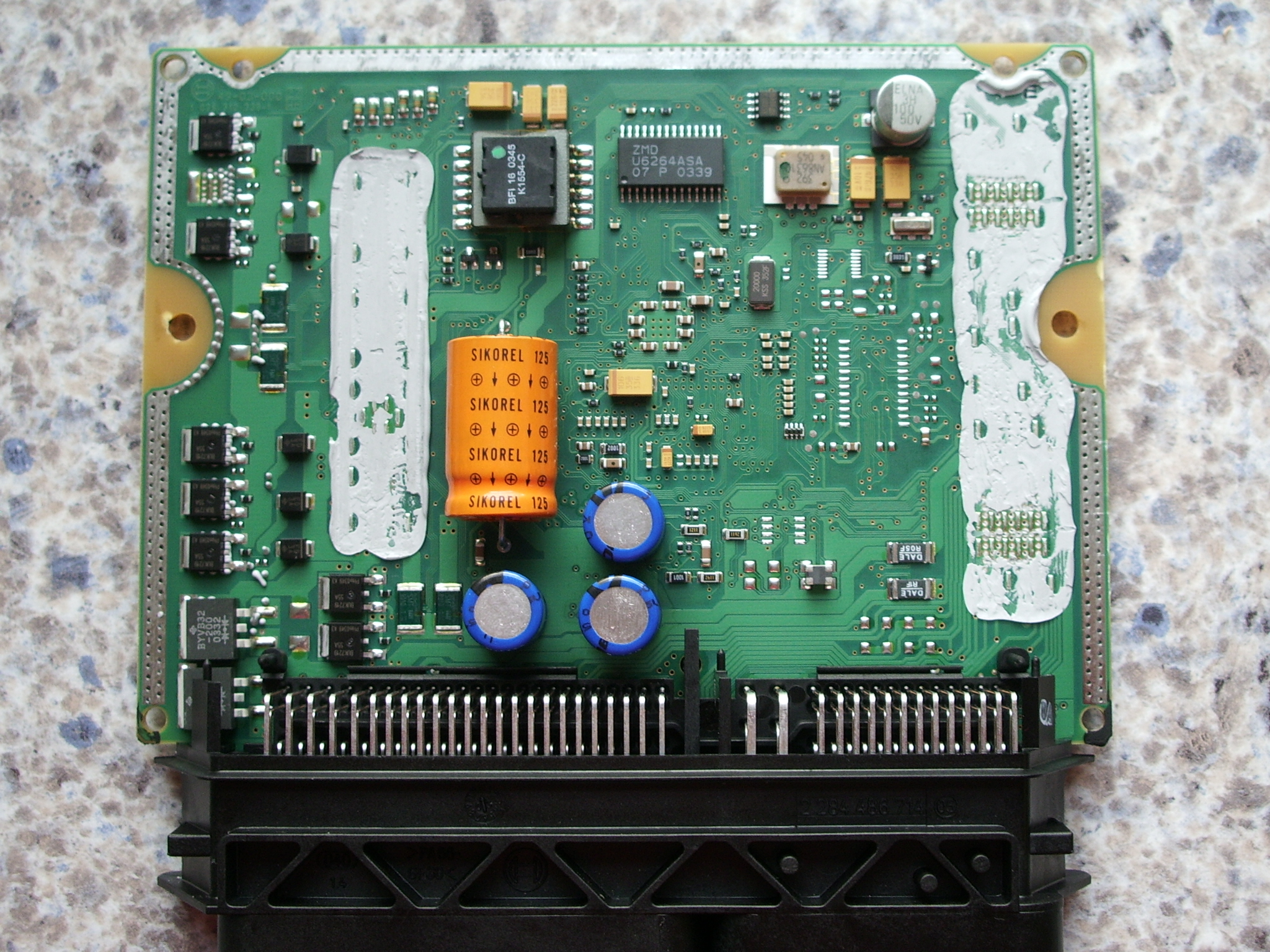
Example diesel ECU circuit boardThese photographs show the logic and power sides of an opened common-rail electronic diesel control unit. They are included for general hardware context: the source does not identify the EDC generation or variant, so they should not be used to identify a particular EDC16 model.Logic and microcontroller side. Photo: Techie / Techie2, Wikimedia Commons; licence: CC BY-SA 3.0; unmodified.Actuator and power side. Photo: Techie / Techie2, Wikimedia Commons; licence: CC BY-SA 3.0; unmodified.
Sources
Curated reference notes. Applicability follows the cited sources; hardware testing by this wiki is not implied.
Volkswagen Self-Study Programme 304: Electronic Diesel Control EDC 16. Volkswagen AG, Service Training; independent PDF mirror. EDC16 description uses the V10 TDI unit-injector system, with R5 differences. Source revision SSP 304, especially printed pages 4, 8–10 and 15; accessed 2026-11-10.Volkswagen Self-Study Programme 350: The 3.0l V6 TDI engine. Volkswagen AG, Service Training; independent PDF mirror. Example of EDC 16 C with a common-rail injection system. Source revision SSP 350, technical status March 2005, printed pages 4–5; accessed 2026-11-10.Robert Bosch GmbH: Electronic Diesel Control EDC, technical instruction, 2001, printed pages 75–77; independent mirror. General description of torque-controlled EDC16, not a function definition for every calibration; accessed 10 November 2026.
Page organisation changed
Field
Revision 3
Revision 5
Page type
ECU hub
ECU hub
Subject
ECUs
ECUs
Parent
Bosch
Bosch EDC
Applies to
No ECU-specific applicability
No ECU-specific applicability
Tool groups
None
None
Vehicle makes
None
None
Rendered revisions
Open each version to inspect formatting, tables and photographs.
Revision 3: Bosch EDC16
What is EDC16?
Bosch EDC16 is a family of electronic diesel engine management systems. Volkswagen describes its V10 TDI EDC16 as torque-oriented: the ECU coordinates requests from the driver and other vehicle systems, then works out how to deliver the resulting torque through fuel injection and air control.
Torque and injection quantity
Both matter. A request or limit may be expressed as torque in newton metres (Nm), while the fuel needed to produce it is represented as an injection quantity, often milligrams per cylinder per combustion cycle (mg/stroke). Limits on available air and other operating conditions can reduce the quantity delivered. The exact signals, maps, units and order of calculations depend on the ECU software.
Family scope
EDC16 covers different manufacturers, engines and injection systems. Volkswagen SSP 304 describes a unit-injector V10 TDI; SSP 350 identifies an EDC 16 C common-rail V6 TDI. Do not assume their injectors, map addresses or calibrations are interchangeable.
Robert Bosch GmbH: Electronic Diesel Control EDC, technical instruction, 2001, printed pages 75–77; independent mirror. General description of torque-controlled EDC16, not a function definition for every calibration; accessed 10 November 2026.
Revision 5: Bosch EDC16
What is EDC16?
Bosch EDC16 is a family of electronic diesel engine management systems. Volkswagen describes its V10 TDI EDC16 as torque-oriented: the ECU coordinates requests from the driver and other vehicle systems, then works out how to deliver the resulting torque through fuel injection and air control.
Torque and injection quantity
Both matter. A request or limit may be expressed as torque in newton metres (Nm), while the fuel needed to produce it is represented as an injection quantity, often milligrams per cylinder per combustion cycle (mg/stroke). Limits on available air and other operating conditions can reduce the quantity delivered. The exact signals, maps, units and order of calculations depend on the ECU software.
Family scope
EDC16 covers different manufacturers, engines and injection systems. Volkswagen SSP 304 describes a unit-injector V10 TDI; SSP 350 identifies an EDC 16 C common-rail V6 TDI. Do not assume their injectors, map addresses or calibrations are interchangeable.
These photographs show the logic and power sides of an opened common-rail electronic diesel control unit. They are included for general hardware context: the source does not identify the EDC generation or variant, so they should not be used to identify a particular EDC16 model.
Robert Bosch GmbH: Electronic Diesel Control EDC, technical instruction, 2001, printed pages 75–77; independent mirror. General description of torque-controlled EDC16, not a function definition for every calibration; accessed 10 November 2026.