What the number measures
An octane number is a measure of how far a spark-ignition fuel can be pushed before the end-gas autoignites. The US Energy Information Administration defines it from the pressure at which the fuel autoignites in a test engine: a higher number is a more stable fuel. AJ6 Engineering is explicit about what it is not. The rating has no direct link to flame speed or to calorific value, and it does not describe a tendency to pre-ignite. A higher grade does not contain more energy. It resists knock.
That resistance is why octane shows up in tuning. If the engine is already knock-limited, a higher rating can allow more compression, more boost or more spark advance before the end-gas lights itself. If the engine is not knocking on the lower grade, there is no power in the higher one. The Nevada Department of Agriculture states the same limit for the US antiknock index: there is no advantage in a higher index than the engine needs in order to run without knock.
How the scale is set
The scale is a comparison, not a chemical analysis of the sample. Two reference liquids define it. Normal heptane is 0. Iso-octane, 2,2,4-trimethylpentane, is 100, chosen because it strongly resists autoignition. A fuel's octane number is the volume percentage of iso-octane in a heptane blend that knocks with the same intensity, in the same test engine, at the same compression.
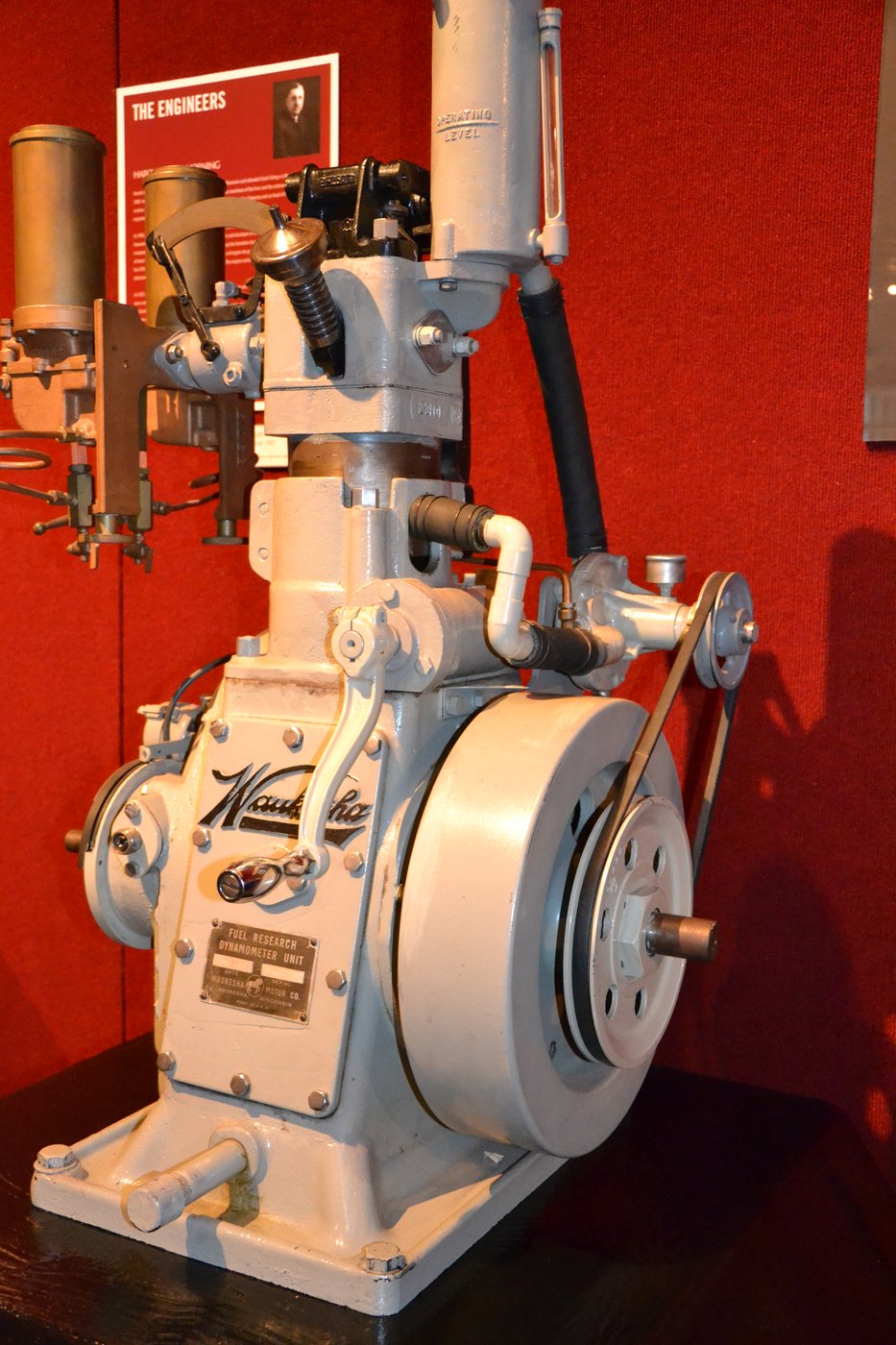
The engine is a single-cylinder Cooperative Fuel Research unit with a variable compression ratio. ASTM D2699, the research method, compares the sample's knock intensity with one or more primary reference blends and reads the research octane number from the blend that matches. The method's working range is 40 to 120. Fuels above 100 are rated against reference blends other than plain heptane and iso-octane. The motor method, ASTM D2700, uses the same idea of a matched reference blend under harder running conditions.
RON, MON and the pump label
Two standard tests are run because a fuel that resists knock in gentle running can be weaker when speed and temperature rise. The research octane number, RON, is the milder test: lower speed and a cooler mixture. ASTM D2699 says it correlates with antiknock performance under mild conditions. The motor octane number, MON, is the harsher test: higher speed and a hotter inlet mixture. AJ6 treats RON as a guide to low-speed knock, the audible pinking, and MON as a guide to high-speed knock, which is often inaudible and is the more damaging of the two.
| Name | What is measured | Where the number is used |
|---|---|---|
| RON | Knock resistance in the milder research test, ASTM D2699 | The figure printed on UK petrol pumps |
| MON | Knock resistance in the harsher motor test, ASTM D2700 | Quoted with RON in fuel specifications. Rarely the only number on a pump |
| Sensitivity | RON minus MON | A large gap means the fuel looks better on the mild test than on the severe one |
| Antiknock index, (R+M)/2 | The average of RON and MON | The large number on a US pump. ASTM D2699 points to specification D4814 for this index |
The two pump conventions are not interchangeable. A UK pump marked 95 is a RON. A US pump marked 91 is an antiknock index, the average of a higher RON and a lower MON. Comparing them as if they were the same scale will pick the wrong fuel.
In Great Britain the standard grade is 95 octane and, since September 2021, E10. The super grade sold as the E5 alternative is 97 octane or higher. The legal minimum behind the standard grade, in the retained fuel-quality specification, is 95 research octane number and 85 motor octane number. A pump marked 97, 98 or 99 is claiming a higher RON than that minimum. The label on that pump is the figure to use, and a 97 does not satisfy an engine or a map that asks for 98 or 99.
E5 and E10 are ethanol limits, up to 5 percent and up to 10 percent. They are not octane grades. Standard 95 can be E10, and the protected super grade is E5, but a higher RON is a separate claim from the ethanol sticker. Check both.
Why a higher rating resists knock
Knock is the end-gas reaching autoignition temperature and pressure before the flame consumes it. A higher octane rating means that autoignition point sits further away, so the same compression, boost, inlet temperature and spark advance are less likely to light the end-gas. That is the whole of the benefit.
On an engine that is already against the knock limit, the extra margin can be spent as earlier spark, more boost or a higher compression ratio, which is where the power and the efficiency come from. Ignition timing, forced induction and compression ratio are those three levers. On an engine with margin left, the same fuel change does nothing useful, because the energy in the litre has not increased.
The mild and harsh tests disagree often enough to matter. Sensitivity is RON minus MON. AJ6's warning still holds: a fuel can meet a RON label and be weaker on the motor test, and an absence of audible pinking does not prove the fuel is safe at high speed and high load. If a map was developed on a 99 RON fuel, filling the tank with 95 RON removes the margin the spark and boost were set with. The ECU's knock control may pull timing back, which hides the noise and usually costs torque and raises exhaust temperature. It is not a substitute for the fuel the calibration assumes.
What it does not fix
Octane does not cure a lean mixture, a heat-soaked charge, or a spark table that is simply too early for the boost. Those still have to be put right. It also does not stop pre-ignition from a glowing plug or from carbon. Pre-ignition starts before the spark, and the octane rating is not the control for it. Both are set out in engine knock.
A diesel is not rated or tuned on this scale. Its combustion is already autoignition, so a petrol octane number does not describe it. The timing lever on a diesel is injection, covered under ignition timing.
Sources
- Gasoline explained: octane in depth. U.S. Energy Information Administration. Octane as resistance to autoignition, iso-octane as 100, normal heptane as 0, the research and motor tests, and the (R+M)/2 pump label. Accessed 2026-11-11.
- ASTM D2699. ASTM International. Research octane number by matching knock intensity to a primary reference blend on a CFR engine. Working range 40 to 120. Accessed 2026-11-11.
- ASTM D2700. ASTM International. Motor octane number by the same reference-blend method under the motor-method conditions. Accessed 2026-11-11.
- Combustion maladies and fuel qualities. AJ6 Engineering technical book, chapter 5. RON as the UK pump figure, MON as the harsher test, sensitivity, and octane's lack of a direct link to flame speed, calorific value or pre-ignition. Accessed 2026-11-11.
- Fuel quality specification, petrol limits. legislation.gov.uk, retained Directive 98/70/EC annex. Minimum 95 research octane number and 85 motor octane number for the standard grade. Accessed 2026-11-11.
- E10 petrol explained. GOV.UK. Standard 95 octane petrol as E10, and super grade 97+ octane as the E5 alternative. Accessed 2026-11-11.
- Gasoline testing program. Nevada Department of Agriculture. Antiknock index as (R+M)/2, and no advantage from a higher index than the engine needs to run without knock. Accessed 2026-11-11.