Removed text is struck through; added text is highlighted.
What knock is
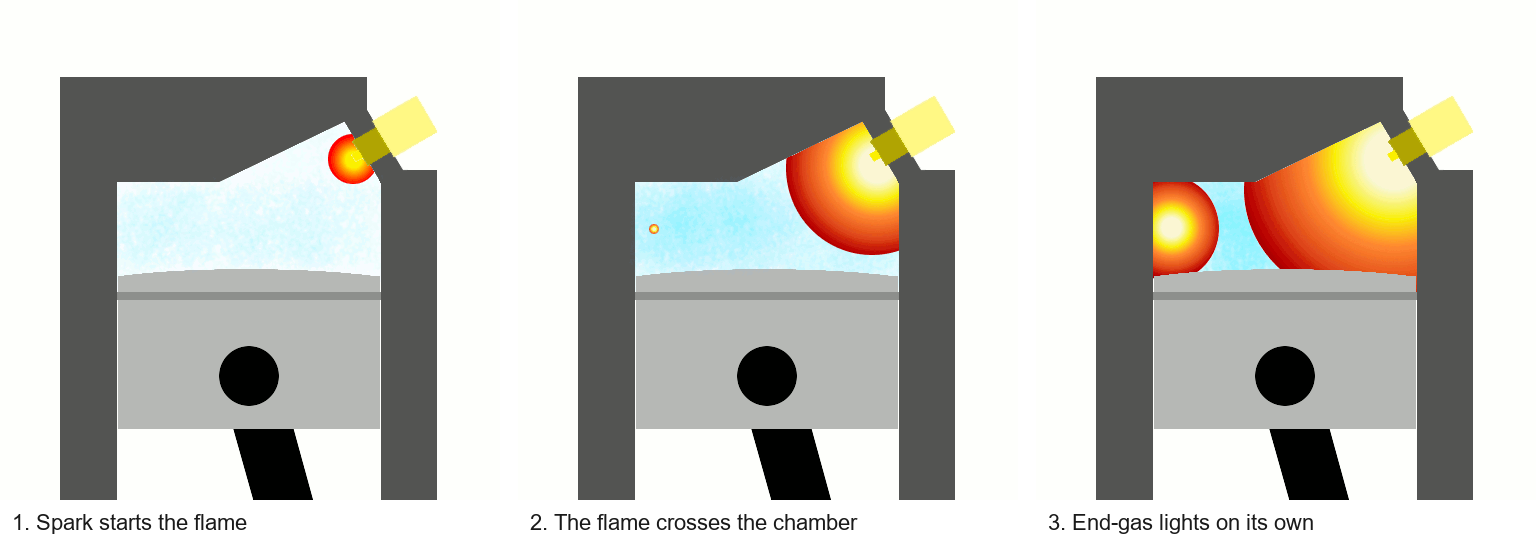
In a spark-ignition engine the plug starts a flame, and that flame is meant to burn the mixture across the chamber. Knock is what happens when a pocket of the unburned mixture, the end-gas ahead of the flame, ignites on its own. Corrigan and Fontanesi describe that autoignition as the event behind knock, and they record the noise it makes as a sharp metallic sound. The autoignition is much faster than the flame. It sends a pressure wave across the chamber, the wave reflects, and the engine structure rings. That ring is the noise.
The plug starts one flame. A second flame then appears in the unburned end-gas, away from the plug. Stills from Cliquetis.gif by PerOX, public domain. Labels added for this page. The moving version is on that Commons page.
Heywood's description, as they quote it, is a race between the flame and the reactions already under way in the end-gas. If the flame arrives first, combustion stays under the control of the spark. If the end-gas reaches its autoignition point first, the spark is no longer the only thing deciding how the charge burns. Compression ratio, boost, inlet temperature, spark timing, mixture and the fuel's knock resistance all move the result of that race. Spark timing and the knock limit are covered from the calibration side in ignition timing for performance. The fuel side is fuel octane.
Pinking and uncontrolled combustion
Workshop language uses one word, knock, for a light noise and for a burn that has got away. They are the same end-gas event at different strengths, and they are not the same as pre-ignition.
Pinking
Pinking is the light, audible knock heard at lower engine speeds. AJ6 Engineering describes it as the result of the piston dwelling near top dead centre, around the knee of a conventional advance curve. The metallic pink is obvious, and while it stays light it is often more of an annoyance than an immediate failure. It is still knock. Leaving it in a calibration, or chasing it with more advance, is how a light pink becomes the damage in the next section.
Uncontrolled combustion
When a large part of the end-gas autoignites, combustion is no longer a flame the spark started. The US Energy Information Administration calls that secondary burn uncontrolled combustion: pressure in the cylinder spikes, which is the knock. Bosch Motorsport uses the same term for the vibration a knock sensor is built to detect.
Corrigan and Fontanesi separate a moderate knock, whose pressure wave travels at the speed of sound, from the case where that wave couples with the chemistry and the reaction front runs well above the speed of sound. They call that developing detonation, or super-knock, and it is the form likely to damage the engine. AJ6's account of the damage runs from a nibbled piston crown or head, usually far from the plug, to a melted or holed piston. Moderate knock can go on for a long time on some engines. There is no safe amount to leave in, because the step from a nibbled crown to a hole is not predictable.
High-speed knock is the dangerous one to miss. The piston is near top dead centre for less time, so knock is less likely, but if it happens the structure has less chance to pass the extra heat into the coolant. It is also harder to hear over the rest of the engine.
Pre-ignition
Pre-ignition is a hot spot lighting the mixture before the plug fires. Early researchers already treated it as a different event from knock, because knock comes after the spark. A plug of the wrong heat range, a sharp edge, or soft carbon that glows when the engine is opened up after a long light-load run can start it. AJ6 notes that fuel octane does not control pre-ignition the way it controls knock, and that detonation and pre-ignition can feed each other until surface ignition runs away.
Low-speed pre-ignition on a modern direct-injection engine is the related case: oil droplets or particles from the chamber light a large autoignition that spark retard does not stop. Knock control only moves the spark. It cannot put out a burn that started before the spark.
What it sounds like
Light knock is a sharp metallic pink or ping, which is where the word pinking comes from. It shows under load, often at lower rpm, and it goes away when the throttle is lifted. A mechanical rattle from a bearing or a piston stays with engine speed on a closed throttle. Combustion knock does not.
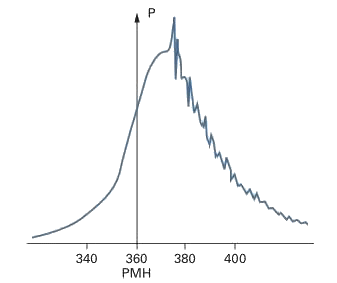
Cylinder pressure against crank angle during knock. PMH is top dead centre. The smooth rise is compression and the flame. The jagged oscillation after the peak is the pressure wave heard as a metallic pink. Diagram by Ascaron, Cliquetis graph.gif, converted from the original GIF, CC BY-SA 3.0.Wikipedia's engine-knocking article and Wikimedia Commons do not include a recording of pinking. Clips that turn up under the name engine knock are usually a bearing, a starter or an ordinary engine, and those are the other sounds. This wiki can show the pictures. It cannot embed an audio player.
Heavy knock is the same metallic character, harder and more of a hammer. At higher rpm it sits under valve, injector and exhaust noise, so an engine can be knocking hard while it sounds ordinary from the driver's seat. That is why a pipe, headphones or the knock sensor are used, rather than trusting the cabin.
Listening with a pipe
A length of pipe or hose is a stethoscope for the block. One end is held in firm contact with a solid metal point on the block or the head, close to the cylinders. The other end goes to the ear. Structure-borne noise from combustion travels up the pipe, without the exhaust and the fan mixed in. A flexible hose on the ear end keeps the listener off the hot metal. A short copper or steel tube is the usual engine end, because it conducts the ring of the casting.
Knock appears under load, so an idle tells you almost nothing. The useful check is on a dyno, or with the pipe already fixed in place before the car is driven. Do not lean into a running engine to chase a noise, and do not drive with a loose pipe at your ear. Keep the hose clear of belts, pulleys, the fan and the exhaust.
Listening with headphones
Headphones do the same job once the engine has to be loaded on the road. Tuning practice calls the tool a det can: ear defenders fed by a hose from a pipe or a clamp on the block, or an electronic version with a microphone or sensor and a small amplifier. Engine Basics describes both. The defenders shut out the cabin, so a light pink is audible while the engine is in the load and rpm being tuned.
Bolt or clamp the pickup to a flat, clean face on the block, in the same sort of place a knock sensor is fitted, and route the hose so it cannot catch a belt or rest on the exhaust. Confirm that combustion is audible before looking for a fault. Have a passenger listen, or listen on the dyno. The level through a sealed hose can be painfully loud, so the earpieces come off if it hurts.
Use the throttle as the test. If the metallic pink is present in a loaded gear and gone on the overrun, it is combustion knock. If the rattle is still there with the throttle shut, look for a mechanical cause before changing the spark.
What the knock sensor tells the ECU
A production knock sensor is a piezoelectric vibration pickup bolted to the crankcase. Bosch describes it measuring structure-borne noise, recognising knock by its higher frequencies, and reporting that to the ECU. Inside a Bosch Motorsport sensor a seismic mass presses on a piezoceramic as the block moves, and the ceramic produces a voltage. Their KS4-R is specified to cover 3 to 25 kHz. The ringing frequency itself depends on the acoustic shape of the chamber, so it is not the same number for every bore.
The ECU's job is to light the mixture as early as it can, and to move the spark later when the sensor reports knock. Delaying the spark, as the Energy Information Administration puts it, places the controlled burn where cylinder pressure is not at its highest, which takes the end-gas off the autoignition point. The engine gives up some efficiency to stay in one piece. Bosch lists different fuel qualities as one reason for that closed loop: the same hardware can run nearer the knock limit on a good fuel and pull timing back on a poor one.
On an ECU that can assign the vibration to a cylinder, the retard is applied to that cylinder rather than to the whole engine. Motronic 7 keeps a fast correction for the event in progress and a slower learned correction for regions that keep knocking, then advances back toward the base timing when the knock stops. The size of each step and the maximum retard are part of that calibration. They are not a universal number of degrees. The map layout is in ME7 ignition and knock. Other families split the same job differently. A single ignition table on a printout is not evidence that knock control is absent.
Knock control is a backstop. A log that shows retard whenever the engine is loaded means the timing, the boost, the temperatures or the fuel are already past the limit. Raising the detection threshold to hide that retard does not remove the knock. Sustained knock can mark a piston before the controller has finished reacting, and a sensor on the wrong face, or one that is loose, can miss the cylinder that is doing it.
Retard also pushes heat into the exhaust. The turbine, the exhaust valve and the catalyst see that heat. Timing, boost and exhaust temperature have to be read together, as ignition timing for performance describes.
When knock appears
Knock appears when the end-gas is hot enough, and at a high enough pressure, for long enough, before the flame arrives. The usual ways to get there on a petrol engine are:
Spark too early. More advance gives the end-gas more time at high pressure. Retarding the spark is the ECU's immediate answer, and it is the first calibration change when a new map pinks.Too much boost or compression. Both raise the pressure and temperature the end-gas starts from. A timing table from a low-compression engine is not a starting point for a boosted one. See compression ratio and forced induction.High temperature. A hot inlet charge, a heat-soaked intercooler, hot coolant, or a piston and plug that cannot reject heat, all move the end-gas toward autoignition. Charge temperature is the lever in charge cooling. Early knock work already treated fuel enrichment and cooler metal, including the water jacket and the plug, as ways to hold the limit off.The wrong fuel. A lower octane than the map assumes knocks at a lower pressure and temperature. The rating is explained in fuel octane.The wrong mixture. Enriching a knocking mixture is a long-established way to suppress knock. Ricardo's tests, for the gasoline he ran, did not show a straight line: the knock-limited compression ratio was worst at one mixture and improved both richer and weaker of that point. On a tuned engine the failure is a delivered mixture that is not the one the timing and boost were set for. AJ6 also records knock in high-speed cruise at about 75 to 90 percent load, where closed-loop stoichiometric fuelling meets timing set for economy. Fuelling hardware is in fuel system upgrades.Low speed under load. The piston spends longer near top dead centre, which is the pinking region. High-speed knock is less obvious and more severe if it is reached.A hot spot or carbon. These are the usual start of pre-ignition, which knock retard does not fix. A plug heat range that is too hot belongs in this group.
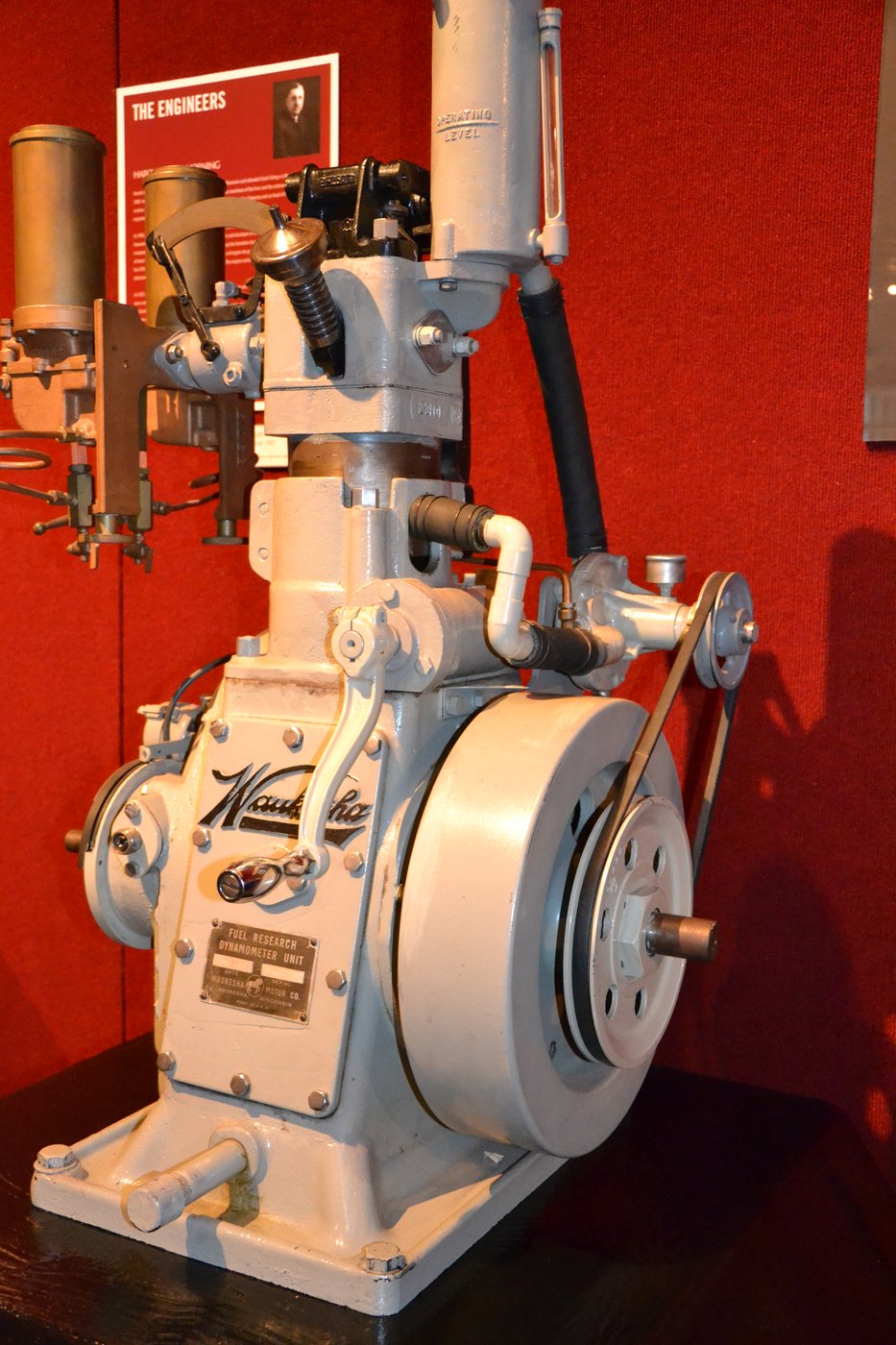
A Waukesha CFR fuel-research engine. Compression is raised until the test fuel knocks as hard as a reference blend, which is how an octane number is assigned. Photograph by Thomas Fehring, resized, Wikimedia Commons, CC BY-SA 4.0.
A diesel does not knock in this way. Its combustion is already autoignition, in locally rich regions of a lean charge, and the timing lever is injection, not a spark. Do not copy a petrol knock correction into a diesel injection map. The distinction is in ignition timing for performance.
Using it while tuning
Listen, or log the knock correction, in the rpm and load being changed. A pink that tracks the throttle is combustion. Pull spark or boost until it is gone, then look at charge temperature, coolant temperature, the fuel grade and the delivered mixture before putting the advance back. The spark the engine will accept is the earliest one with no knock and an exhaust temperature the hardware can live with.
A light pink at low rpm is the warning you can hear. The knock you cannot hear, at high load and high rpm, is the one that holes a piston. Headphones, a pipe on the dyno, or a knock-sensor log are how that second one is caught.
Sources
Knock: A Century of Research. Daire James Corrigan and Stefano Fontanesi, SAE International Journal of Engines 15(1), 2022, doi:10.4271/03-15-01-0004. End-gas autoignition, the metallic sound, acoustic modes, developing detonation, the separation from pre-ignition and low-speed pre-ignition, Heywood's race, Ricardo on mixture, and Horning on enrichment and temperature. Open access, Creative Commons Attribution 4.0. Accessed 2026-11-11.Combustion maladies and fuel qualities. AJ6 Engineering technical book, chapter 5. Pinking, high-speed detonation, pre-ignition, piston damage, and cruise knock at part load. Accessed 2026-11-11.Gasoline explained: octane in depth. U.S. Energy Information Administration. Controlled burn, uncontrolled secondary combustion, and spark retard as the ECU response. Accessed 2026-11-11.Knock sensor. Bosch Mobility. Piezoelectric structure-borne measurement on the crankcase, higher frequencies, and ignition adjustment, including for fuel quality. Accessed 2026-11-11.Knock sensor KS4-R. Bosch Motorsport. Vibration from uncontrolled combustion, seismic mass and piezoceramic, 3 to 25 kHz. Accessed 2026-11-11.Detonation cans. Engine Basics. Headphones fed from the block, mechanical hose and electronic microphone versions, used to hear the ping under load. Accessed 2026-11-11.Cliquetis.gif. PerOX, public domain. Animation of the second flame. Stills used above. Accessed 2026-11-11.Cliquetis graph.gif. Ascaron, Creative Commons Attribution-ShareAlike 3.0. Pressure against crank angle. Accessed 2026-11-11.Waukesha CFR knock-test engine. Photograph by Thomas Fehring, Creative Commons Attribution-ShareAlike 4.0. Accessed 2026-11-11.ME7 ignition and knock reference. This wiki. Immediate cylinder correction and learned retard that advances back when knock stops.Knock: A Century of Research. Daire James Corrigan and Stefano Fontanesi, SAE International Journal of Engines 15(1), 2022, doi:10.4271/03-15-01-0004. End-gas autoignition, the metallic sound, acoustic modes, developing detonation, the separation from pre-ignition and low-speed pre-ignition, Heywood's race, Ricardo on mixture, and Horning on enrichment and temperature. Open access, Creative Commons Attribution 4.0. Accessed 2026-11-11.Combustion maladies and fuel qualities. AJ6 Engineering technical book, chapter 5. Pinking, high-speed detonation, pre-ignition, piston damage, and cruise knock at part load. Accessed 2026-11-11.Gasoline explained: octane in depth. U.S. Energy Information Administration. Controlled burn, uncontrolled secondary combustion, and spark retard as the ECU response. Accessed 2026-11-11.Knock sensor. Bosch Mobility. Piezoelectric structure-borne measurement on the crankcase, higher frequencies, and ignition adjustment, including for fuel quality. Accessed 2026-11-11.Knock sensor KS4-R. Bosch Motorsport. Vibration from uncontrolled combustion, seismic mass and piezoceramic, 3 to 25 kHz. Accessed 2026-11-11.Detonation cans. Engine Basics. Headphones fed from the block, mechanical hose and electronic microphone versions, used to hear the ping under load. Accessed 2026-11-11.ME7 ignition and knock reference. This wiki. Immediate cylinder correction and learned retard that advances back when knock stops.
Rendered revisions
Open each version to inspect formatting, tables and photographs.
Revision 1: Engine knock
What knock is
In a spark-ignition engine the plug starts a flame, and that flame is meant to burn the mixture across the chamber. Knock is what happens when a pocket of the unburned mixture, the end-gas ahead of the flame, ignites on its own. Corrigan and Fontanesi describe that autoignition as the event behind knock, and they record the noise it makes as a sharp metallic sound. The autoignition is much faster than the flame. It sends a pressure wave across the chamber, the wave reflects, and the engine structure rings. That ring is the noise.
Heywood's description, as they quote it, is a race between the flame and the reactions already under way in the end-gas. If the flame arrives first, combustion stays under the control of the spark. If the end-gas reaches its autoignition point first, the spark is no longer the only thing deciding how the charge burns. Compression ratio, boost, inlet temperature, spark timing, mixture and the fuel's knock resistance all move the result of that race. Spark timing and the knock limit are covered from the calibration side in ignition timing for performance. The fuel side is fuel octane.
Pinking and uncontrolled combustion
Workshop language uses one word, knock, for a light noise and for a burn that has got away. They are the same end-gas event at different strengths, and they are not the same as pre-ignition.
Pinking
Pinking is the light, audible knock heard at lower engine speeds. AJ6 Engineering describes it as the result of the piston dwelling near top dead centre, around the knee of a conventional advance curve. The metallic pink is obvious, and while it stays light it is often more of an annoyance than an immediate failure. It is still knock. Leaving it in a calibration, or chasing it with more advance, is how a light pink becomes the damage in the next section.
Uncontrolled combustion
When a large part of the end-gas autoignites, combustion is no longer a flame the spark started. The US Energy Information Administration calls that secondary burn uncontrolled combustion: pressure in the cylinder spikes, which is the knock. Bosch Motorsport uses the same term for the vibration a knock sensor is built to detect.
Corrigan and Fontanesi separate a moderate knock, whose pressure wave travels at the speed of sound, from the case where that wave couples with the chemistry and the reaction front runs well above the speed of sound. They call that developing detonation, or super-knock, and it is the form likely to damage the engine. AJ6's account of the damage runs from a nibbled piston crown or head, usually far from the plug, to a melted or holed piston. Moderate knock can go on for a long time on some engines. There is no safe amount to leave in, because the step from a nibbled crown to a hole is not predictable.
High-speed knock is the dangerous one to miss. The piston is near top dead centre for less time, so knock is less likely, but if it happens the structure has less chance to pass the extra heat into the coolant. It is also harder to hear over the rest of the engine.
Pre-ignition
Pre-ignition is a hot spot lighting the mixture before the plug fires. Early researchers already treated it as a different event from knock, because knock comes after the spark. A plug of the wrong heat range, a sharp edge, or soft carbon that glows when the engine is opened up after a long light-load run can start it. AJ6 notes that fuel octane does not control pre-ignition the way it controls knock, and that detonation and pre-ignition can feed each other until surface ignition runs away.
Low-speed pre-ignition on a modern direct-injection engine is the related case: oil droplets or particles from the chamber light a large autoignition that spark retard does not stop. Knock control only moves the spark. It cannot put out a burn that started before the spark.
What it sounds like
Light knock is a sharp metallic pink or ping, which is where the word pinking comes from. It shows under load, often at lower rpm, and it goes away when the throttle is lifted. A mechanical rattle from a bearing or a piston stays with engine speed on a closed throttle. Combustion knock does not.
Heavy knock is the same metallic character, harder and more of a hammer. At higher rpm it sits under valve, injector and exhaust noise, so an engine can be knocking hard while it sounds ordinary from the driver's seat. That is why a pipe, headphones or the knock sensor are used, rather than trusting the cabin.
Listening with a pipe
A length of pipe or hose is a stethoscope for the block. One end is held in firm contact with a solid metal point on the block or the head, close to the cylinders. The other end goes to the ear. Structure-borne noise from combustion travels up the pipe, without the exhaust and the fan mixed in. A flexible hose on the ear end keeps the listener off the hot metal. A short copper or steel tube is the usual engine end, because it conducts the ring of the casting.
Knock appears under load, so an idle tells you almost nothing. The useful check is on a dyno, or with the pipe already fixed in place before the car is driven. Do not lean into a running engine to chase a noise, and do not drive with a loose pipe at your ear. Keep the hose clear of belts, pulleys, the fan and the exhaust.
Listening with headphones
Headphones do the same job once the engine has to be loaded on the road. Tuning practice calls the tool a det can: ear defenders fed by a hose from a pipe or a clamp on the block, or an electronic version with a microphone or sensor and a small amplifier. Engine Basics describes both. The defenders shut out the cabin, so a light pink is audible while the engine is in the load and rpm being tuned.
Bolt or clamp the pickup to a flat, clean face on the block, in the same sort of place a knock sensor is fitted, and route the hose so it cannot catch a belt or rest on the exhaust. Confirm that combustion is audible before looking for a fault. Have a passenger listen, or listen on the dyno. The level through a sealed hose can be painfully loud, so the earpieces come off if it hurts.
Use the throttle as the test. If the metallic pink is present in a loaded gear and gone on the overrun, it is combustion knock. If the rattle is still there with the throttle shut, look for a mechanical cause before changing the spark.
What the knock sensor tells the ECU
A production knock sensor is a piezoelectric vibration pickup bolted to the crankcase. Bosch describes it measuring structure-borne noise, recognising knock by its higher frequencies, and reporting that to the ECU. Inside a Bosch Motorsport sensor a seismic mass presses on a piezoceramic as the block moves, and the ceramic produces a voltage. Their KS4-R is specified to cover 3 to 25 kHz. The ringing frequency itself depends on the acoustic shape of the chamber, so it is not the same number for every bore.
The ECU's job is to light the mixture as early as it can, and to move the spark later when the sensor reports knock. Delaying the spark, as the Energy Information Administration puts it, places the controlled burn where cylinder pressure is not at its highest, which takes the end-gas off the autoignition point. The engine gives up some efficiency to stay in one piece. Bosch lists different fuel qualities as one reason for that closed loop: the same hardware can run nearer the knock limit on a good fuel and pull timing back on a poor one.
On an ECU that can assign the vibration to a cylinder, the retard is applied to that cylinder rather than to the whole engine. Motronic 7 keeps a fast correction for the event in progress and a slower learned correction for regions that keep knocking, then advances back toward the base timing when the knock stops. The size of each step and the maximum retard are part of that calibration. They are not a universal number of degrees. The map layout is in ME7 ignition and knock. Other families split the same job differently. A single ignition table on a printout is not evidence that knock control is absent.
Knock control is a backstop. A log that shows retard whenever the engine is loaded means the timing, the boost, the temperatures or the fuel are already past the limit. Raising the detection threshold to hide that retard does not remove the knock. Sustained knock can mark a piston before the controller has finished reacting, and a sensor on the wrong face, or one that is loose, can miss the cylinder that is doing it.
Retard also pushes heat into the exhaust. The turbine, the exhaust valve and the catalyst see that heat. Timing, boost and exhaust temperature have to be read together, as ignition timing for performance describes.
When knock appears
Knock appears when the end-gas is hot enough, and at a high enough pressure, for long enough, before the flame arrives. The usual ways to get there on a petrol engine are:
Spark too early. More advance gives the end-gas more time at high pressure. Retarding the spark is the ECU's immediate answer, and it is the first calibration change when a new map pinks.
Too much boost or compression. Both raise the pressure and temperature the end-gas starts from. A timing table from a low-compression engine is not a starting point for a boosted one. See compression ratio and forced induction.
High temperature. A hot inlet charge, a heat-soaked intercooler, hot coolant, or a piston and plug that cannot reject heat, all move the end-gas toward autoignition. Charge temperature is the lever in charge cooling. Early knock work already treated fuel enrichment and cooler metal, including the water jacket and the plug, as ways to hold the limit off.
The wrong fuel. A lower octane than the map assumes knocks at a lower pressure and temperature. The rating is explained in fuel octane.
The wrong mixture. Enriching a knocking mixture is a long-established way to suppress knock. Ricardo's tests, for the gasoline he ran, did not show a straight line: the knock-limited compression ratio was worst at one mixture and improved both richer and weaker of that point. On a tuned engine the failure is a delivered mixture that is not the one the timing and boost were set for. AJ6 also records knock in high-speed cruise at about 75 to 90 percent load, where closed-loop stoichiometric fuelling meets timing set for economy. Fuelling hardware is in fuel system upgrades.
Low speed under load. The piston spends longer near top dead centre, which is the pinking region. High-speed knock is less obvious and more severe if it is reached.
A hot spot or carbon. These are the usual start of pre-ignition, which knock retard does not fix. A plug heat range that is too hot belongs in this group.
A diesel does not knock in this way. Its combustion is already autoignition, in locally rich regions of a lean charge, and the timing lever is injection, not a spark. Do not copy a petrol knock correction into a diesel injection map. The distinction is in ignition timing for performance.
Using it while tuning
Listen, or log the knock correction, in the rpm and load being changed. A pink that tracks the throttle is combustion. Pull spark or boost until it is gone, then look at charge temperature, coolant temperature, the fuel grade and the delivered mixture before putting the advance back. The spark the engine will accept is the earliest one with no knock and an exhaust temperature the hardware can live with.
A light pink at low rpm is the warning you can hear. The knock you cannot hear, at high load and high rpm, is the one that holes a piston. Headphones, a pipe on the dyno, or a knock-sensor log are how that second one is caught.
Sources
Knock: A Century of Research. Daire James Corrigan and Stefano Fontanesi, SAE International Journal of Engines 15(1), 2022, doi:10.4271/03-15-01-0004. End-gas autoignition, the metallic sound, acoustic modes, developing detonation, the separation from pre-ignition and low-speed pre-ignition, Heywood's race, Ricardo on mixture, and Horning on enrichment and temperature. Open access, Creative Commons Attribution 4.0. Accessed 2026-11-11.
Combustion maladies and fuel qualities. AJ6 Engineering technical book, chapter 5. Pinking, high-speed detonation, pre-ignition, piston damage, and cruise knock at part load. Accessed 2026-11-11.
Gasoline explained: octane in depth. U.S. Energy Information Administration. Controlled burn, uncontrolled secondary combustion, and spark retard as the ECU response. Accessed 2026-11-11.
Knock sensor. Bosch Mobility. Piezoelectric structure-borne measurement on the crankcase, higher frequencies, and ignition adjustment, including for fuel quality. Accessed 2026-11-11.
Knock sensor KS4-R. Bosch Motorsport. Vibration from uncontrolled combustion, seismic mass and piezoceramic, 3 to 25 kHz. Accessed 2026-11-11.
Detonation cans. Engine Basics. Headphones fed from the block, mechanical hose and electronic microphone versions, used to hear the ping under load. Accessed 2026-11-11.
ME7 ignition and knock reference. This wiki. Immediate cylinder correction and learned retard that advances back when knock stops.
Revision 2: Engine knock
What knock is
In a spark-ignition engine the plug starts a flame, and that flame is meant to burn the mixture across the chamber. Knock is what happens when a pocket of the unburned mixture, the end-gas ahead of the flame, ignites on its own. Corrigan and Fontanesi describe that autoignition as the event behind knock, and they record the noise it makes as a sharp metallic sound. The autoignition is much faster than the flame. It sends a pressure wave across the chamber, the wave reflects, and the engine structure rings. That ring is the noise.
The plug starts one flame. A second flame then appears in the unburned end-gas, away from the plug. Stills from Cliquetis.gif by PerOX, public domain. Labels added for this page. The moving version is on that Commons page.
Heywood's description, as they quote it, is a race between the flame and the reactions already under way in the end-gas. If the flame arrives first, combustion stays under the control of the spark. If the end-gas reaches its autoignition point first, the spark is no longer the only thing deciding how the charge burns. Compression ratio, boost, inlet temperature, spark timing, mixture and the fuel's knock resistance all move the result of that race. Spark timing and the knock limit are covered from the calibration side in ignition timing for performance. The fuel side is fuel octane.
Pinking and uncontrolled combustion
Workshop language uses one word, knock, for a light noise and for a burn that has got away. They are the same end-gas event at different strengths, and they are not the same as pre-ignition.
Pinking
Pinking is the light, audible knock heard at lower engine speeds. AJ6 Engineering describes it as the result of the piston dwelling near top dead centre, around the knee of a conventional advance curve. The metallic pink is obvious, and while it stays light it is often more of an annoyance than an immediate failure. It is still knock. Leaving it in a calibration, or chasing it with more advance, is how a light pink becomes the damage in the next section.
Uncontrolled combustion
When a large part of the end-gas autoignites, combustion is no longer a flame the spark started. The US Energy Information Administration calls that secondary burn uncontrolled combustion: pressure in the cylinder spikes, which is the knock. Bosch Motorsport uses the same term for the vibration a knock sensor is built to detect.
Corrigan and Fontanesi separate a moderate knock, whose pressure wave travels at the speed of sound, from the case where that wave couples with the chemistry and the reaction front runs well above the speed of sound. They call that developing detonation, or super-knock, and it is the form likely to damage the engine. AJ6's account of the damage runs from a nibbled piston crown or head, usually far from the plug, to a melted or holed piston. Moderate knock can go on for a long time on some engines. There is no safe amount to leave in, because the step from a nibbled crown to a hole is not predictable.
High-speed knock is the dangerous one to miss. The piston is near top dead centre for less time, so knock is less likely, but if it happens the structure has less chance to pass the extra heat into the coolant. It is also harder to hear over the rest of the engine.
Pre-ignition
Pre-ignition is a hot spot lighting the mixture before the plug fires. Early researchers already treated it as a different event from knock, because knock comes after the spark. A plug of the wrong heat range, a sharp edge, or soft carbon that glows when the engine is opened up after a long light-load run can start it. AJ6 notes that fuel octane does not control pre-ignition the way it controls knock, and that detonation and pre-ignition can feed each other until surface ignition runs away.
Low-speed pre-ignition on a modern direct-injection engine is the related case: oil droplets or particles from the chamber light a large autoignition that spark retard does not stop. Knock control only moves the spark. It cannot put out a burn that started before the spark.
What it sounds like
Light knock is a sharp metallic pink or ping, which is where the word pinking comes from. It shows under load, often at lower rpm, and it goes away when the throttle is lifted. A mechanical rattle from a bearing or a piston stays with engine speed on a closed throttle. Combustion knock does not.
Cylinder pressure against crank angle during knock. PMH is top dead centre. The smooth rise is compression and the flame. The jagged oscillation after the peak is the pressure wave heard as a metallic pink. Diagram by Ascaron, Cliquetis graph.gif, converted from the original GIF, CC BY-SA 3.0.
Wikipedia's engine-knocking article and Wikimedia Commons do not include a recording of pinking. Clips that turn up under the name engine knock are usually a bearing, a starter or an ordinary engine, and those are the other sounds. This wiki can show the pictures. It cannot embed an audio player.
Heavy knock is the same metallic character, harder and more of a hammer. At higher rpm it sits under valve, injector and exhaust noise, so an engine can be knocking hard while it sounds ordinary from the driver's seat. That is why a pipe, headphones or the knock sensor are used, rather than trusting the cabin.
Listening with a pipe
A length of pipe or hose is a stethoscope for the block. One end is held in firm contact with a solid metal point on the block or the head, close to the cylinders. The other end goes to the ear. Structure-borne noise from combustion travels up the pipe, without the exhaust and the fan mixed in. A flexible hose on the ear end keeps the listener off the hot metal. A short copper or steel tube is the usual engine end, because it conducts the ring of the casting.
Knock appears under load, so an idle tells you almost nothing. The useful check is on a dyno, or with the pipe already fixed in place before the car is driven. Do not lean into a running engine to chase a noise, and do not drive with a loose pipe at your ear. Keep the hose clear of belts, pulleys, the fan and the exhaust.
Listening with headphones
Headphones do the same job once the engine has to be loaded on the road. Tuning practice calls the tool a det can: ear defenders fed by a hose from a pipe or a clamp on the block, or an electronic version with a microphone or sensor and a small amplifier. Engine Basics describes both. The defenders shut out the cabin, so a light pink is audible while the engine is in the load and rpm being tuned.
Bolt or clamp the pickup to a flat, clean face on the block, in the same sort of place a knock sensor is fitted, and route the hose so it cannot catch a belt or rest on the exhaust. Confirm that combustion is audible before looking for a fault. Have a passenger listen, or listen on the dyno. The level through a sealed hose can be painfully loud, so the earpieces come off if it hurts.
Use the throttle as the test. If the metallic pink is present in a loaded gear and gone on the overrun, it is combustion knock. If the rattle is still there with the throttle shut, look for a mechanical cause before changing the spark.
What the knock sensor tells the ECU
A production knock sensor is a piezoelectric vibration pickup bolted to the crankcase. Bosch describes it measuring structure-borne noise, recognising knock by its higher frequencies, and reporting that to the ECU. Inside a Bosch Motorsport sensor a seismic mass presses on a piezoceramic as the block moves, and the ceramic produces a voltage. Their KS4-R is specified to cover 3 to 25 kHz. The ringing frequency itself depends on the acoustic shape of the chamber, so it is not the same number for every bore.
The ECU's job is to light the mixture as early as it can, and to move the spark later when the sensor reports knock. Delaying the spark, as the Energy Information Administration puts it, places the controlled burn where cylinder pressure is not at its highest, which takes the end-gas off the autoignition point. The engine gives up some efficiency to stay in one piece. Bosch lists different fuel qualities as one reason for that closed loop: the same hardware can run nearer the knock limit on a good fuel and pull timing back on a poor one.
On an ECU that can assign the vibration to a cylinder, the retard is applied to that cylinder rather than to the whole engine. Motronic 7 keeps a fast correction for the event in progress and a slower learned correction for regions that keep knocking, then advances back toward the base timing when the knock stops. The size of each step and the maximum retard are part of that calibration. They are not a universal number of degrees. The map layout is in ME7 ignition and knock. Other families split the same job differently. A single ignition table on a printout is not evidence that knock control is absent.
Knock control is a backstop. A log that shows retard whenever the engine is loaded means the timing, the boost, the temperatures or the fuel are already past the limit. Raising the detection threshold to hide that retard does not remove the knock. Sustained knock can mark a piston before the controller has finished reacting, and a sensor on the wrong face, or one that is loose, can miss the cylinder that is doing it.
Retard also pushes heat into the exhaust. The turbine, the exhaust valve and the catalyst see that heat. Timing, boost and exhaust temperature have to be read together, as ignition timing for performance describes.
When knock appears
Knock appears when the end-gas is hot enough, and at a high enough pressure, for long enough, before the flame arrives. The usual ways to get there on a petrol engine are:
Spark too early. More advance gives the end-gas more time at high pressure. Retarding the spark is the ECU's immediate answer, and it is the first calibration change when a new map pinks.
Too much boost or compression. Both raise the pressure and temperature the end-gas starts from. A timing table from a low-compression engine is not a starting point for a boosted one. See compression ratio and forced induction.
High temperature. A hot inlet charge, a heat-soaked intercooler, hot coolant, or a piston and plug that cannot reject heat, all move the end-gas toward autoignition. Charge temperature is the lever in charge cooling. Early knock work already treated fuel enrichment and cooler metal, including the water jacket and the plug, as ways to hold the limit off.
The wrong fuel. A lower octane than the map assumes knocks at a lower pressure and temperature. The rating is explained in fuel octane.
The wrong mixture. Enriching a knocking mixture is a long-established way to suppress knock. Ricardo's tests, for the gasoline he ran, did not show a straight line: the knock-limited compression ratio was worst at one mixture and improved both richer and weaker of that point. On a tuned engine the failure is a delivered mixture that is not the one the timing and boost were set for. AJ6 also records knock in high-speed cruise at about 75 to 90 percent load, where closed-loop stoichiometric fuelling meets timing set for economy. Fuelling hardware is in fuel system upgrades.
Low speed under load. The piston spends longer near top dead centre, which is the pinking region. High-speed knock is less obvious and more severe if it is reached.
A hot spot or carbon. These are the usual start of pre-ignition, which knock retard does not fix. A plug heat range that is too hot belongs in this group.
A Waukesha CFR fuel-research engine. Compression is raised until the test fuel knocks as hard as a reference blend, which is how an octane number is assigned. Photograph by Thomas Fehring, resized, Wikimedia Commons, CC BY-SA 4.0.
A diesel does not knock in this way. Its combustion is already autoignition, in locally rich regions of a lean charge, and the timing lever is injection, not a spark. Do not copy a petrol knock correction into a diesel injection map. The distinction is in ignition timing for performance.
Using it while tuning
Listen, or log the knock correction, in the rpm and load being changed. A pink that tracks the throttle is combustion. Pull spark or boost until it is gone, then look at charge temperature, coolant temperature, the fuel grade and the delivered mixture before putting the advance back. The spark the engine will accept is the earliest one with no knock and an exhaust temperature the hardware can live with.
A light pink at low rpm is the warning you can hear. The knock you cannot hear, at high load and high rpm, is the one that holes a piston. Headphones, a pipe on the dyno, or a knock-sensor log are how that second one is caught.
Sources
Knock: A Century of Research. Daire James Corrigan and Stefano Fontanesi, SAE International Journal of Engines 15(1), 2022, doi:10.4271/03-15-01-0004. End-gas autoignition, the metallic sound, acoustic modes, developing detonation, the separation from pre-ignition and low-speed pre-ignition, Heywood's race, Ricardo on mixture, and Horning on enrichment and temperature. Open access, Creative Commons Attribution 4.0. Accessed 2026-11-11.
Combustion maladies and fuel qualities. AJ6 Engineering technical book, chapter 5. Pinking, high-speed detonation, pre-ignition, piston damage, and cruise knock at part load. Accessed 2026-11-11.
Gasoline explained: octane in depth. U.S. Energy Information Administration. Controlled burn, uncontrolled secondary combustion, and spark retard as the ECU response. Accessed 2026-11-11.
Knock sensor. Bosch Mobility. Piezoelectric structure-borne measurement on the crankcase, higher frequencies, and ignition adjustment, including for fuel quality. Accessed 2026-11-11.
Knock sensor KS4-R. Bosch Motorsport. Vibration from uncontrolled combustion, seismic mass and piezoceramic, 3 to 25 kHz. Accessed 2026-11-11.
Detonation cans. Engine Basics. Headphones fed from the block, mechanical hose and electronic microphone versions, used to hear the ping under load. Accessed 2026-11-11.
Cliquetis.gif. PerOX, public domain. Animation of the second flame. Stills used above. Accessed 2026-11-11.