What this covers
The Mercedes-Benz 7G-TRONIC 722.9 is a seven-speed automatic transmission with an electronic transmission controller integrated into the electrohydraulic valve-body assembly. In Mercedes' early training material, replacement or software work can involve flashing, SCN coding, drive-authorisation personalisation and teach-in; which steps apply depends on the actual vehicle and controller.
This page is a technical reference, not a tested coding database. For the general 16-digit SCN format, historical fax route and the distinction between SCN and variant coding, see Mercedes ECU coding and SCN coding.
Controller, valve body and identification
The VGS or ETC controller is part of the transmission's electrohydraulic assembly. Mercedes' 2004 training material describes production-time measurement of each valve-body assembly and storage of matching valve characteristics in the controller. Its period workshop guidance must not be treated as proof that every later repair method or replacement combination is identical.
Record the chassis and VIN, engine, transmission designation, control-unit hardware and software identifiers, valve-body/EHS reference, current coding and relevant faults. Controller generations and software variants are not automatically interchangeable. An apparently matching short code is not enough to establish that the valve body, software, vehicle equipment and drive-authorisation state match.
Factory coding and commissioning
Mercedes' 2004 722.9 training material describes the following historical sequence for its documented systems: collect the vehicle and software object-number data in STAR/DAS; obtain the SCN and coding data using the authorised service; enter the coding string, SCN and check digit; then carry out the other required commissioning steps. The document describes a CVN process for specified model-year 2005 applications and drive-authorisation learning for a new controller. The exact applicable procedure must be checked for the vehicle, release and market.
In a 2004 training example the displayed 16-digit SCN is 0004483210 15 0001: the spaces display the 10 + 2 + 4 groups. It is an illustration from that training material, not a code to apply to another vehicle. The longer coding string and the check digit displayed alongside it are separate fields. In the documented process DAS uses check digit 2 to check the entered data; the training material says that check digit is not transmitted to the control unit.
Drive authorisation is separate from variant coding. Mercedes describes personalising a new controller; third-party repair tools also describe support for saving coding data and servicing some used 722.9 controllers. Those tool descriptions are vendor claims, not a guarantee that any used part can be reused or that it will have the correct valve calibration, software, coding or authorisation.
What a four-character coding value means
Workshops often encounter short VGS variant identifiers as well as the numeric SCN. Mercedes bulletin T-B-27.00/96, March 2007, describes a four-character value in the coding display as one indication that coding was accepted in its specified 722.9 application. That short displayed value, the 16-digit SCN, the longer variant-coding data and the check digits must not be assumed to be the same field.
The bulletin also describes cases where a 722.9 enters limp-home or engages harshly following programming/coding and instructs technicians not to road-test in that situation. Follow the current fault-specific service procedure rather than using an example code as a repair instruction.
Community reverse engineering: what is actually published
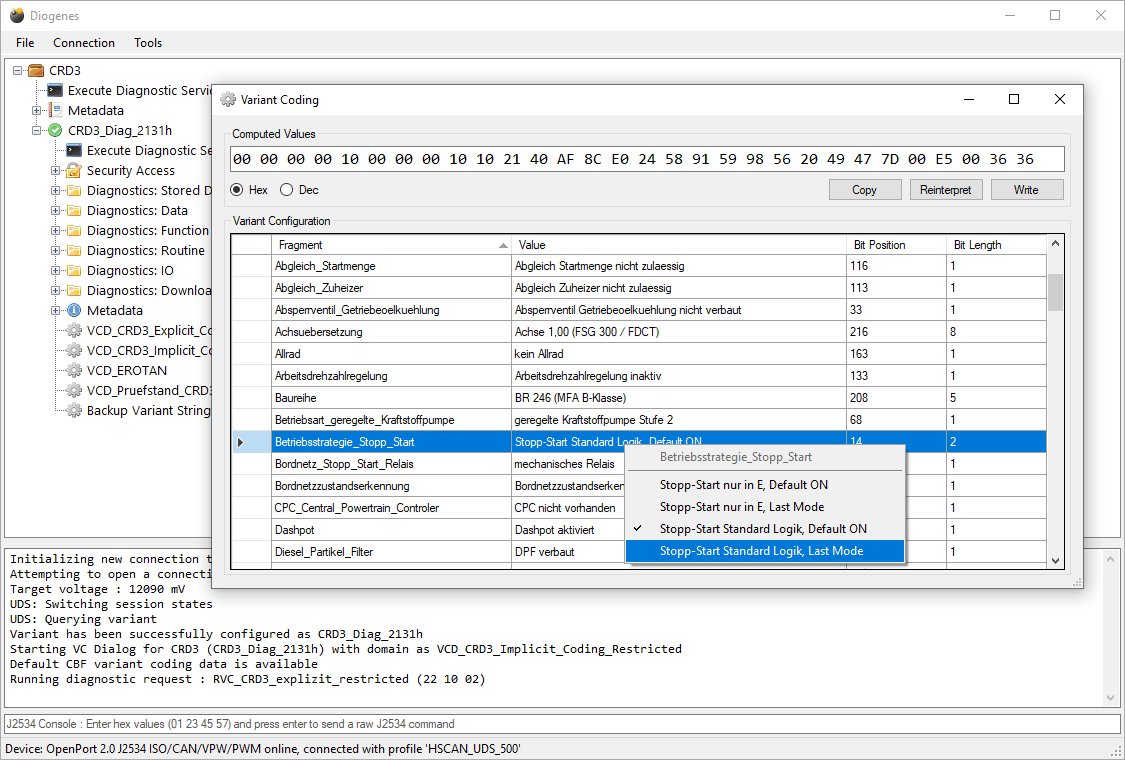
CaesarSuite and its Diogenes application are an independent open-source project for working with Mercedes diagnostic CBF definitions and variant-coding data. Its documentation describes parsing and displaying variant-coding fields, and labels writing experimental. The project reports limitations in interpreting some diagnostic service scripts. This is independent research, not Mercedes XENTRY, and it does not establish that the manufacturer's online SCN-selection service has been replicated.

In a December 2020 project discussion, a contributor posted a read trace for VGSNAG2 / VGS3_0403 and compared it with a Vediamo display showing Y1RA. The trace includes the bytes 79 31 72 61, which encode the lowercase ASCII characters y1ra. The project author interpreted the example as that displayed variant. This is one reported controller/software example; it does not prove a universal byte layout, acceptable replacement coding or an SCN-generation algorithm.
One published VGS3 read trace
| Item | What the project discussion reports |
|---|---|
| Definition and variant | VGSNAG2, VGS3_0403; the coding domain was identified as VCD_SCN_Variantencodierung_VGS_73. |
| Read request | 21 B1, as reported by the contributor. |
| Reassembled response | The posted sequence has 48 bytes, starts 61 B1 79 31 72 61 and ends 90 55 68 00. The complete trace and original CAN frames are in the source. |
| Displayed variant | The four bytes 79 31 72 61 represent lowercase ASCII y1ra; the contributor reported that Vediamo displayed Y1RA. |
| Author's hypothesis | The project author considered the final four bytes a possible identifier of the system that last coded the unit, but stated that this interpretation was unconfirmed. |
These are observations from one December 2020 public research discussion, not results independently reproduced by Tuning Wiki. The multi-frame trace includes diagnostic-response bytes as well as coding data. Do not treat the sample as an interchangeable coding string or assume its positions apply to other VGS revisions.
The same discussion suggests that trailing bytes may record a tool fingerprint, but the author explicitly says the interpretation was unconfirmed. Do not treat those bytes as a proven checksum, signature or security algorithm for all VGS units. The source distinguishes the observed data from its author's hypothesis.
Enthusiast collections and lookup tools catalogue vehicle, hardware, EHS, software and reported coding strings. For example, the Mercedes 7G SCN Data Browser listing describes a read-only reference and a user-supplied dataset. The publisher's 26 January 2026 update for version 5.0 reports 4,732 entries and filtering by car, model, hardware, V and EHS; it says local field edits are for reference only and do not operate an ECU. The count is the publisher's claim about that release, not an independently verified count of valid combinations. A matching database row is a lead for research, not validation of the data's origin, compatibility or a replacement for vehicle-specific manufacturer information. This wiki has not tested the software or the dataset.
Do not confuse the Ultimate NAG52 open-source replacement-controller project for the 722.6 with a 722.9/VGS solution.
Research and workshop checks
- Preserve an original diagnostic report and record the exact controller, EHS, software and vehicle identifiers before making changes.
- For research, compare read-only records from the same controller and software revision, change one documented condition at a time, and separate raw observations from inferred bit meanings.
- Keep the 16-digit SCN, short variant label, raw coding string, check digit, CVN and drive-authorisation status in separate fields.
- For an actual repair, verify the original valve-body characteristics, supported replacement, power supply, commissioning and functional checks against current manufacturer information.
Sources
- Mercedes-Benz 722.9 technical training, pages 61–77, June 2004, independent mirror. Describes the early controller, SCN procedure, sample 16-digit SCN, check digits, CVN and personalisation.
- Mercedes-Benz 7G-TRONIC in the workshop: tips and tricks, September 2007, independent mirror. Describes the electrohydraulic assembly and period diagnostic considerations.
- Mercedes-Benz T-B-27.00/96: limp-home or harsh engagement after programming/SCN coding, 29 March 2007, independent mirror.
- JinGen Lim, CaesarSuite / Diogenes and project discussion with VGS3_0403 trace. Independent project and contributor observations; project write support is described as experimental.
- Abrites: 722.9 electronic transmission control units. Vendor documentation describing supported coding-data preservation and renewal functions; applicability is tool and unit dependent.
- Mercedes 7G SCN Data Browser listing. Publisher's description of an offline lookup tool and third-party data; the dataset has not been independently verified here.